Behzadifard Mahin, Soleimani Masoud
Dezful University of Medical Sciences, Dezful, Iran.
Department of hematology, Tarbiat Modares University, Tehran, Iran.
Thromb J. 2022 Mar 30;20(1):13. doi: 10.1186/s12959-022-00375-1.
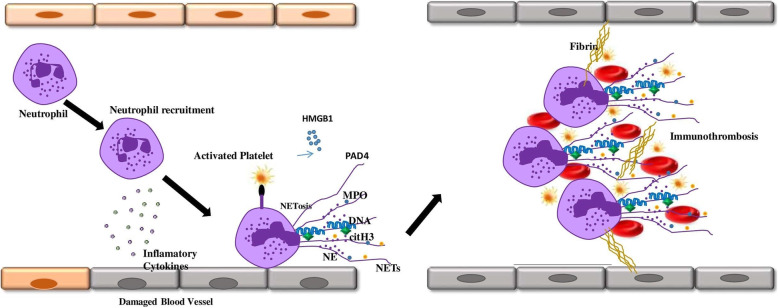
Coronavirus disease 2019 (COVID-19) infection is related to immune hyperactivity, the release of inflammatory cytokines, and immunothrombosis. Among the underlying mechanisms in COVID-19 thrombosis, neutrophil extracellular traps (NETs) formation, NETosis, may have a significant role. COVID-19 thrombi obtained from extracorporeal membrane oxygenation contained an accumulation of neutrophils and in a higher amount of NETs when compared with non-COVID-19 thrombi specimens.
During sepsis and inflammatory status, NETs released from neutrophils and histones and nucleosomes extruded into the extracellular space and take part in the host innate immunity defense, inflammation, and thrombosis. Excessive NETosis is related to clinical progression and respiratory failure in infections and sepsis. NETosis act as a scaffold for thrombus formation, and new associative data support the relation between deregulated immune responses with thrombus formation and organ failure. NETosis is reported in COVID-19 patients. In COVID-19 infection, overproduction of tissue factor (TF) by neutrophils has a role in immunothrombosis. Additionally, NETs can trap TF pathway inhibitor (TFPI) as the only endogenous protein that effectively inhibits the activity of the significant proteases- complexes, TF-FVIIa and prothrombinase.
Because of NETosis can induce intrinsic and extrinsic coagulation cascade activation through the production of TF, activation of FXII, and inhibition of TFPI and fibrinolysis and induce immunothrombosis, targeting NETosis may diminish thrombus formation related to NETs in COVID-19 patients.
2019冠状病毒病(COVID-19)感染与免疫亢进、炎性细胞因子释放及免疫性血栓形成有关。在COVID-19血栓形成的潜在机制中,中性粒细胞胞外诱捕网(NETs)形成即NETosis可能起重要作用。与非COVID-19血栓标本相比,从体外膜肺氧合获得的COVID-19血栓含有大量中性粒细胞及更多的NETs。
在脓毒症和炎症状态下,中性粒细胞释放的NETs以及挤出到细胞外空间的组蛋白和核小体参与宿主固有免疫防御、炎症和血栓形成。过度的NETosis与感染和脓毒症的临床进展及呼吸衰竭有关。NETosis为血栓形成提供支架,新的相关数据支持免疫反应失调与血栓形成和器官衰竭之间的关系。COVID-19患者中报道有NETosis。在COVID-19感染中,中性粒细胞过度产生组织因子(TF)在免疫性血栓形成中起作用。此外,NETs可捕获组织因子途径抑制剂(TFPI),TFPI是唯一能有效抑制重要蛋白酶复合物TF-FVIIa和凝血酶原酶活性的内源性蛋白质。
由于NETosis可通过产生TF、激活FXII、抑制TFPI和纤维蛋白溶解诱导内源性和外源性凝血级联激活并诱导免疫性血栓形成,针对NETosis可能减少COVID-19患者中与NETs相关的血栓形成。