Cirka BV, Healthcare Strategy and Innovation, Zeist, The Netherlands.
Department of Biomedical Data Sciences, LUMC, Leiden, The Netherlands.
Appl Clin Inform. 2023 Mar;14(2):326-336. doi: 10.1055/s-0043-1767681. Epub 2023 May 3.
Reuse of health care data for various purposes, such as the care process, for quality measurement, research, and finance, will become increasingly important in the future; therefore, "Collect Once Use Many Times" (COUMT). Clinical information models (CIMs) can be used for content standardization. Data collection for national quality registries (NQRs) often requires manual data entry or batch processing. Preferably, NQRs collect required data by extracting data recorded during the health care process and stored in the electronic health record.
The first objective of this study was to analyze the level of coverage of data elements in NQRs with developed Dutch CIMs (DCIMs). The second objective was to analyze the most predominant DCIMs, both in terms of the coverage of data elements as well as in their prevalence across existing NQRs.
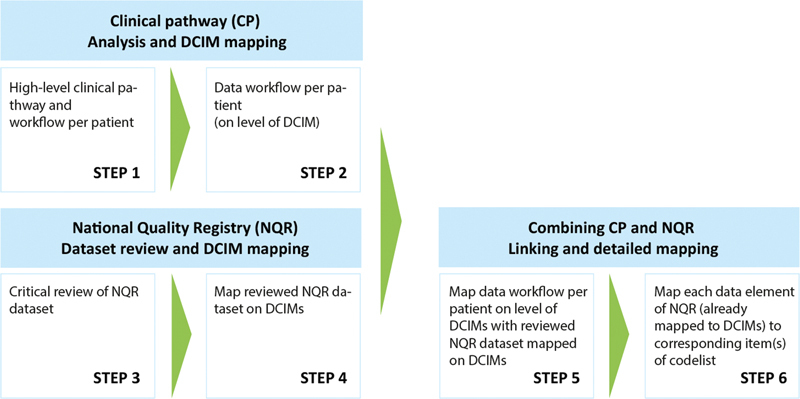
For the first objective, a mapping method was used which consisted of six steps, ranging from a description of the clinical pathway to a detailed mapping of data elements. For the second objective, the total number of data elements that matched with a specific DCIM was counted and divided by the total number of evaluated data elements.
An average of 83.0% (standard deviation: 11.8%) of data elements in studied NQRs could be mapped to existing DCIMs . In total, 5 out of 100 DCIMs were needed to map 48.6% of the data elements.
This study substantiates the potential of using existing DCIMs for data collection in Dutch NQRs and gives direction to further implementation of DCIMs. The developed method is applicable to other domains. For NQRs, implementation should start with the five DCIMs that are most prevalently used in the NQRs. Furthermore, a national agreement on the leading principle of COUMT for the use and implementation for DCIMs and (inter)national code lists is needed.
未来,出于医疗流程、质量测量、研究和财务等各种目的,重复使用医疗保健数据将变得越来越重要;因此,提出了“一次采集、多次使用”(Collect Once Use Many Times,COUMT)。临床信息模型(Clinical Information Model,CIM)可用于内容标准化。国家质量登记处(National Quality Registries,NQR)的数据收集通常需要手动数据录入或批处理。理想情况下,NQR 通过提取记录在电子健康记录中的医疗流程中记录的数据来收集所需的数据。
本研究的首要目标是分析使用荷兰开发的临床信息模型(Dutch Clinical Information Model,DCIM)的 NQR 中数据元素的涵盖程度。第二个目标是分析最主要的 DCIM,既要考虑数据元素的涵盖程度,也要考虑其在现有 NQR 中的流行程度。
对于第一个目标,使用了一种映射方法,包括六个步骤,从临床路径的描述到数据元素的详细映射。对于第二个目标,统计与特定 DCIM 匹配的数据元素的总数,并将其除以评估的数据元素总数。
在所研究的 NQR 中,平均 83.0%(标准差:11.8%)的数据元素可以映射到现有的 DCIM 中。总共需要 5 个 DCIM 来映射 48.6%的数据元素。
本研究证实了在荷兰 NQR 中使用现有 DCIM 进行数据采集的潜力,并为进一步实施 DCIM 提供了方向。所开发的方法适用于其他领域。对于 NQR,应从在 NQR 中使用最广泛的 5 个 DCIM 开始实施。此外,还需要就 COUMT 的使用和实施 DCIM 以及(国际)代码列表的主导原则达成国家协议。