Golestaneh Ladan, Golovey Rimon, Navarro-Torres Mariela, Roach Christopher, Lantigua-Reyes Naomy, Umeukeje Ebele M, Fox Aaron, Melamed Michal L, Cavanaugh Kerri L
Division of Nephrology, Department of Medicine, Albert Einstein College of Medicine/Montefiore Medical Center, Bronx, New York.
Division of Nephrology and Hypertension, Vanderbilt University Medical Center, Nashville, Tennessee.
Kidney Med. 2023 Mar 20;5(5):100630. doi: 10.1016/j.xkme.2023.100630. eCollection 2023 May.
The 'PEER-HD' multicenter study tests the effectiveness of peer mentorship to reduce hospitalizations in patients receiving maintenance hemodialysis. In this study, we describe the feasibility, efficacy, and acceptability of the mentor training program.
Educational program evaluation including the following aspects: (1) description of training content, (2) quantitative analysis of feasibility and acceptability of the program, and (3) quantitative pre-post analysis of efficacy of the training to impart knowledge and self-efficacy.
Data were collected using baseline clinical and sociodemographic questionnaires from mentor participants enrolled in Bronx, NY, and Nashville, TN, themselves receiving maintenance hemodialysis.
The outcome variables were the following: (1) feasibility measured by training module attendance and completion, (2) efficacy of the program to impart knowledge and self-efficacy measured by kidney knowledge and self-efficacy surveys, and (3) acceptability as measured by an 11-item survey of trainer performance and module content.
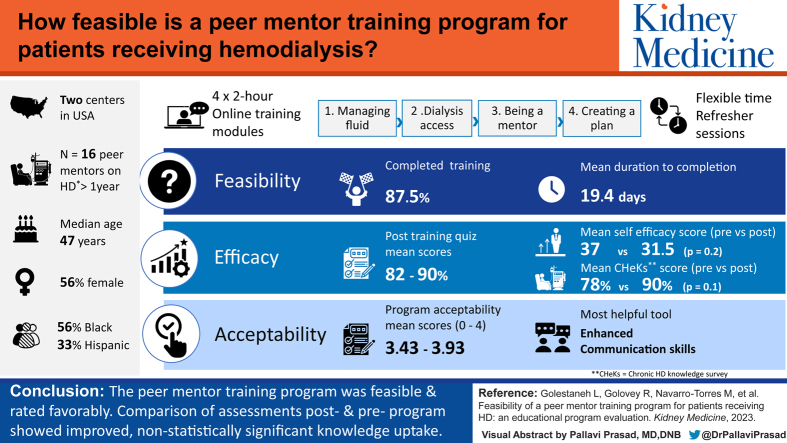
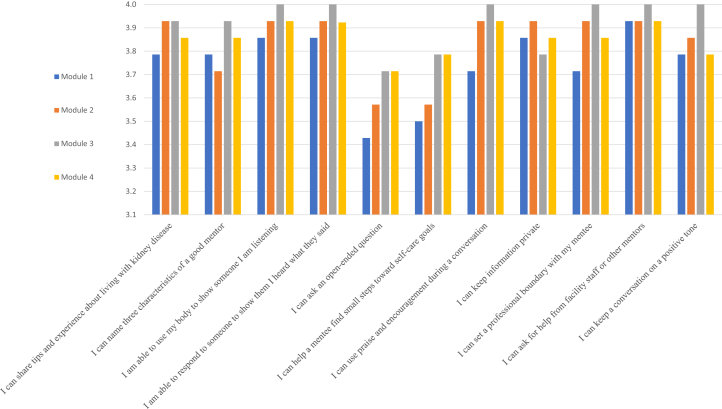
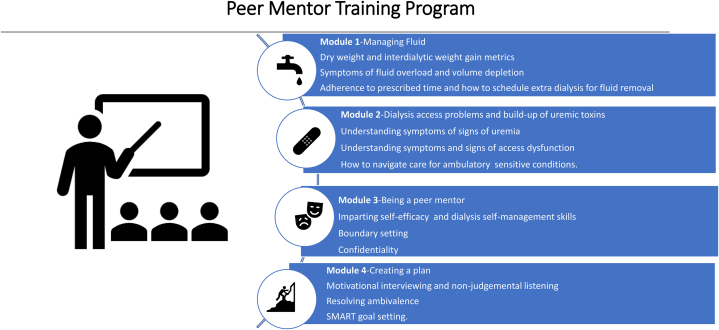
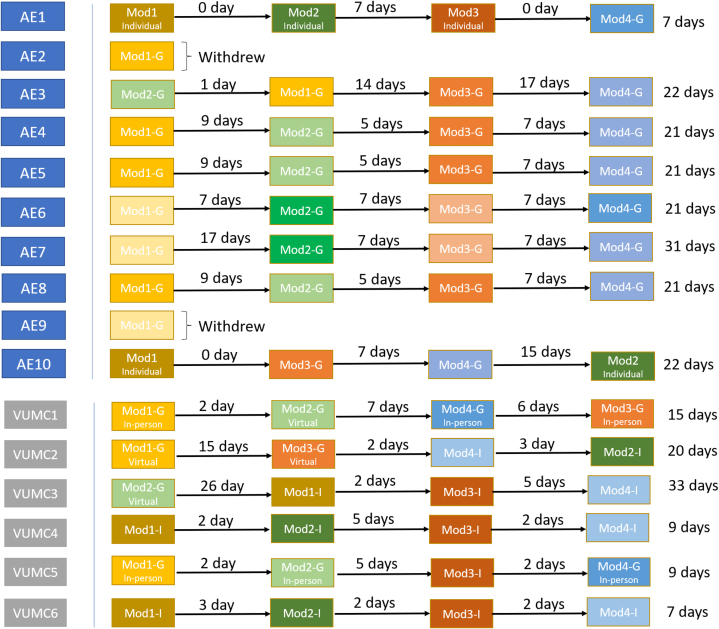
The PEER-HD training program included 4 2-hour modules that covered topics including dialysis-specific knowledge and mentorship skills. Of the 16 mentor participants, 14 completed the training program. There was complete attendance to all training modules, though some patients required flexibility in scheduling and format. Performance on posttraining quizzes was consistent with high knowledge (mean scores ranged from 82.0%-90.0% correct). Mean dialysis-specific knowledge scores trended higher post training than at baseline though this difference was not statistically significant (90.0% vs 78.1%; = 0.1). No change in mean self-efficacy scores was demonstrated from before to after training, among mentor participants ( = 0.2). Program evaluation assessments of acceptability were favorable [mean of all patient scores (0-4) within each module ranged from 3.43-3.93].
Small sample size.
The PEER-HD mentor training program required accommodation to patients' schedules but was feasible. Participants rated the program favorably, and although the comparison of performance on knowledge assessments post- and pre-program showed uptake of knowledge, this was not statistically significant.
“PEER-HD”多中心研究旨在测试同伴指导对减少维持性血液透析患者住院率的有效性。在本研究中,我们描述了导师培训项目的可行性、有效性和可接受性。
教育项目评估包括以下几个方面:(1)培训内容描述;(2)项目可行性和可接受性的定量分析;(3)培训传授知识和自我效能的有效性的定量前后分析。
使用基线临床和社会人口学问卷从纽约州布朗克斯和田纳西州纳什维尔登记参加的导师参与者那里收集数据,这些参与者自身接受维持性血液透析。
结果变量如下:(1)通过培训模块的出席率和完成率衡量的可行性;(2)通过肾脏知识和自我效能调查衡量的项目传授知识和自我效能的有效性;(3)通过对培训师表现和模块内容的11项调查衡量的可接受性。
PEER-HD培训项目包括4个2小时的模块,涵盖了包括透析特定知识和指导技能等主题。16名导师参与者中,14名完成了培训项目。所有培训模块的出席率都很高,不过一些患者在时间安排和形式上需要灵活性。培训后测验的成绩与高知识水平一致(平均得分正确范围为82.0%-90.0%)。尽管这种差异无统计学意义(90.0%对78.1%;P = 0.1),但培训后特定透析知识的平均得分比基线时呈上升趋势。在导师参与者中,培训前后自我效能平均得分未显示出变化(P = 0.2)。项目评估的可接受性评价良好[每个模块内所有患者得分(0-4)的平均值范围为3.43-3.93]。
样本量小。
PEER-HD导师培训项目需要根据患者的日程安排进行调整,但具有可行性。参与者对该项目评价良好,尽管项目前后知识评估表现的比较显示出知识的吸收,但这无统计学意义。