Wu Ziyi, Su Jiazheng, Chai Nianyao, Cheng Siyang, Wang Xuanyu, Zhang Ziling, Liu Xuanling, Zhong Han, Yang Jianfei, Wang Zhiping, Liu Jianbo, Li Xin, Lin Hong
State Key Laboratory of New Ceramics and Fine Processing, School of Materials Science and Engineering, Tsinghua University, Beijing, 100084, P. R. China.
State Key Laboratory of Advanced Technology for Materials Synthesis and Processing, International School of Materials Science and Engineering, Wuhan University of Technology, Wuhan, 430070, P. R. China.
Adv Sci (Weinh). 2023 Jul;10(20):e2300010. doi: 10.1002/advs.202300010. Epub 2023 May 4.
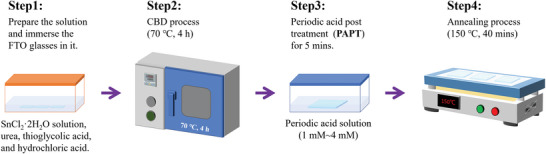
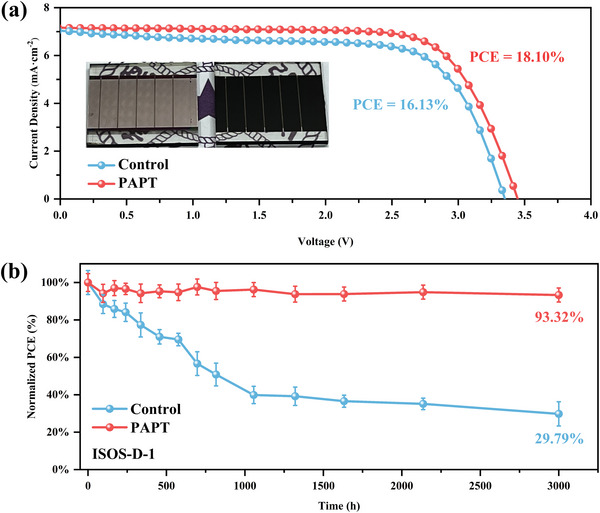
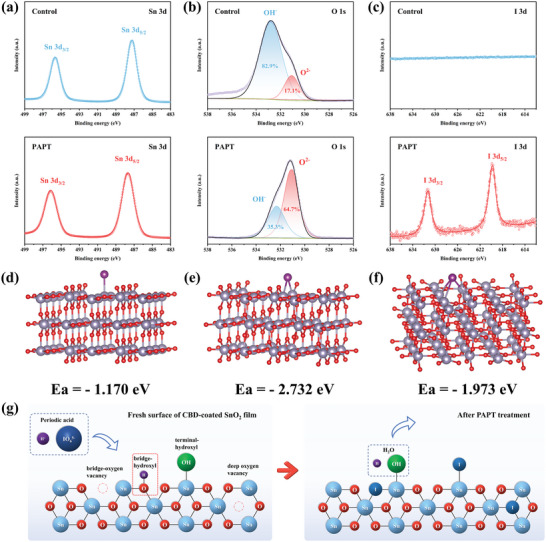
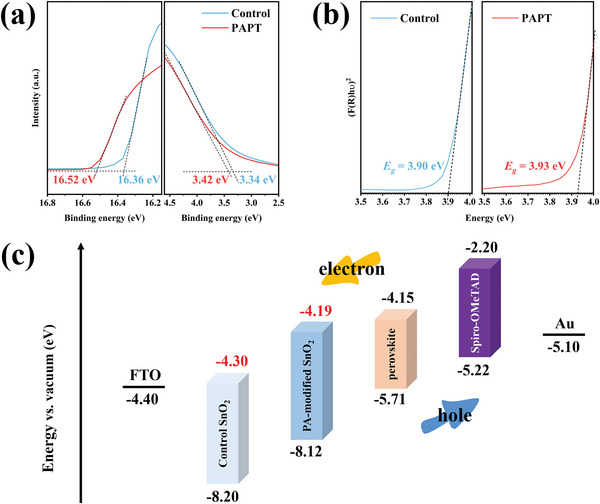
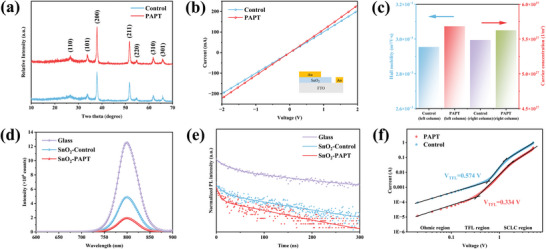
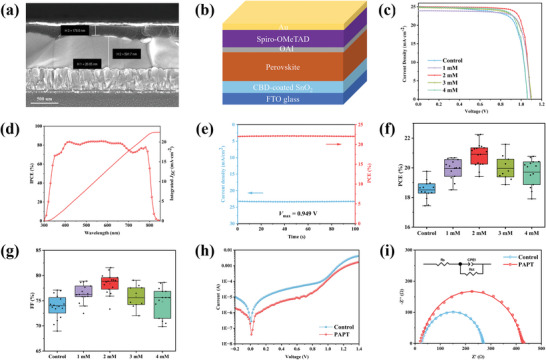
Chemical bath deposition (CBD) has been demonstrated as a remarkable technology to fabricate high-quality SnO electron transport layer (ETL) for large-area perovskite solar cells (PSCs). However, surface defects always exist on the SnO film coated by the CBD process, impairing the devices' performance. Here, a facile periodic acid post-treatment (PAPT) method is developed to modify the SnO layer. Periodic acid can react with hydroxyl groups on the surface of SnO films and oxidize Tin(II) oxide to Tin(IV) oxide. With the help of periodic acid, a better energy level alignment between the SnO and perovskite layers is achieved. In addition, the PAPT method inhibits interfacial nonradiative recombination and facilitates charge transportation. Such a multifunctional strategy enables to fabricate PSC with a champion power conversion efficiency (PCE) of 22.25%, which remains 93.32% of its initial efficiency after 3000 h without any encapsulation. Furthermore, 3 × 3 cm perovskite mini-modules are presented, achieving a champion efficiency of 18.10%. All these results suggest that the PAPT method is promising for promoting the commercial application of large-area PSCs.
化学浴沉积(CBD)已被证明是一种用于制造大面积钙钛矿太阳能电池(PSC)高质量SnO电子传输层(ETL)的卓越技术。然而,通过CBD工艺涂覆的SnO薄膜表面总是存在缺陷,这会损害器件的性能。在此,开发了一种简便的高碘酸后处理(PAPT)方法来修饰SnO层。高碘酸可与SnO薄膜表面的羟基反应,并将氧化锡(II)氧化为氧化锡(IV)。借助高碘酸,SnO层与钙钛矿层之间实现了更好的能级匹配。此外,PAPT方法抑制了界面非辐射复合并促进了电荷传输。这种多功能策略能够制造出冠军功率转换效率(PCE)为22.25%的PSC,在无任何封装的情况下经过3000小时后,其效率仍保持初始效率的93.32%。此外,展示了3×3 cm的钙钛矿微型模块,实现了18.10%的冠军效率。所有这些结果表明,PAPT方法对于推动大面积PSC的商业应用具有前景。