Department of Critical Care Medicine, Dushu Lake Hospital Affiliated to Soochow University, Suzhou, Jiangsu, China.
Department of Critical Care Medicine, The First Affiliated Hospital of Soochow University, Suzhou, Jiangsu, China.
BMC Anesthesiol. 2023 May 4;23(1):153. doi: 10.1186/s12871-023-02095-z.
This study was conducted to investigate the effects and safety of remimazolam versus propofol on cerebral oxygen saturation and cerebral hemodynamics during the induction of general anesthesia in patients receiving carotid endarterectomy (CEA), so as to provide theoretical basis for better clinical application of remimazolam.
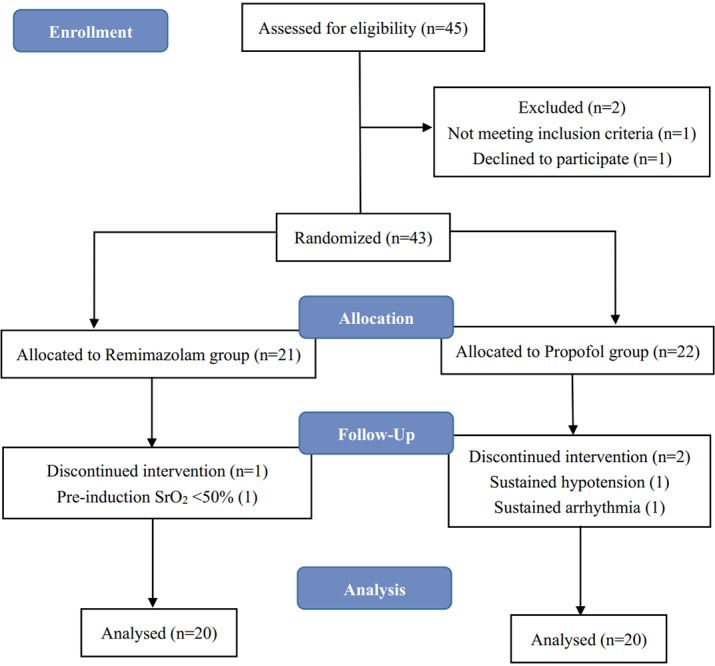
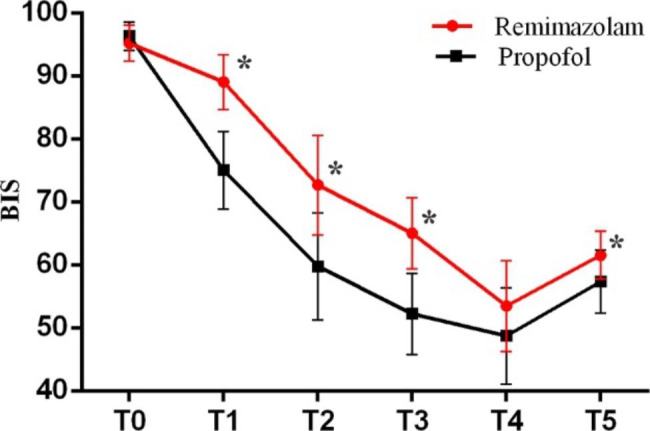
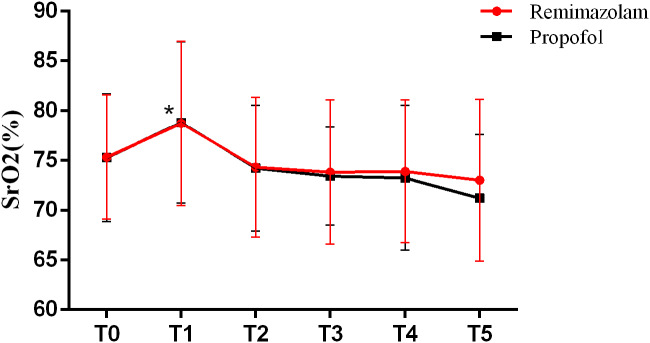
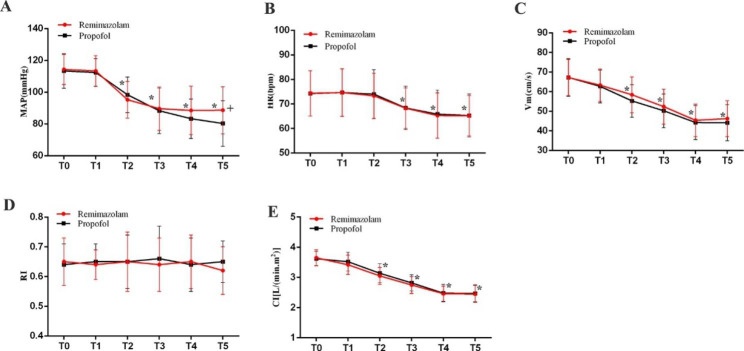
Forty-three patients (60-75 years old) with carotid artery stenosis (carotid artery stenosis greater than 70%) were randomly divided into the remimazolam group (R group) and the propofol group (P group). Anesthesia was induced with remimazolam (0.3 mg/kg) or propofol (1.5-2 mg/kg) individually. At time of admission (T0), post-anesthesia induction (T1), consciousness disappears (T2), 1 min after loss of consciousness (T3), 2 min after loss of consciousness (T4) and pre-endotracheal intubation (T5), measurement in patients with regional cerebral oxygen saturation (SrO), average blood flow velocity (Vm), resistance index (RI), mean arterial pressure (MAP), heart rate (HR) and cardiac index (CI) were recorded.
SrO increased significantly in both groups after induction of anesthesia compared with baseline (P < 0.05) and decreased after loss of consciousness (P < 0.05). There was no difference in the mean value of the relative changes in SrO between the groups. Meanwhile, the Vm, RI, HR and CI of each time point between two groups showed no statistically significant difference (P > 0.05) while MAP in group P at T5 was lower than that in group R individually(P < 0.05). In each group, Vm, HR, CI and MAP at T2-T5 were all significantly reduced compared with T1, with statistically differences(P < 0.05). Specifically, there was no difference of RI at each time between or within groups(P > 0.05).
Our study revealed that remimazolam can be administered safely and effectively during the induction of general anesthesia for carotid endarterectomy in elder population and it demonstrated superiority in hemodynamic changes compared with propofol.
This trial was retrospectively registered with the Chinese Clinical Trial Registry.
ChiCTR2300070370. Date of registration: April 11, 2023.
本研究旨在探讨瑞马唑仑与丙泊酚在颈动脉内膜切除术(CEA)患者全麻诱导期间对脑氧饱和度和脑血流动力学的影响和安全性,为更好地临床应用瑞马唑仑提供理论依据。
43 例(60-75 岁)颈动脉狭窄(颈动脉狭窄大于 70%)患者随机分为瑞马唑仑组(R 组)和丙泊酚组(P 组)。分别给予瑞马唑仑(0.3mg/kg)或丙泊酚(1.5-2mg/kg)诱导麻醉。于入室时(T0)、麻醉诱导后(T1)、意识消失时(T2)、意识消失后 1min(T3)、意识消失后 2min(T4)、气管插管前(T5)记录患者局部脑氧饱和度(SrO2)、平均血流速度(Vm)、阻力指数(RI)、平均动脉压(MAP)、心率(HR)和心指数(CI)。
两组麻醉诱导后 SrO2 均较基础值显著升高(P<0.05),意识消失后降低(P<0.05)。两组 SrO2 相对变化的平均值无差异。同时,两组各时间点的 Vm、RI、HR 和 CI 差异均无统计学意义(P>0.05),而 P 组 T5 时的 MAP 明显低于 R 组(P<0.05)。两组 T2-T5 时的 Vm、HR、CI 和 MAP 均明显低于 T1,差异有统计学意义(P<0.05)。具体而言,两组各时间点的 RI 差异均无统计学意义(P>0.05)。
本研究表明,瑞马唑仑可安全有效地应用于老年人群颈动脉内膜切除术的全麻诱导,其在血流动力学变化方面优于丙泊酚。
本试验在中国临床试验注册中心进行了回顾性注册。
ChiCTR2300070370. 注册日期:2023 年 4 月 11 日。