
纤毛衔接蛋白tubby和TULP3在柯蒂氏器中的分布。
Distribution of ciliary adaptor proteins tubby and TULP3 in the organ of Corti.
作者信息
Lindner Laura A, Derstroff Dennis, Oliver Dominik, Reimann Katrin
机构信息
Department of Otorhinolaryngology, Head and Neck Surgery, University Hospital Marburg, Philipps-University Marburg, Marburg, Germany.
Department of Neurophysiology, Institute of Physiology and Pathophysiology, Philipps-University Marburg, Marburg, Germany.
出版信息
Front Neurosci. 2023 Apr 18;17:1162937. doi: 10.3389/fnins.2023.1162937. eCollection 2023.
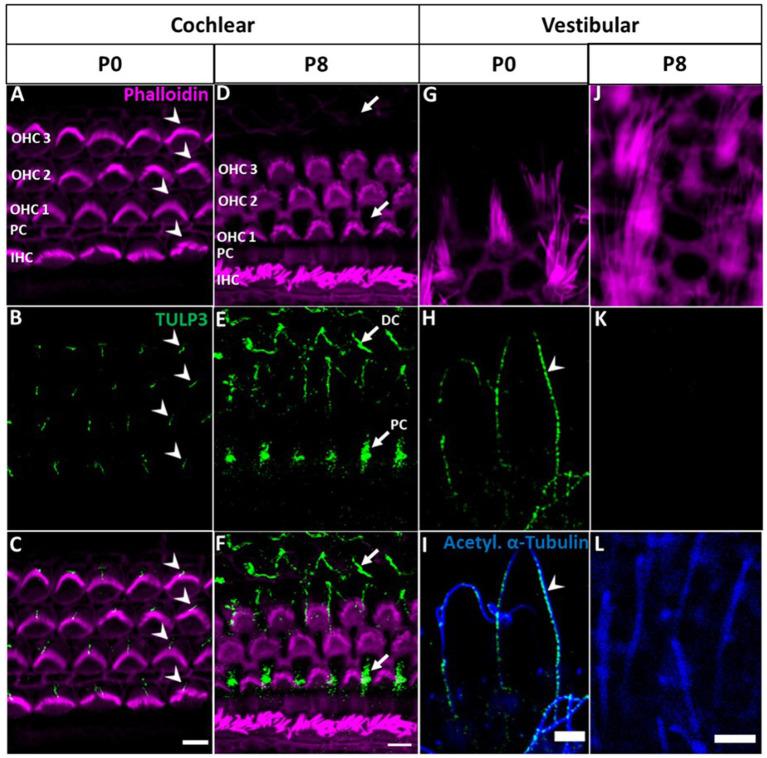
Tubby-like proteins are membrane-associated adaptors that mediate directional trafficking into primary cilia. In inner ear sensory epithelia, cilia-including the hair cell's kinocilium-play important roles as organizers of polarity, tissue architecture and cellular function. However, auditory dysfunction in tubby mutant mice was recently found to be related to a non-ciliary function of tubby, the organization of a protein complex in sensory hair bundles of auditory outer hair cells (OHCs). Targeting of signaling components into cilia in the cochlea might therefore rather rely on closely related tubby-like proteins (TULPs). In this study, we compared cellular and subcellular localization of tubby and TULP3 in the mouse inner ear sensory organs. Immunofluorescence microscopy confirmed the previously reported highly selective localization of tubby in the stereocilia tips of OHCs and revealed a previously unnoticed transient localization to kinocilia during early postnatal development. TULP3 was detected in the organ of Corti and vestibular sensory epithelium, where it displayed a complex spatiotemporal pattern. TULP3 localized to kinocilia of cochlear and vestibular hair cells in early postnatal development but disappeared subsequently before the onset of hearing. This pattern suggested a role in targeting ciliary components into kinocilia, possibly related to the developmental processes that shape the sensory epithelia. Concurrent with loss from kinocilia, pronounced TULP3 immunolabeling progressively appeared at microtubule bundles in non-sensory Pillar (PCs) and Deiters cells (DC). This subcellular localization may indicate a novel function of TULP proteins associated with the formation or regulation of microtubule-based cellular structures.
类Tubby蛋白是与膜相关的衔接蛋白,介导物质向初级纤毛的定向运输。在内耳感觉上皮中,纤毛(包括毛细胞的动纤毛)作为极性、组织结构和细胞功能的组织者发挥着重要作用。然而,最近发现Tubby突变小鼠的听觉功能障碍与Tubby的非纤毛功能有关,即听觉外毛细胞(OHC)感觉毛束中蛋白复合物的组织。因此,耳蜗中信号成分向纤毛的靶向运输可能更多地依赖于密切相关的类Tubby蛋白(TULP)。在本研究中,我们比较了Tubby和TULP3在小鼠内耳感觉器官中的细胞和亚细胞定位。免疫荧光显微镜证实了先前报道的Tubby在OHC静纤毛顶端的高度选择性定位,并揭示了在出生后早期发育过程中Tubby向动纤毛的一种先前未被注意到的短暂定位。在柯蒂氏器和前庭感觉上皮中检测到了TULP3,其呈现出复杂的时空模式。在出生后早期发育阶段,TULP3定位于耳蜗和前庭毛细胞的动纤毛,但随后在听力开始之前消失。这种模式表明其在将纤毛成分靶向运输到动纤毛中发挥作用,可能与塑造感觉上皮的发育过程有关。与从动纤毛中消失同时发生的是,明显的TULP3免疫标记逐渐出现在非感觉柱状细胞(PC)和Deiters细胞(DC)的微管束中。这种亚细胞定位可能表明TULP蛋白与基于微管的细胞结构的形成或调节相关的新功能。




 Zotero 插件