Scheinberg Tahlia, Lin Hui-Ming, Fitzpatrick Michael, Azad Arun A, Bonnitcha Paul, Davies Amy, Heller Gillian, Huynh Kevin, Mak Blossom, Mahon Kate, Sullivan David, Meikle Peter J, Horvath Lisa G
Medical Oncology, Chris O'Brien Lifehouse, Camperdown, NSW, Australia.
Advanced Prostate Cancer Group, Garvan Institute of Medical Research, Darlinghurst, NSW, Australia.
Prostate Cancer Prostatic Dis. 2024 Mar;27(1):136-143. doi: 10.1038/s41391-023-00666-2. Epub 2023 May 5.
Using comprehensive plasma lipidomic profiling from men with metastatic castration-resistant prostate cancer (mCRPC), we have previously identified a poor-prognostic lipid profile associated with shorter overall survival (OS). In order to translate this biomarker into the clinic, these men must be identifiable via a clinically accessible, regulatory-compliant assay.
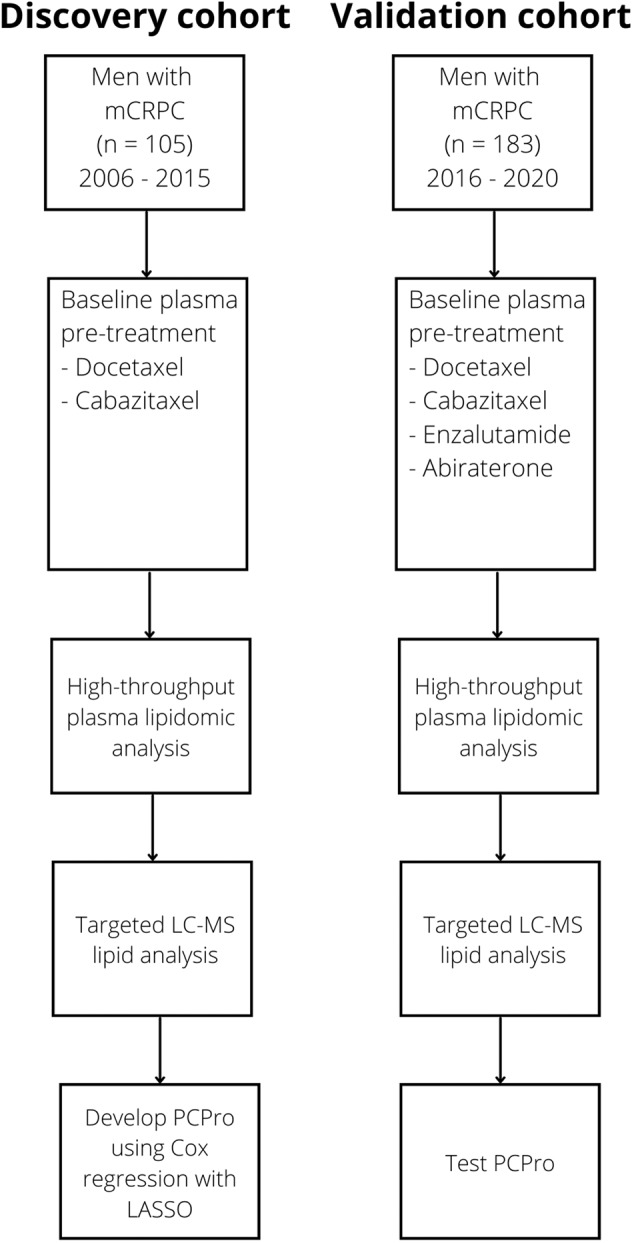
A single regulatory-compliant liquid chromatography-mass spectrometry assay of candidate lipids was developed and tested on a mCRPC Discovery cohort of 105 men. Various risk-score Cox regression prognostic models of OS were built using the Discovery cohort. The model with the highest concordance index (PCPro) was chosen for validation and tested on an independent Validation cohort of 183 men.
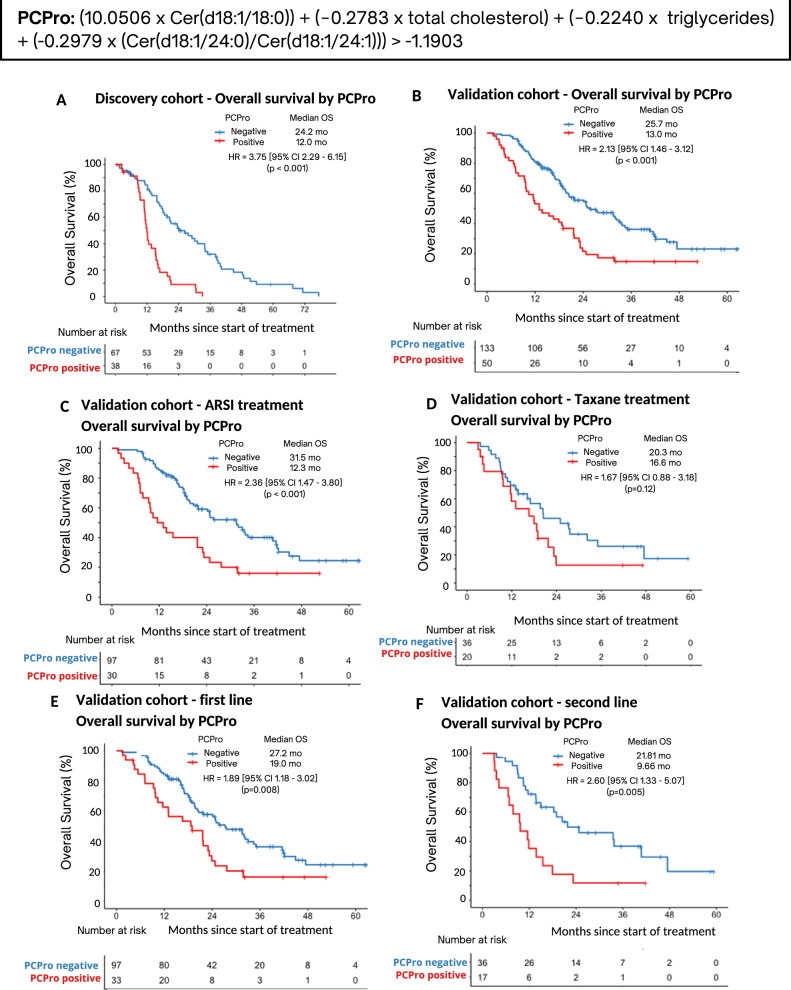
PCPro, the lipid biomarker, contains Cer(d18:1/18:0), Cer(d18:1/24:0), Cer(d18:1/24:1), triglycerides and total cholesterol. Within the Discovery and Validation cohorts, men who were PCPro positive had significantly shorter OS compared to those who were PCPro negative (Discovery: median OS 12.0 months vs 24.2 months, hazard ratio (HR) 3.75 [95% confidence interval (CI) 2.29-6.15], p < 0.001, Validation: median OS 13.0 months vs 25.7 months, HR = 2.13 [95% CI 1.46-3.12], p < 0.001).
We have developed PCPro, a lipid biomarker assay capable of prospectively identifying men with mCRPC with a poor prognosis. Prospective clinical trials are required to determine if men who are PCPro positive will benefit from therapeutic agents targeting lipid metabolism.
通过对转移性去势抵抗性前列腺癌(mCRPC)男性患者进行全面的血浆脂质组学分析,我们之前已鉴定出一种与较短总生存期(OS)相关的不良预后脂质谱。为了将这种生物标志物应用于临床,必须通过临床可及、符合监管要求的检测方法来识别这些男性患者。
开发了一种符合监管要求的候选脂质液相色谱 - 质谱检测方法,并在105名mCRPC发现队列男性患者中进行测试。使用发现队列构建了各种OS的风险评分Cox回归预后模型。选择一致性指数最高的模型(PCPro)进行验证,并在183名男性患者的独立验证队列中进行测试。
脂质生物标志物PCPro包含神经酰胺(Cer(d18:1/18:0))、神经酰胺(Cer(d18:1/24:0))、神经酰胺(Cer(d18:1/24:1))、甘油三酯和总胆固醇。在发现队列和验证队列中,PCPro阳性的男性患者与PCPro阴性的男性患者相比,OS显著更短(发现队列:中位OS 12.0个月对24.2个月,风险比(HR)3.75 [95%置信区间(CI)2.29 - 6.15],p < 0.001;验证队列:中位OS 13.0个月对25.7个月,HR = 2.13 [95% CI 1.46 - 3.12],p < 0.001)。
我们开发了PCPro,一种脂质生物标志物检测方法,能够前瞻性地识别预后不良的mCRPC男性患者。需要进行前瞻性临床试验来确定PCPro阳性的男性患者是否会从靶向脂质代谢的治疗药物中获益。