Lin Hui-Ming, Yeung Nicole, Hastings Jordan F, Croucher David R, Huynh Kevin, Meikle Thomas G, Mellett Natalie A, Kwan Edmond M, Davis Ian D, Tran Ben, Mahon Kate L, Zhang Alison, Stockler Martin R, Briscoe Karen, Marx Gavin, Bastick Patricia, Crumbaker Megan L, Joshua Anthony M, Azad Arun A, Meikle Peter J, Horvath Lisa G
Garvan Institute of Medical Research, Darlinghurst, NSW 2010, Australia.
St Vincent's Clinical School, UNSW Sydney (the University of New South Wales), Darlinghurst, NSW 2010, Australia.
Cancers (Basel). 2021 Oct 1;13(19):4964. doi: 10.3390/cancers13194964.
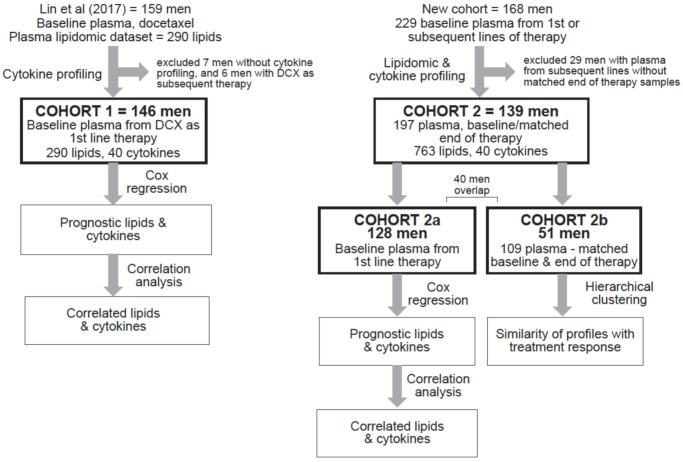
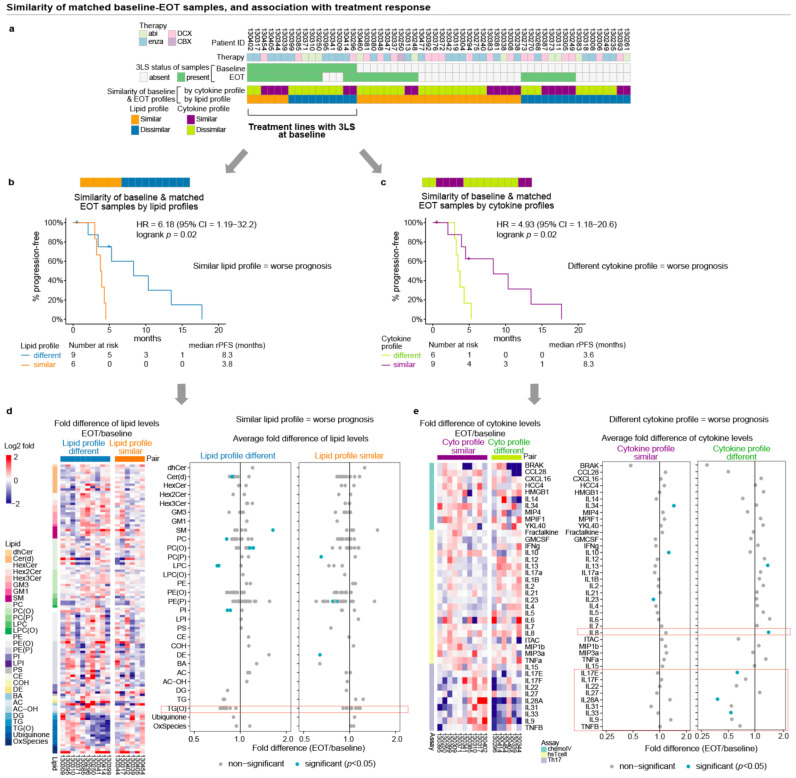
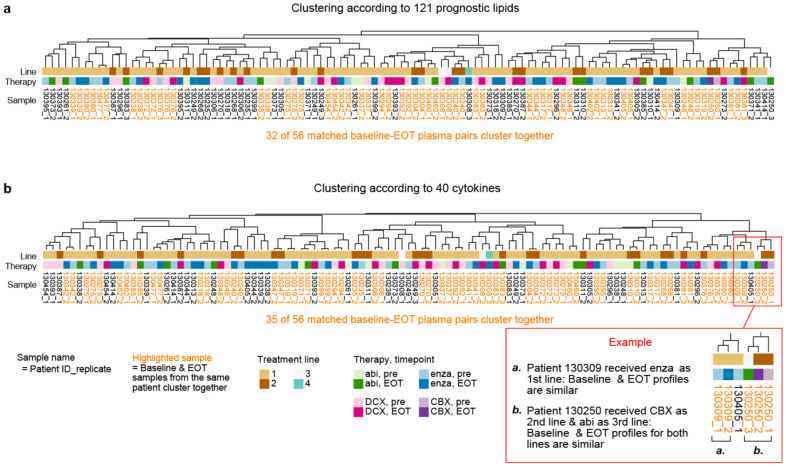
Circulating lipids or cytokines are associated with prognosis in metastatic castration-resistant prostate cancer (mCRPC). This study aimed to understand the interactions between lipid metabolism and immune response in mCRPC by investigating the relationship between the plasma lipidome and cytokines. Plasma samples from two independent cohorts of men with mCRPC ( = 146, 139) having life-prolonging treatments were subjected to lipidomic and cytokine profiling (290, 763 lipids; 40 cytokines). Higher baseline levels of sphingolipids, including ceramides, were consistently associated with shorter overall survival in both cohorts, whereas the associations of cytokines with overall survival were inconsistent. Increasing levels of IL6, IL8, CXCL16, MPIF1, and YKL40 correlated with increasing levels of ceramide in both cohorts. Men with a poor prognostic 3-lipid signature at baseline had a shorter time to radiographic progression (poorer treatment response) if their lipid profile at progression was similar to that at baseline, or their cytokine profile at progression differed to that at baseline. In conclusion, baseline levels of circulating lipids were more consistent as prognostic biomarkers than cytokines. The correlation between circulating ceramides and cytokines suggests the regulation of immune responses by ceramides. The association of treatment response with the change in lipid profiles warrants further research into metabolic interventions.
循环脂质或细胞因子与转移性去势抵抗性前列腺癌(mCRPC)的预后相关。本研究旨在通过调查血浆脂质组与细胞因子之间的关系,了解mCRPC中脂质代谢与免疫反应之间的相互作用。对来自两个接受延长生命治疗的mCRPC男性独立队列(分别为146例、139例)的血浆样本进行脂质组学和细胞因子分析(检测290种、763种脂质;40种细胞因子)。包括神经酰胺在内的鞘脂基线水平较高在两个队列中均始终与较短的总生存期相关,而细胞因子与总生存期的关联则不一致。在两个队列中,IL6、IL8、CXCL16、MPIF1和YKL40水平升高均与神经酰胺水平升高相关。基线时具有不良预后3-脂质特征的男性,如果其进展时的脂质谱与基线时相似,或者其进展时的细胞因子谱与基线时不同,则其影像学进展时间较短(治疗反应较差)。总之,作为预后生物标志物,循环脂质的基线水平比细胞因子更具一致性。循环神经酰胺与细胞因子之间的相关性表明神经酰胺对免疫反应有调节作用。治疗反应与脂质谱变化之间的关联值得对代谢干预进行进一步研究。