Department of Biochemistry and Molecular Medicine and University of California Davis Comprehensive Cancer Center, University of California Davis School of Medicine, Sacramento, CA, USA.
Institute for Stem Cell Biology and Regenerative Medicine, Stanford University School of Medicine, Stanford, CA, USA.
Breast Cancer Res. 2023 May 5;25(1):52. doi: 10.1186/s13058-023-01651-2.
In light of the growing appreciation for the role of collective cell motility in metastasis, a deeper understanding of the underlying signaling pathways will be critical to translating these observations to the treatment of advanced cancers. Here, we examine the contribution of Wnt/planar cell polarity (Wnt/PCP), one of the non-canonical Wnt signaling pathways and defined by the involvement of the tetraspanin-like proteins Vangl1 and Vangl2, to breast tumor cell motility, collective cell invasiveness and mammary tumor metastasis.
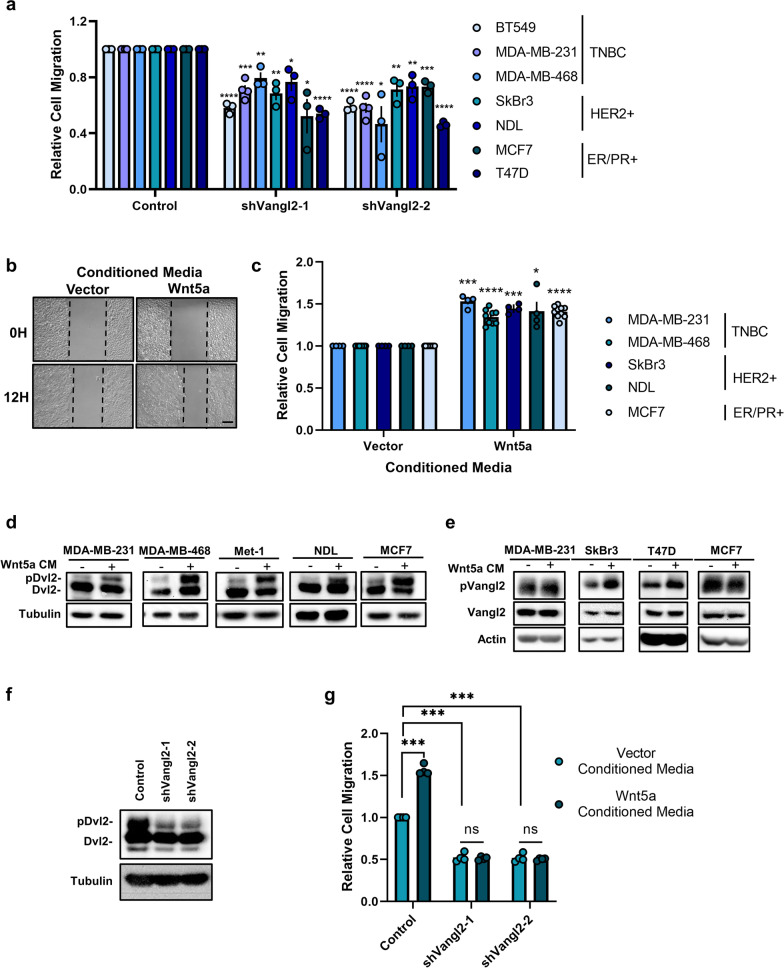
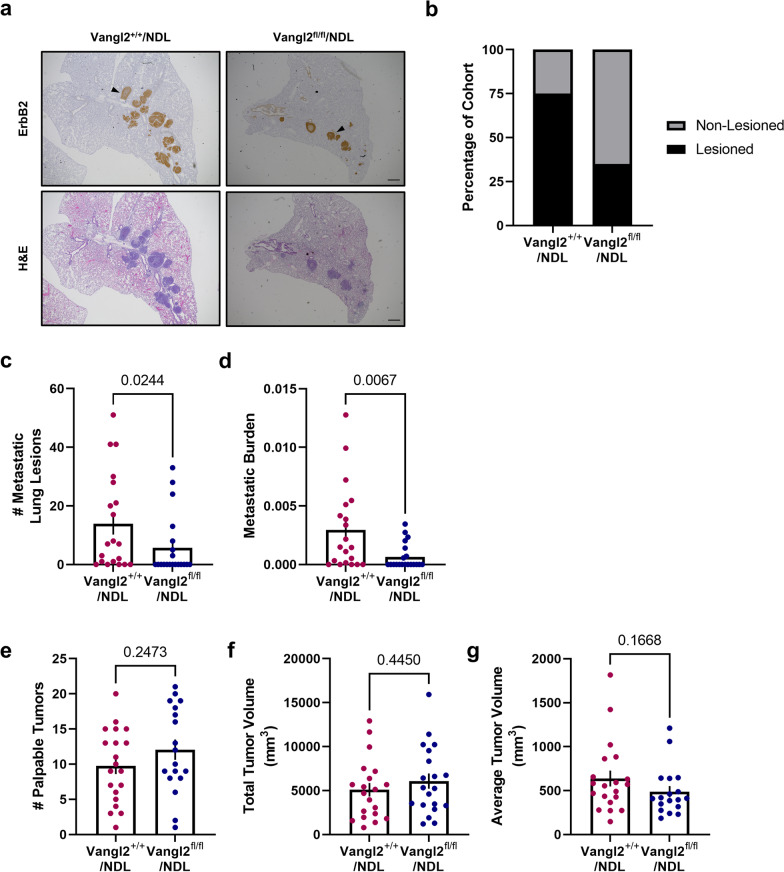
Vangl1 and Vangl2 knockdown and overexpression and Wnt5a stimulation were employed to manipulate Wnt/PCP signaling in a battery of breast cancer cell lines representing all breast cancer subtypes, and in tumor organoids from MMTV-PyMT mice. Cell migration was assessed by scratch and organoid invasion assays, Vangl protein subcellular localization was assessed by confocal fluorescence microscopy, and RhoA activation was assessed in real time by fluorescence imaging with an advanced FRET biosensor. The impact of Wnt/PCP suppression on mammary tumor growth and metastasis was assessed by determining the effect of conditional Vangl2 knockout on the MMTV-NDL mouse mammary tumor model.
We observed that Vangl2 knockdown suppresses the motility of all breast cancer cell lines examined, and overexpression drives the invasiveness of collectively migrating MMTV-PyMT organoids. Vangl2-dependent RhoA activity is localized in real time to a subpopulation of motile leader cells displaying a hyper-protrusive leading edge, Vangl protein is localized to leader cell protrusions within leader cells, and actin cytoskeletal regulator RhoA is preferentially activated in the leader cells of a migrating collective. Mammary gland-specific knockout of Vangl2 results in a striking decrease in lung metastases in MMTV-NDL mice, but does not impact primary tumor growth characteristics.
We conclude that Vangl-dependent Wnt/PCP signaling promotes breast cancer collective cell migration independent of breast tumor subtype and facilitates distant metastasis in a genetically engineered mouse model of breast cancer. Our observations are consistent with a model whereby Vangl proteins localized at the leading edge of leader cells in a migrating collective act through RhoA to mediate the cytoskeletal rearrangements required for pro-migratory protrusion formation.
鉴于人们对细胞集体运动在转移中的作用的认识不断加深,深入了解潜在的信号通路对于将这些观察结果转化为晚期癌症的治疗方法至关重要。在这里,我们研究了非经典 Wnt 信号通路之一的 Wnt/平面细胞极性(Wnt/PCP)的贡献,该通路的特征是涉及四跨膜蛋白样蛋白 Vangl1 和 Vangl2,以研究乳腺癌细胞的运动性、细胞集体侵袭性和乳腺肿瘤转移。
在一系列代表所有乳腺癌亚型的乳腺癌细胞系以及 MMTV-PyMT 小鼠的肿瘤类器官中,采用 Vangl1 和 Vangl2 敲低和过表达以及 Wnt5a 刺激来操纵 Wnt/PCP 信号。通过划痕和类器官侵袭实验评估细胞迁移,通过共聚焦荧光显微镜评估 Vangl 蛋白亚细胞定位,并用先进的 FRET 生物传感器实时评估 RhoA 激活。通过确定条件性 Vangl2 敲除对 MMTV-NDL 小鼠乳腺肿瘤模型的影响来评估 Wnt/PCP 抑制对乳腺肿瘤生长和转移的影响。
我们观察到,Vangl2 敲低抑制了所有检查的乳腺癌细胞系的运动性,而过表达则驱动了集体迁移的 MMTV-PyMT 类器官的侵袭性。Vangl2 依赖性 RhoA 活性实时定位于具有超突起前缘的运动性先导细胞的亚群中,Vangl 蛋白定位于先导细胞中的先导细胞突起内,并且肌动蛋白细胞骨架调节剂 RhoA 在迁移集体的先导细胞中优先激活。乳腺特异性 Vangl2 敲除可导致 MMTV-NDL 小鼠肺部转移明显减少,但不影响原发性肿瘤生长特征。
我们得出结论,Vangl 依赖性 Wnt/PCP 信号促进了乳腺癌细胞的集体迁移,而与乳腺癌亚型无关,并促进了乳腺癌的远处转移。在乳腺癌的基因工程小鼠模型中,我们的观察结果与一种模型一致,即位于迁移集体的先导细胞前缘的 Vangl 蛋白通过 RhoA 作用,介导促进迁移的突起形成所需的细胞骨架重排。