Department of Radiation Oncology, University of Tübingen, Tübingen, Germany.
German Cancer Consortium (DKTK), partner site Tübingen, and German Cancer Research Center (DKFZ), Heidelberg, Germany.
Eur J Nucl Med Mol Imaging. 2023 Aug;50(10):3084-3096. doi: 10.1007/s00259-023-06254-9. Epub 2023 May 6.
Tumor hypoxia and other microenvironmental factors are key determinants of treatment resistance. Hypoxia positron emission tomography (PET) and functional magnetic resonance imaging (MRI) are established prognostic imaging modalities to identify radiation resistance in head-and-neck cancer (HNC). The aim of this preclinical study was to develop a multi-parametric imaging parameter specifically for focal radiotherapy (RT) dose escalation using HNC xenografts of different radiation sensitivities.
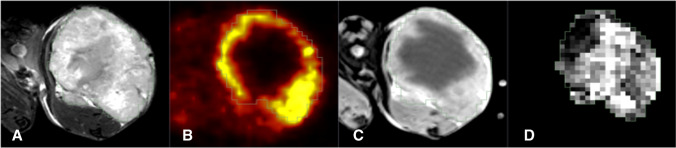
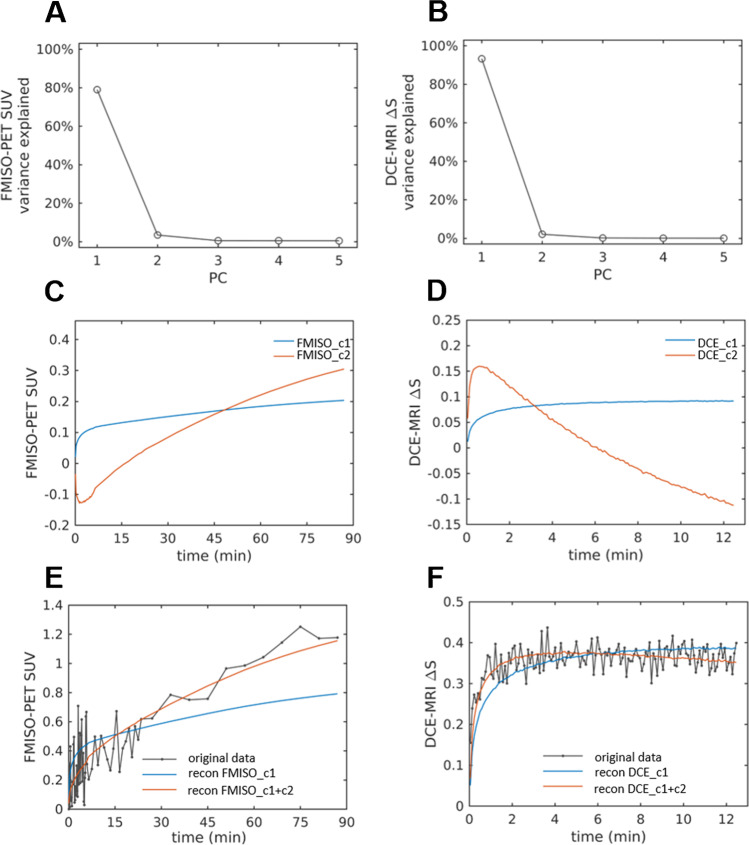
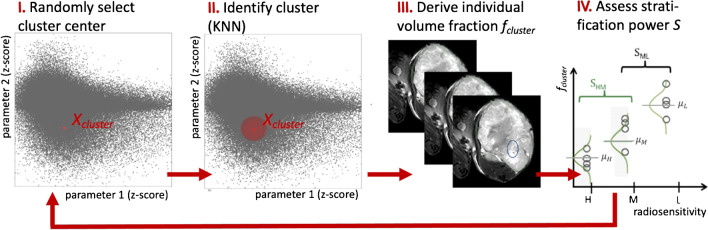
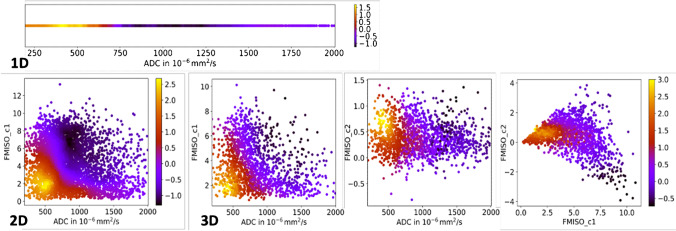
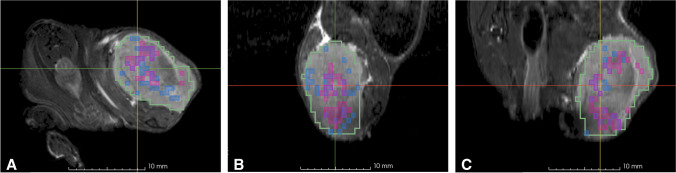
A total of eight human HNC xenograft models were implanted into 68 immunodeficient mice. Combined PET/MRI using dynamic [18F]-fluoromisonidazole (FMISO) hypoxia PET, diffusion-weighted (DW), and dynamic contrast-enhanced MRI was carried out before and after fractionated RT (10 × 2 Gy). Imaging data were analyzed on voxel-basis using principal component (PC) analysis for dynamic data and apparent diffusion coefficients (ADCs) for DW-MRI. A data- and hypothesis-driven machine learning model was trained to identify clusters of high-risk subvolumes (HRSs) from multi-dimensional (1-5D) pre-clinical imaging data before and after RT. The stratification potential of each 1D to 5D model with respect to radiation sensitivity was evaluated using Cohen's d-score and compared to classical features such as mean/peak/maximum standardized uptake values (SUV) and tumor-to-muscle-ratios (TMR) as well as minimum/valley/maximum/mean ADC.
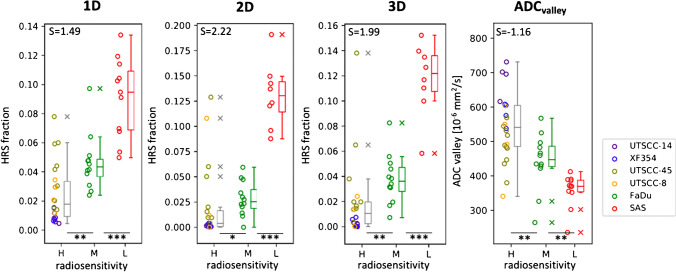
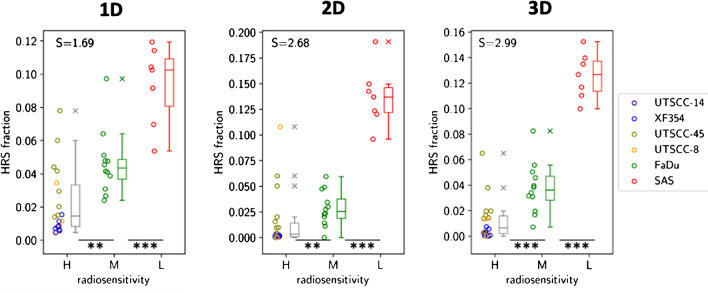
Complete 5D imaging data were available for 42 animals. The final preclinical model for HRS identification at baseline yielding the highest stratification potential was defined in 3D imaging space based on ADC and two FMISO PCs ([Formula: see text]). In 1D imaging space, only clusters of ADC revealed significant stratification potential ([Formula: see text]). Among all classical features, only ADC showed significant correlation to radiation resistance ([Formula: see text]). After 2 weeks of RT, FMISO_c1 showed significant correlation to radiation resistance ([Formula: see text]).
A quantitative imaging metric was described in a preclinical study indicating that radiation-resistant subvolumes in HNC may be detected by clusters of ADC and FMISO using combined PET/MRI which are potential targets for future functional image-guided RT dose-painting approaches and require clinical validation.
肿瘤缺氧和其他微环境因素是治疗耐药性的关键决定因素。正电子发射断层扫描(PET)和功能磁共振成像(MRI)是确定头颈部癌症(HNC)放射抵抗的既定预后成像方式。本临床前研究的目的是开发一种多参数成像参数,专门用于使用不同放射敏感性的 HNC 异种移植物进行聚焦放射治疗(RT)剂量递增。
总共将 8 个人类 HNC 异种移植模型植入 68 只免疫缺陷小鼠中。在分次 RT(10×2 Gy)前后进行了使用动态 [18F]-氟米索硝唑(FMISO)缺氧 PET、扩散加权(DW)和动态对比增强 MRI 的联合 PET/MRI。使用主成分(PC)分析对动态数据和表观扩散系数(ADC)进行 DW-MRI 分析,对体素基础上的成像数据进行分析。使用数据和假设驱动的机器学习模型从 RT 前后的多维(1-5D)临床前成像数据中识别高风险亚体积(HRS)的聚类。使用 Cohen 的 d 分数评估每个 1D 至 5D 模型在辐射敏感性方面的分层潜力,并将其与经典特征(如平均/峰值/最大标准化摄取值(SUV)和肿瘤肌肉比(TMR)以及最小/谷值/最大值/平均 ADC)进行比较。
42 只动物提供了完整的 5D 成像数据。在基于 ADC 和两个 FMISO-PC 的 3D 成像空间中定义了基线时产生最高分层潜力的最终临床前 HRS 识别模型([公式:见正文])。在 1D 成像空间中,只有 ADC 簇显示出显著的分层潜力([公式:见正文])。在所有经典特征中,只有 ADC 与放射抵抗性呈显著相关性([公式:见正文])。在 RT 2 周后,FMISO_c1 与放射抵抗性呈显著相关性([公式:见正文])。
本临床前研究描述了一种定量成像指标,表明使用结合 PET/MRI 的 ADC 和 FMISO 簇可能可以检测到 HNC 中的辐射抵抗性亚体积,这可能是未来功能图像引导 RT 剂量绘画方法的潜在靶点,需要进行临床验证。