Bridge Institute of Experimental Tumor Therapy, West German Cancer Center, University Hospital Essen, Essen, Germany; Division of Solid Tumor Translational Oncology, German Cancer Research Center (DKFZ) and German Cancer Consortium (DKTK), Partner Site University Hospital Essen, Heidelberg, Germany; Department of Medical Oncology, West German Cancer Center, University Hospital Essen, Essen, Germany; German Cancer Consortium (DKTK), Partner Site University Hospital Essen, Essen, Germany.
Bridge Institute of Experimental Tumor Therapy, West German Cancer Center, University Hospital Essen, Essen, Germany; Division of Solid Tumor Translational Oncology, German Cancer Research Center (DKFZ) and German Cancer Consortium (DKTK), Partner Site University Hospital Essen, Heidelberg, Germany; Department of Medical Oncology, West German Cancer Center, University Hospital Essen, Essen, Germany.
ESMO Open. 2023 Jun;8(3):101539. doi: 10.1016/j.esmoop.2023.101539. Epub 2023 May 4.
Pancreatic cancer has a dismal prognosis. One reason is resistance to cytotoxic drugs. Molecularly matched therapies might overcome this resistance but the best approach to identify those patients who may benefit is unknown. Therefore, we sought to evaluate a molecularly guided treatment approach.
We retrospectively analyzed the clinical outcome and mutational status of patients with pancreatic cancer who received molecular profiling at the West German Cancer Center Essen from 2016 to 2021. We carried out a 47-gene DNA next-generation sequencing (NGS) panel. Furthermore, we assessed microsatellite instability-high/deficient mismatch repair (MSI-H/dMMR) status and, sequentially and only in case of KRAS wild-type, gene fusions via RNA-based NGS. Patient data and treatment were retrieved from the electronic medical records.
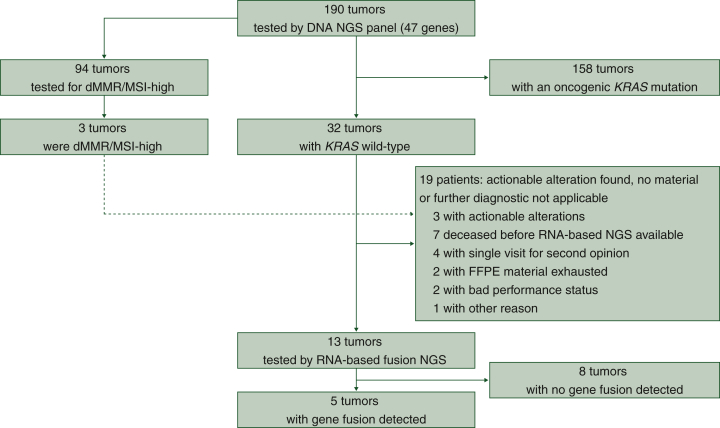
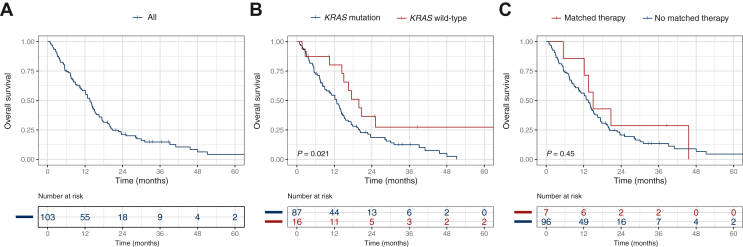
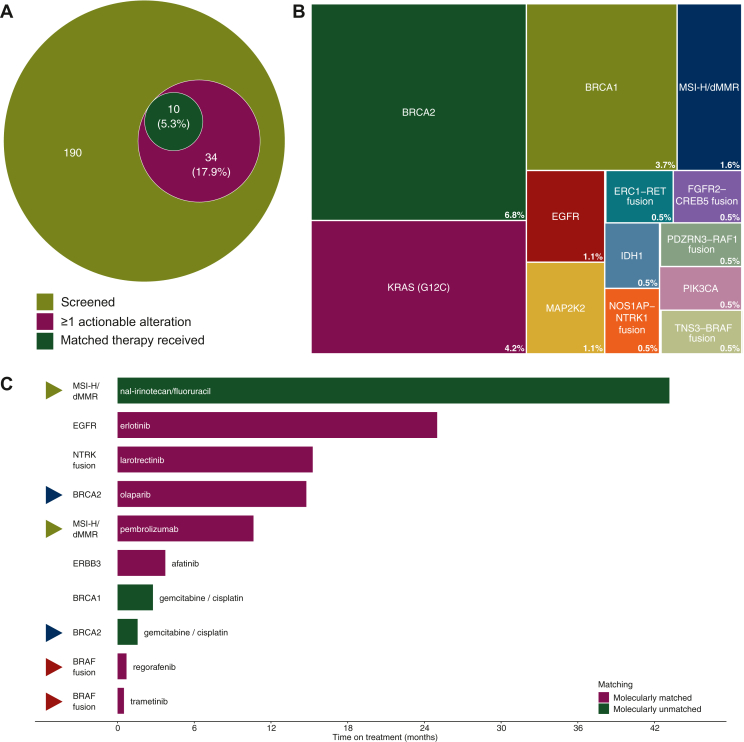
Of 190 included patients, 171 had pancreatic ductal adenocarcinoma (90%). One hundred and three patients had stage IV pancreatic cancer at diagnosis (54%). MMR analysis in 94 patients (94/190, 49.5%) identified 3 patients with dMMR (3/94, 3.2%). Notably, we identified 32 patients with KRAS wild-type status (16.8%). To identify driver alterations in these patients, we conducted an RNA-based fusion assay on 13 assessable samples and identified 5 potentially actionable fusions (5/13, 38.5%). Overall, we identified 34 patients with potentially actionable alterations (34/190, 17.9%). Of these 34 patients, 10 patients (10/34, 29.4%) finally received at least one molecularly targeted treatment and 4 patients had an exceptional response (>9 months on treatment).
Here, we show that a small-sized gene panel can suffice to identify relevant therapeutic options for pancreatic cancer patients. Informally comparing with previous large-scale studies, this approach yields a similar detection rate of actionable targets. We propose molecular sequencing of pancreatic cancer as standard of care to identify KRAS wild-type and rare molecular subsets for targeted treatment strategies.
胰腺癌预后较差。原因之一是对细胞毒性药物的耐药性。分子匹配疗法可能克服这种耐药性,但尚不清楚最佳的识别可能受益的患者的方法。因此,我们试图评估一种分子指导的治疗方法。
我们回顾性分析了 2016 年至 2021 年期间在德国西部癌症中心埃森接受分子谱分析的胰腺癌患者的临床结果和突变状态。我们进行了 47 个基因 DNA 下一代测序(NGS)面板。此外,我们评估了微卫星不稳定性高/错配修复缺陷(MSI-H/dMMR)状态,并在 KRAS 野生型的情况下,通过基于 RNA 的 NGS 依次且仅在 KRAS 野生型的情况下评估基因融合。从电子病历中检索患者数据和治疗情况。
190 例患者中,171 例为胰腺导管腺癌(90%)。103 例患者在诊断时为 IV 期胰腺癌(54%)。在 94 例患者(94/190,49.5%)中进行了 MMR 分析,发现 3 例 dMMR(3/94,3.2%)。值得注意的是,我们发现 32 例患者 KRAS 野生型(16.8%)。为了在这些患者中鉴定出驱动突变,我们对 13 个可评估样本进行了基于 RNA 的融合检测,发现了 5 个潜在可治疗的融合(5/13,38.5%)。总体而言,我们鉴定出 34 例具有潜在可治疗改变的患者(34/190,17.9%)。在这 34 例患者中,10 例(10/34,29.4%)最终接受了至少一种分子靶向治疗,4 例患者有异常反应(治疗时间超过 9 个月)。
在这里,我们表明一个小尺寸的基因面板足以识别胰腺癌患者的相关治疗选择。与以前的大规模研究非正式比较,这种方法产生了类似的可治疗靶点检测率。我们建议对胰腺癌进行分子测序,以确定 KRAS 野生型和罕见的分子亚型,从而制定靶向治疗策略。