ITS Data Science, Premier, Inc., Charlotte, North Carolina.
Department of Public Health Sciences, College of Health and Human Sciences, University of North Carolina at Charlotte, Charlotte, North Carolina; The School of Data Science, University of North Carolina at Charlotte, Charlotte, North Carolina; Faculty of Medicine, School of Public Health, Imperial College London, London, United Kingdom.
Am J Prev Med. 2023 Oct;65(4):727-734. doi: 10.1016/j.amepre.2023.05.002. Epub 2023 May 4.
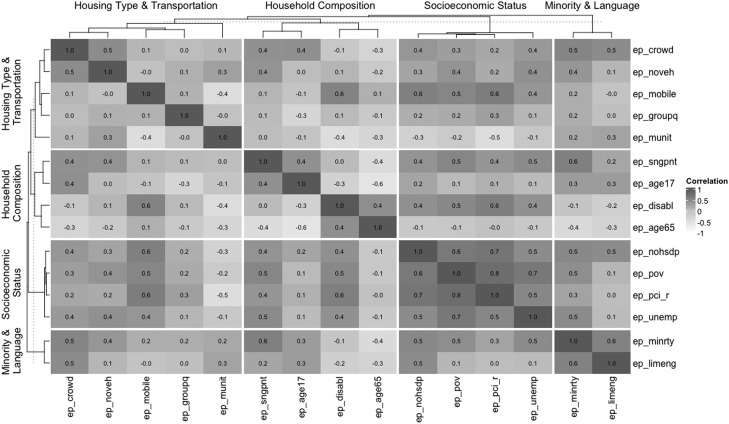
A variety of industry composite indices are employed within health research in risk-adjusted outcome measures and to assess health-related social needs. During the COVID-19 pandemic, the relationships among risk adjustment, clinical outcomes, and composite indices of social risk have become relevant topics for research and healthcare operations. Despite the widespread use of these indices, composite indices are often comprised of correlated variables and therefore may be affected by information duplicity of their underlying risk factors.
A novel approach is proposed to assign outcome- and disease group-driven weights to social risk variables to form disease and outcome-specific social risk indices and apply the approach to the county-level Centers for Disease Control and Prevention social vulnerability factors for demonstration. The method uses a subset of principal components reweighed through Poisson rate regressions while controlling for county-level patient mix. The analyses use 6,135,302 unique patient encounters from 2021 across seven disease strata.
The reweighed index shows reduced root mean squared error in explaining county-level mortality in five of the seven disease strata and equivalent performance in the remaining strata compared with the reduced root mean squared error using the current Centers for Disease Control and Prevention Social Vulnerability Index as a benchmark.
A robust method is provided, designed to overcome challenges with current social risk indices, by accounting for redundancy and assigning more meaningful disease and outcome-specific variable weights.
在风险调整后的结果衡量和评估与健康相关的社会需求方面,健康研究中使用了各种行业综合指数。在 COVID-19 大流行期间,风险调整、临床结果和社会风险综合指数之间的关系成为研究和医疗保健运营的相关主题。尽管这些指数被广泛使用,但综合指数通常由相关变量组成,因此可能会受到其基础风险因素信息重复的影响。
提出了一种新方法,为社会风险变量分配与结果和疾病组相关的权重,以形成疾病和结果特定的社会风险指数,并应用该方法对县级疾病预防控制中心社会脆弱性因素进行演示。该方法使用了通过泊松率回归重新加权的主成分的子集,同时控制了县级患者组合。分析使用了来自 2021 年七个疾病层的 6,135,302 个独特患者就诊的子集。
与当前疾病预防控制中心社会脆弱性指数作为基准相比,在五种疾病层中,重新加权的指数在解释县级死亡率方面的均方根误差降低,而在其余层中的表现相当。
提供了一种稳健的方法,通过考虑冗余并为更有意义的疾病和结果特定变量分配权重,克服了当前社会风险指数面临的挑战。