MaineHealth Institute for Research, Scarborough, ME, USA.
Endocrinol Metab (Seoul). 2023 Apr;38(2):203-213. doi: 10.3803/EnM.2023.1673. Epub 2023 Apr 27.
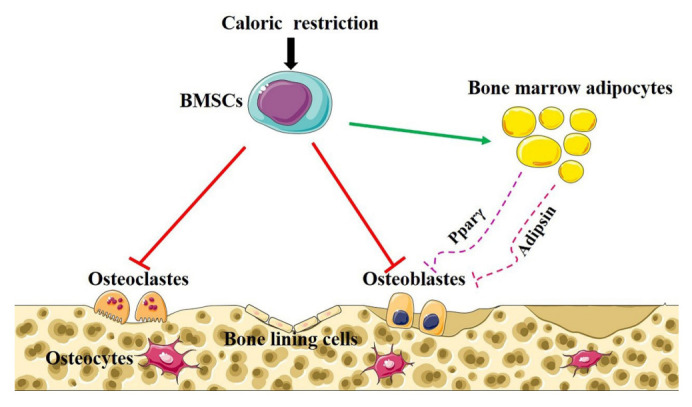
Caloric restriction (CR) is now a popular lifestyle choice due to its ability in experimental animals to improve lifespan, reduce body weight, and lessen oxidative stress. However, more and more emerging evidence suggests this treatment requires careful consideration because of its detrimental effects on the skeletal system. Experimental and clinical studies show that CR can suppress bone growth and raise the risk of fracture, but the specific mechanisms are poorly understood. Reduced mechanical loading has long been thought to be the primary cause of weight loss-induced bone loss from calorie restriction. Despite fat loss in peripheral depots with calorie restriction, bone marrow adipose tissue (BMAT) increases, and this may play a significant role in this pathological process. Here, we update recent advances in our understanding of the effects of CR on the skeleton, the possible pathogenic role of BMAT in CR-induced bone loss, and some strategies to mitigate any potential side effects on the skeletal system.
热量限制(CR)现在是一种流行的生活方式选择,因为它能够在实验动物中延长寿命、减轻体重和减少氧化应激。然而,越来越多的新证据表明,这种治疗方法需要谨慎考虑,因为它会对骨骼系统造成不良影响。实验和临床研究表明,CR 会抑制骨骼生长并增加骨折的风险,但具体的机制尚不清楚。长期以来,人们一直认为,减少机械负荷是热量限制导致体重减轻性骨丢失的主要原因。尽管热量限制会导致外周脂肪减少,但骨髓脂肪组织(BMAT)会增加,这可能在这个病理过程中发挥重要作用。在这里,我们更新了对 CR 对骨骼影响的最新认识,以及 BMAT 在 CR 诱导的骨丢失中的可能致病作用,以及一些减轻对骨骼系统潜在副作用的策略。