Macchi Alberto, Giorli Alessia, Cantone Elena, Carlotta Pipolo Giorgia, Arnone Flavio, Barbone Umberto, Bertazzoni Giacomo, Bianchini Chiara, Ciofalo Andrea, Cipolla Federica, De Massimi Alessio, De Vita Carla, Di Lieto Cristina, Ghidini Angelo, Govoni Marco, Gramellini Giulia, Maselli Del Giudice Alessandro, Ottaviano Giancarlo, Seccia Veronica, Sireci Federico, Sollini Giacomo, Staffieri Claudia, Gallo Stefania, Heffler Enrico, La Mantia Ignazio, De Corso Eugenio, Canevari Frank Rikki, Lombardo Nicola, Malvezzi Luca, Orietti Gabriele, Pasquini Ernesto, Presutti Livio, Monti Giulia
ENT Clinic Asst Sette Laghi – University of Insubria, Varese, Italy.
ENT Unit, University of Siena, Siena, Italy.
Front Allergy. 2023 Apr 21;4:1083964. doi: 10.3389/falgy.2023.1083964. eCollection 2023.
The impairment of the sense of smell is often related to chronic rhinosinusitis (CRS) with or without nasal polyps (CRSwNP, CRSsNP). CRSwNP is a frequent condition that drastically worsens the quality of life of those affected; it has a higher prevalence than CRSsNP. CRSwNP patients experience severe loss of smell with earlier presentation and are more likely to experience recurrence of their symptoms, often requiring revision surgery.
The present study performed a multicentric data collection, enrolling 811 patients with CRS divided according to the inflammatory endotype (Type 2 and non-Type 2). All patients were referred for nasal endoscopy for the assessment of nasal polyposis using nasal polyp score (NPS); Sniffin' Sticks olfactory test were performed to measure olfactory function, and SNOT-22 (22-item sinonasal outcome test) questionnaire was used to assess patients' quality of life; allergic status was evaluated with skin prick test and nasal cytology completed the evaluation when available.
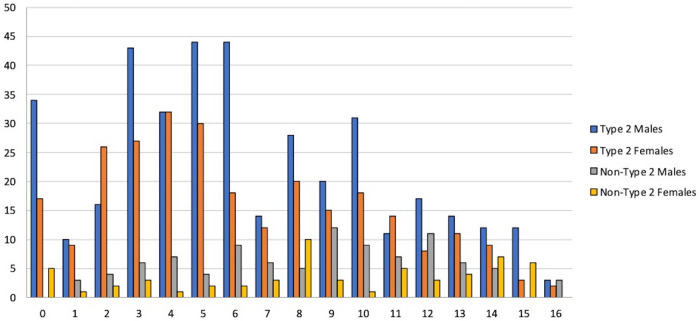
Data showed that Type 2 inflammation is more common than non-type 2 (656 patients versus 155) and patients suffer from worse quality of life and nasal polyp score. Moreover, 86.1% of patients with Type 2 CRSwNP were affected by a dysfunction of the sense of smell while it involved a lesser percentage of non-Type 2 patients. Indeed, these data give us new information about type-2 inflammation patients' characteristics.
The present study confirms that olfactory function weights on patients' QoL and it represents an important therapeutic goal that can also improve patients' compliance when achieved. In a future - and present - perspective of rhinological precision medicine, an impairment of the sense of smell could help the clinician to characterize patients better and to choose the best treatment available.
嗅觉障碍通常与伴有或不伴有鼻息肉的慢性鼻-鼻窦炎(CRS,即伴鼻息肉的慢性鼻-鼻窦炎CRSwNP和不伴鼻息肉的慢性鼻-鼻窦炎CRSsNP)相关。CRSwNP是一种常见病症,会严重恶化患者的生活质量;其患病率高于CRSsNP。CRSwNP患者嗅觉严重丧失,症状出现更早,且更易复发,常需进行修正手术。
本研究进行了多中心数据收集,纳入811例CRS患者,并根据炎症内型(2型和非2型)进行分组。所有患者均接受鼻内镜检查,使用鼻息肉评分(NPS)评估鼻息肉情况;进行嗅觉棒嗅觉测试以测量嗅觉功能,并使用SNOT-22(22项鼻鼻窦结局测试)问卷评估患者的生活质量;通过皮肤点刺试验评估过敏状态,如有条件则进行鼻细胞学检查以完善评估。
数据显示,2型炎症比非2型炎症更常见(656例患者对155例),且患者的生活质量和鼻息肉评分更差。此外,86.1%的2型CRSwNP患者存在嗅觉功能障碍,而非2型患者中这一比例较低。实际上,这些数据为我们提供了有关2型炎症患者特征的新信息。
本研究证实嗅觉功能对患者的生活质量有影响,它是一个重要的治疗目标,实现这一目标还可提高患者的依从性。从当前和未来鼻科学精准医学的角度来看,嗅觉障碍有助于临床医生更好地对患者进行特征描述,并选择最佳可用治疗方法。