Cantone Elena, De Corso Eugenio, Ricciardiello Filippo, Di Nola Claudio, Grimaldi Giusi, Allocca Viviana, Motta Gaetano
Department of Neuroscience, Reproductive and Odontostomatological Sciences-ENT Section, University of Naples Federico II, 80131 Naples, Italy.
Head and Neck Department-ENT Section, AOU Federico II, 80131 Naples, Italy.
J Pers Med. 2022 Jul 26;12(8):1215. doi: 10.3390/jpm12081215.
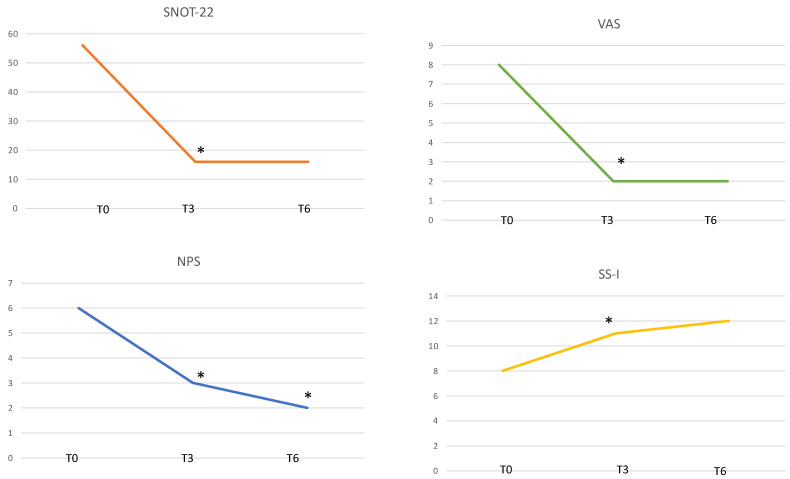
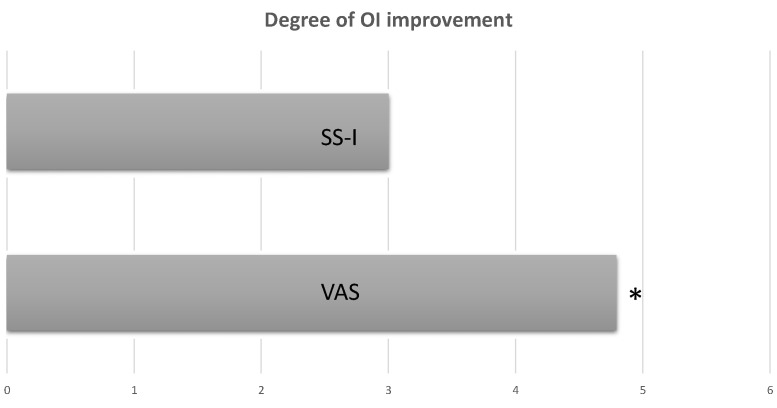
Chronic rhinosinusitis with nasal polyps (CRSwNP) is a chronic type 2 inflammatory disease characterized by olfactory impairment (OI) as one of the most troublesome symptoms. Currently, biologics represent a new option in the treatment of uncontrolled type 2 CRSwNP. This is a retrospective real-life observational study involving adult patients affected by severe uncontrolled CRSwNP. At baseline, and 3 and 6 months after Dupilumab add on to intranasal steroids (INS), patients underwent the 22-item Sinonasal Outcome Test (SNOT-22), nasal endoscopy, Visual Analogue Scale (VAS) scale for OI, and Sniffin Sticks-16 items identification test (SS-I). We observed improvement in all clinical outcomes with a significant correlation between VAS-SS-I/SNOT22, whereas we did not find a correlation between Nasal Polyp Score (NPS) and SS-I or VAS. Interestingly, patients reported a higher degree of improvement of OI on the VAS than on the SS-I. These data demonstrate that the patients were not aware about the degree of their OI and the perception of general improvement in their health-related quality of life (HRQoL) may have influenced the VAS score. Moreover, we observed a lack of correlation between NPS and SS-I or VAS, suggesting that OI did not depend on the polyps' volume and may be due mainly to the resolution of inflammation. So, the physiopathological mechanisms underlying OI in CRSwNP and its recovery after Dupilumab might be unrelated to the volume of the polyps and might depend mainly on the anti-inflammatory effects. Future studies including biomarkers may be useful to clarify this aspect.
伴鼻息肉的慢性鼻-鼻窦炎(CRSwNP)是一种慢性2型炎症性疾病,嗅觉障碍(OI)是其最困扰人的症状之一。目前,生物制剂是治疗未得到控制的2型CRSwNP的一种新选择。这是一项回顾性现实生活观察性研究,纳入了受严重未得到控制的CRSwNP影响的成年患者。在基线时,以及在度普利尤单抗添加到鼻内类固醇(INS)治疗后的3个月和6个月,患者接受了22项鼻鼻窦结局测试(SNOT-22)、鼻内镜检查、用于OI的视觉模拟量表(VAS)以及16项嗅觉棒识别测试(SS-I)。我们观察到所有临床结局均有改善,VAS-SS-I/SNOT22之间存在显著相关性,而我们未发现鼻息肉评分(NPS)与SS-I或VAS之间存在相关性。有趣的是,患者报告称在VAS上OI的改善程度高于SS-I。这些数据表明患者并未意识到其OI的程度,并且对其健康相关生活质量(HRQoL)总体改善的感知可能影响了VAS评分。此外,我们观察到NPS与SS-I或VAS之间缺乏相关性,这表明OI并不取决于息肉的体积,可能主要是由于炎症的消退。因此,CRSwNP中OI及其在度普利尤单抗治疗后恢复的生理病理机制可能与息肉体积无关,可能主要取决于抗炎作用。未来包括生物标志物的研究可能有助于阐明这一方面。