Angarita-Fonseca Adriana, Torres-Castro Rodrigo, Benavides-Cordoba Vicente, Chero Santos, Morales-Satán Mauricio, Hernández-López Bricia, Salazar-Pérez Rafael, Larrateguy Santiago, Sanchez-Ramirez Diana C
Université du Québec en Abitibi Témiscamingue, Rouyn-Noranda, QC, Canada.
Centre de Recherche du CHU de Québec, Québec City, QC, Canada.
Front Med (Lausanne). 2023 Apr 20;10:1168628. doi: 10.3389/fmed.2023.1168628. eCollection 2023.
Studies exploring long COVID condition (LCC) in low- and middle-income countries are scarce. Further characterization of LCC patients experiencing activity limitations and their associated healthcare use is needed. This study aimed to describe LCC patients' characteristics, its impact on activities, and associated healthcare use in Latin America (LATAM).
Individuals who (cared for someone or) had COVID-19 and could read, write, and comprehend Spanish and lived in a LATAM country were invited to complete a virtual survey. Sociodemographic characteristics, COVID-19 and LCC symptoms, activity limitations, and healthcare use.
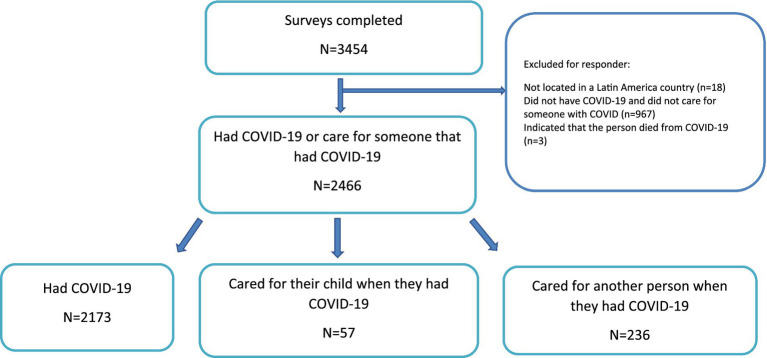
Data from 2,466 people from 16 countries in LATAM were analyzed (females = 65.9%; mean age of 39.5 ± 53.3 years). 1,178 (48%) of the respondents had LCC symptoms (≥3 months). These were more likely to have COVID-19 earlier in the pandemic, were older, had no COVID vaccines, had more comorbidities, needed supplementary oxygen, and reported significantly more COVID-19 symptoms during the infectious period. 33% of the respondents visited a primary care provider, 13% went to the emergency department, 5% were hospitalized, 21% visited a specialist, and 32% consulted ≥1 therapist for LCC symptoms mainly extreme fatigue, sleep difficulties, headaches, muscle or joint pain, and shortness of breath with activity. The most consulted therapists were respiratory therapists (15%) and psychologists (14%), followed by physical therapists (13%), occupational therapists (3%), and speech pathologists (1%). One-third of LCC respondents decreased their regular activities (e.g., work, school) and 8% needed help with activities of daily living (ADLs). LCC respondents who reduced their activities reported more difficulty sleeping, chest pain with activity, depression, and problems with concentration, thinking, and memory, while those who needed help with ADLs were more likely to have difficulty walking, and shortness of breath at rest. Approximately 60% of respondents who experienced activity limitations sought a specialist and 50% consulted therapists.
Results supported previous findings in terms of the LCC demographics, and provided insight into LCC impact on patients' activities and healthcare services used in LATAM. This information is valuable to inform service planning and resource allocation in alignment with the needs of this population.
在低收入和中等收入国家探索新冠长期症状(LCC)的研究很少。需要进一步描述经历活动受限的LCC患者及其相关医疗保健使用情况。本研究旨在描述拉丁美洲(LATAM)LCC患者的特征、其对活动的影响以及相关医疗保健使用情况。
曾感染新冠病毒且能读、写、理解西班牙语并居住在拉丁美洲国家的个人(或照顾过他人的人)被邀请完成一项虚拟调查。调查内容包括社会人口学特征、新冠病毒感染和LCC症状、活动受限情况以及医疗保健使用情况。
对来自拉丁美洲16个国家的2466人的数据进行了分析(女性占65.9%;平均年龄39.5±53.3岁)。1178名(48%)受访者有LCC症状(≥3个月)。这些人在疫情早期更有可能感染新冠病毒,年龄较大,未接种新冠疫苗,有更多合并症,需要补充氧气,并且在感染期报告的新冠病毒症状明显更多。33%的受访者就诊于初级保健提供者,13%前往急诊科,5%住院,21%就诊于专科医生,32%因LCC症状(主要是极度疲劳、睡眠困难、头痛、肌肉或关节疼痛以及活动时呼吸急促)咨询过≥1名治疗师。咨询最多的治疗师是呼吸治疗师(15%)和心理学家(14%),其次是物理治疗师(13%)、职业治疗师(3%)和言语病理学家(1%)。三分之一的LCC受访者减少了日常活动(如工作、上学),8%的人在日常生活活动(ADL)方面需要帮助。减少活动的LCC受访者报告睡眠困难、活动时胸痛、抑郁以及注意力、思维和记忆方面的问题更多,而在ADL方面需要帮助的人更有可能行走困难和静息时呼吸急促。约60%经历活动受限的受访者寻求专科医生帮助,50%咨询过治疗师。
研究结果在LCC人口统计学方面支持了先前的发现,并深入了解了LCC对拉丁美洲患者活动和所使用医疗服务的影响。这些信息对于根据该人群的需求进行服务规划和资源分配具有重要价值。