Center for Health Policy Studies, School of Public Health, Zhejiang University School of Medicine, Hangzhou, China.
Centre for Health Management and Policy Research, School of Public Health, Cheeloo College of Medicine, (NHC Key Laboratory of Health Economics and Policy Research), Shandong University, Jinan, 250012, China.
Antimicrob Resist Infect Control. 2021 Jan 6;10(1):5. doi: 10.1186/s13756-020-00872-w.
Antibiotic resistance (AR) threats public health in China. National-level estimation of economic burden of AR is lacking. We aimed to quantify the economic costs of AR in inpatients in China.
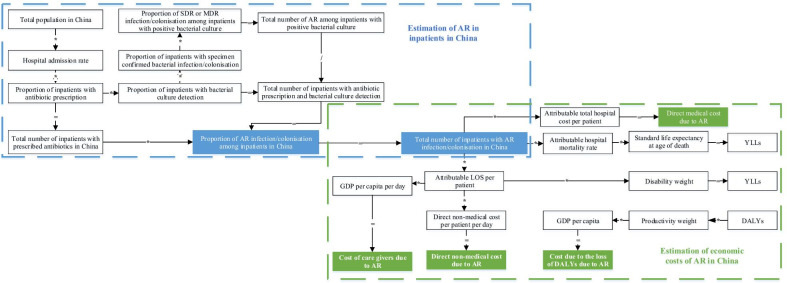
We performed a multicentre and retrospective cohort study including 15,990 patient episodes at four tertiary hospitals in China from 2013 to 2015 to assess the impact of AR on hospital mortality, length of stay, and costs. We estimated the societal economic burden of AR using findings from the cohort study and secondary data from national surveillance hubs and statistical reports.
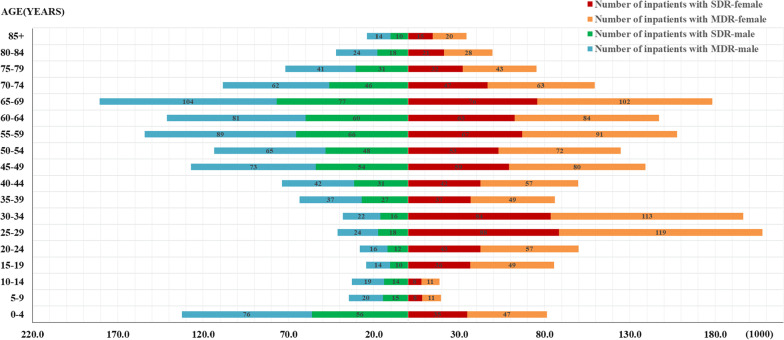
Patients with multi-drug resistant (MDR) infection or colonisation caused by Staphylococcus aureus, Enterococcus faecalis, Enterococcus faecium, Escherichia coli, Klebsiella pneumonia, Pseudomonas aeruginosa, and Acinetobacter baumannii experienced higher individual patient cost ($3391, 95% uncertainty interval (UI) $3188-3594), longer hospital stay (5.48 days, 95% UI 5.10-5.87 days), and higher in-hospital mortality rates (1.50%, 95% UI 1.29-1.70%). In China, 27.45% of bacterial infection or colonisation that occurred in inpatients were resistant, of which 15.77% were MDR. A societal economic burden attributed to AR was estimated to be $77 billion in 2017, which is equivalent to 0.37% of China's yearly gross domestic product, with $57 billion associated with MDR.
This is the first study to estimate national-level economic burden of AR in China. AR places a significant burden on patient health and healthcare systems. Estimation of economic costs of resistant infection or colonisation is the essential step towards building an economic case for global and national actions to combat AMR.
抗生素耐药性(AR)威胁着中国的公共卫生。目前缺乏国家级的 AR 经济负担估计。本研究旨在量化中国住院患者 AR 的经济成本。
我们进行了一项多中心回顾性队列研究,纳入了 2013 年至 2015 年中国四家三级医院的 15990 例患者,以评估 AR 对医院死亡率、住院时间和费用的影响。我们使用队列研究的结果和国家监测中心和统计报告的二级数据来估计 AR 的社会经济负担。
耐多药(MDR)感染或金黄色葡萄球菌、粪肠球菌、屎肠球菌、大肠埃希菌、肺炎克雷伯菌、铜绿假单胞菌和鲍曼不动杆菌定植的患者,其个体患者成本更高(3391 美元,95%置信区间[CI]为 3188-3594 美元),住院时间更长(5.48 天,95%CI 为 5.10-5.87 天),住院死亡率更高(1.50%,95%CI 为 1.29-1.70%)。2017 年,中国住院患者中 27.45%的细菌感染或定植是耐药的,其中 15.77%是 MDR。预计 AR 造成的社会经济负担为 2017 年 770 亿美元,相当于中国国内生产总值(GDP)的 0.37%,其中 570 亿美元与 MDR 相关。
这是第一项估计中国全国范围内 AR 经济负担的研究。AR 给患者健康和医疗系统带来了重大负担。对耐药感染或定植的经济成本进行估计,是建立针对全球和国家对抗 AMR 行动的经济案例的必要步骤。