Hong Du, Zhang Chi, Wu Wenshuo, Lu Xiaohui, Zhang Liping
The First Affiliated Hospital of Zhejiang Chinese Medical University, Hangzhou, China.
Sir Run Run Shaw Hospital, Zhejiang University, Hangzhou, China.
Front Neurol. 2023 Apr 20;14:1133546. doi: 10.3389/fneur.2023.1133546. eCollection 2023.
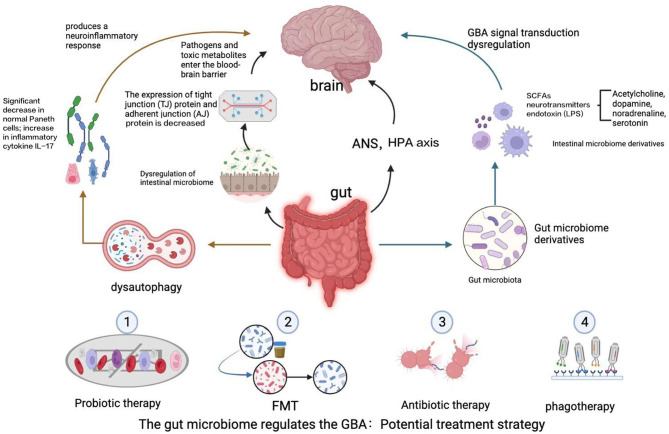
There are trillions of different microorganisms in the human digestive system. These gut microbes are involved in the digestion of food and its conversion into the nutrients required by the body. In addition, the gut microbiota communicates with other parts of the body to maintain overall health. The connection between the gut microbiota and the brain is known as the gut-brain axis (GBA), and involves connections via the central nervous system (CNS), the enteric nervous system (ENS), and endocrine and immune pathways. The gut microbiota regulates the central nervous system bottom-up through the GBA, which has prompted researchers to pay considerable attention to the potential pathways by which the gut microbiota might play a role in the prevention and treatment of amyotrophic lateral sclerosis (ALS). Studies with animal models of ALS have shown that dysregulation of the gut ecology leads to dysregulation of brain-gut signaling. This, in turn, induces changes in the intestinal barrier, endotoxemia, and systemic inflammation, which contribute to the development of ALS. Through the use of antibiotics, probiotic supplementation, phage therapy, and other methods of inducing changes in the intestinal microbiota that can inhibit inflammation and delay neuronal degeneration, the clinical symptoms of ALS can be alleviated, and the progression of the disease can be delayed. Therefore, the gut microbiota may be a key target for effective management and treatment of ALS.
人类消化系统中存在着数万亿种不同的微生物。这些肠道微生物参与食物的消化,并将其转化为身体所需的营养物质。此外,肠道微生物群与身体的其他部位进行交流以维持整体健康。肠道微生物群与大脑之间的联系被称为肠-脑轴(GBA),涉及通过中枢神经系统(CNS)、肠神经系统(ENS)以及内分泌和免疫途径的连接。肠道微生物群通过肠-脑轴自下而上调节中枢神经系统,这促使研究人员高度关注肠道微生物群可能在肌萎缩侧索硬化症(ALS)的预防和治疗中发挥作用的潜在途径。对ALS动物模型的研究表明,肠道生态失调会导致脑-肠信号传导失调。反过来,这会引起肠道屏障、内毒素血症和全身炎症的变化,从而促进ALS的发展。通过使用抗生素、补充益生菌、噬菌体疗法以及其他能够诱导肠道微生物群变化以抑制炎症和延缓神经元变性的方法,可以减轻ALS的临床症状,并延缓疾病的进展。因此,肠道微生物群可能是有效管理和治疗ALS的关键靶点。