Lee Clare J, Mao Huzhang, Thieu Vivian T, Landó Laura Fernández, Thomas Melissa K
Eli Lilly and Company, Indianapolis, IN, 46285, USA.
J Endocr Soc. 2023 Apr 22;7(5):bvad056. doi: 10.1210/jendso/bvad056. eCollection 2023 Mar 6.
Tirzepatide is a glucose-dependent insulinotropic polypeptide and glucagon-like peptide-1 receptor agonist approved for treatment of type 2 diabetes (T2D). SURPASS-1, a phase 3 trial of tirzepatide monotherapy in people with early T2D, enables evaluating effects of tirzepatide on pancreatic beta-cell function and insulin sensitivity (IS) without other background antihyperglycemic medications.
Explore changes in biomarkers of beta-cell function and IS with tirzepatide monotherapy.
Post hoc analyses of fasting biomarkers with analysis of variance and mixed model repeated measures.
Forty-seven sites in 4 countries.
Four hundred seventy-eight T2D participants.
Tirzepatide (5, 10, 15 mg), placebo.
Analyze biomarkers of beta-cell function and IS at 40 weeks.
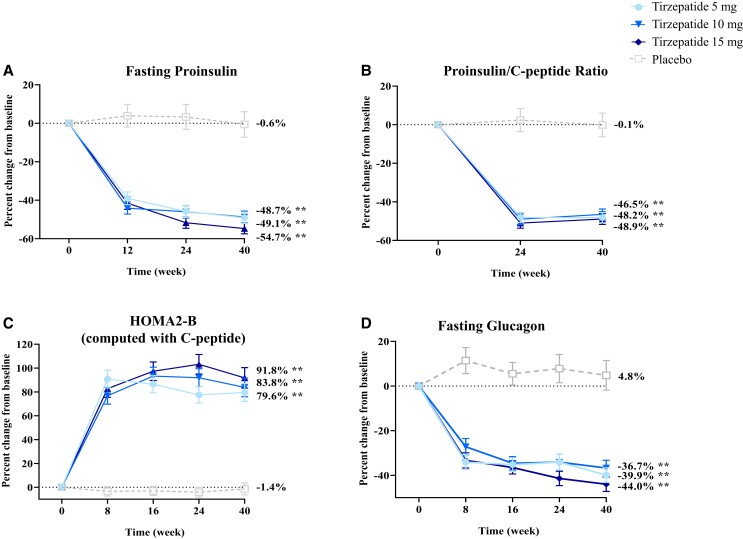
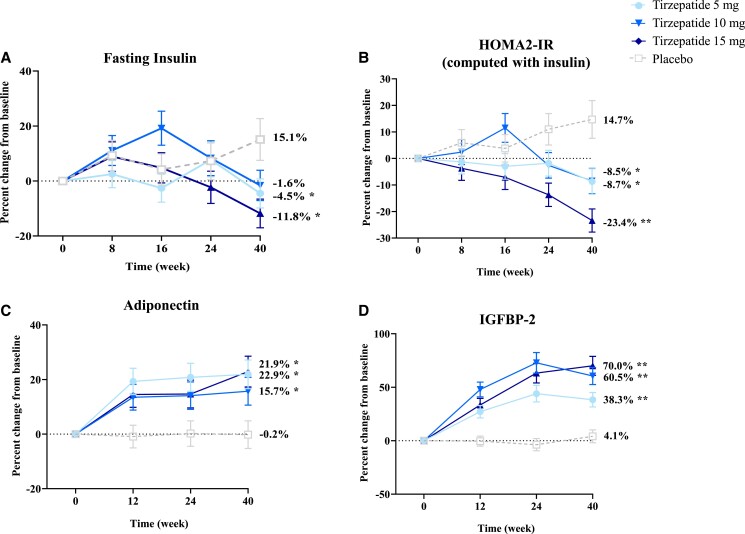
At 40 weeks, markers of beta-cell function improved with tirzepatide monotherapy vs placebo with reductions from baseline in fasting proinsulin levels (49-55% vs -0.6%) and in intact proinsulin/C-peptide ratios (47-49% vs -0.1%) ( < .001, all doses vs placebo). Increases from baseline in homeostatic model assessment for beta-cell function (computed with C-peptide) (77-92% vs -1.4%) and decreases in glucose-adjusted glucagon levels (37-44% vs +4.8%) were observed with tirzepatide vs placebo ( < .001, all doses vs placebo). IS improved as indicated by reductions from baseline in homeostatic model assessment for insulin resistance (9-23% vs +14.7%) and fasting insulin levels (2-12% vs +15%), and increases in total adiponectin (16-23% vs -0.2%) and insulin-like growth factor binding protein 2 (38-70% vs +4.1%) with tirzepatide vs placebo at 40 weeks ( ≤ .031, all doses vs placebo, except for fasting insulin levels with tirzepatide 10 mg).
As monotherapy for early T2D, tirzepatide achieved significant improvements in biomarkers of both pancreatic beta-cell function and IS.
替尔泊肽是一种葡萄糖依赖性促胰岛素多肽和胰高血糖素样肽-1受体激动剂,已被批准用于治疗2型糖尿病(T2D)。SURPASS-1是一项在早期T2D患者中进行的替尔泊肽单药治疗的3期试验,该试验能够在没有其他背景降糖药物的情况下评估替尔泊肽对胰腺β细胞功能和胰岛素敏感性(IS)的影响。
探讨替尔泊肽单药治疗对β细胞功能和IS生物标志物的影响。
采用方差分析和混合模型重复测量对空腹生物标志物进行事后分析。
4个国家的47个研究点。
478名T2D参与者。
替尔泊肽(5、10、15毫克)、安慰剂。
分析40周时β细胞功能和IS的生物标志物。
在40周时,与安慰剂相比,替尔泊肽单药治疗可改善β细胞功能标志物,空腹胰岛素原水平较基线降低(49%-55% vs -0.6%),完整胰岛素原/C肽比值降低(47%-49% vs -0.1%)(所有剂量组与安慰剂组相比,P<0.001)。与安慰剂相比,替尔泊肽使β细胞功能的稳态模型评估(用C肽计算)较基线增加(77%-92% vs -1.4%),葡萄糖调节的胰高血糖素水平降低(37%-44% vs +4.8%)(所有剂量组与安慰剂组相比,P<0.001)。40周时,与安慰剂相比,替尔泊肽使胰岛素抵抗的稳态模型评估较基线降低(9%-23% vs +14.7%)、空腹胰岛素水平降低(2%-12% vs +15%),总脂联素增加(16%-23% vs -0.2%),胰岛素样生长因子结合蛋白2增加(38%-70% vs +4.1%),提示IS得到改善(所有剂量组与安慰剂组相比,P≤0.031,替尔泊肽10毫克组空腹胰岛素水平除外)。
作为早期T2D的单药治疗,替尔泊肽在胰腺β细胞功能和IS的生物标志物方面均取得了显著改善。