Department of Psychiatry, University of California San Diego, San Diego, CA, United States.
San Diego Joint Doctoral Program in Clinical Psychology, San Diego State University, University of California, San Diego, CA, United States.
AIDS Behav. 2023 Oct;27(10):3401-3413. doi: 10.1007/s10461-023-04056-6. Epub 2023 May 8.
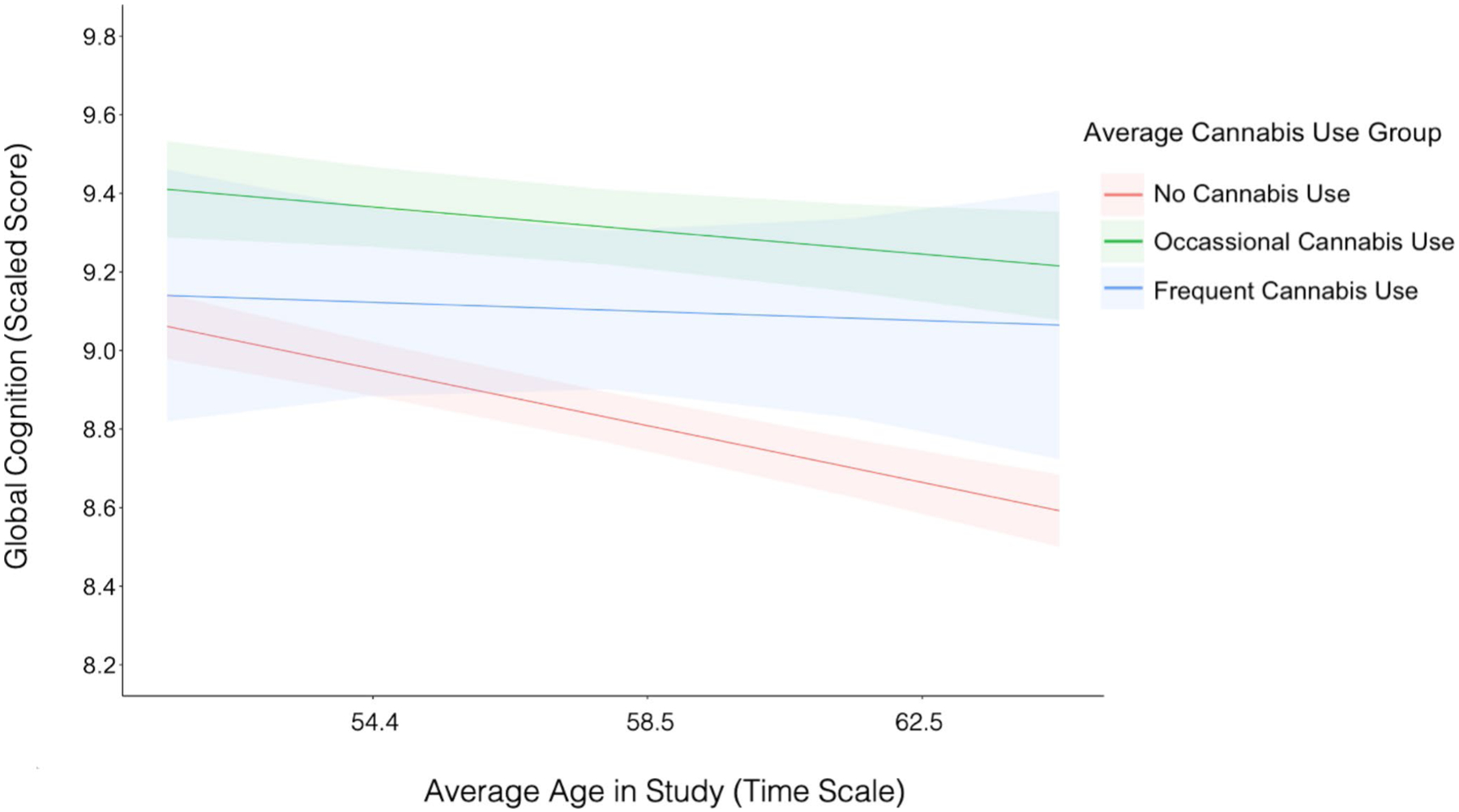
Cannabis use is rapidly increasing among older adults in the United States, in part to treat symptoms of common health conditions (e.g., chronic pain, sleep problems). Longitudinal studies of cannabis use and cognitive decline in aging populations living with chronic disease are lacking. We examined different levels of cannabis use and cognitive and everyday function over time among 297 older adults with HIV (ages 50-84 at baseline). Participants were classified based on average cannabis use: frequent (> weekly) (n = 23), occasional (≤ weekly) (n = 83), and non-cannabis users (n=191) and were followed longitudinally for up to 10 years (average years of follow-up = 3.9). Multi-level models examined the effects of average and recent cannabis use on global cognition, global cognitive decline, and functional independence. Occasional cannabis users showed better global cognitive performance overall compared to non-cannabis users. Rates of cognitive decline and functional problems did not vary by average cannabis use. Recent cannabis use was linked to worse cognition at study visits when participants had THC+ urine toxicology-this short-term decrement in cognition was driven by worse memory and did not extend to reports of functional declines. Occasional (≤ weekly) cannabis use was associated with better global cognition over time in older adults with HIV, a group vulnerable to chronic inflammation and cognitive impairment. Recent THC exposure may have a temporary adverse impact on memory. To inform safe and efficacious medical cannabis use, the effects of specific cannabinoid doses on cognition and biological mechanisms must be investigated in older adults.
美国的老年人越来越多地使用大麻,部分原因是为了治疗常见健康问题(如慢性疼痛、睡眠问题)的症状。缺乏针对患有慢性疾病的老年人群中大麻使用与认知能力下降的纵向研究。我们研究了 297 名患有 HIV 的老年人(基线时年龄在 50-84 岁)在不同时间点的大麻使用水平以及认知和日常功能。参与者根据平均大麻使用情况进行分类:频繁(每周>一次)(n=23)、偶尔(每周≤一次)(n=83)和非大麻使用者(n=191),并进行了长达 10 年的纵向随访(平均随访年限=3.9 年)。多层次模型检验了平均和近期大麻使用对整体认知、整体认知下降和功能独立性的影响。与非大麻使用者相比,偶尔使用大麻者的整体认知表现更好。平均大麻使用与认知能力下降和功能问题的发生率无关。当参与者尿液中含有 THC 且毒理学检测呈阳性时,近期大麻使用与研究期间的认知能力下降有关,这种短期认知能力下降是由记忆力下降引起的,并未扩展到功能下降的报告。偶尔(每周≤一次)大麻使用与 HIV 老年患者的整体认知能力随时间的提高有关,该群体易受到慢性炎症和认知障碍的影响。近期 THC 暴露可能对记忆产生暂时的不利影响。为了确保安全有效的医用大麻使用,必须在老年人中研究特定大麻素剂量对认知和生物学机制的影响。