Department of Laboratory Medicine, Karolinska Institutet, Stockholm, Sweden.
Department of Clinical Neuroscience, Division of Neurology, Karolinska Institute and Karolinska University Hospital, Stockholm, Sweden.
Cell Mol Immunol. 2023 Jun;20(6):613-625. doi: 10.1038/s41423-023-01022-z. Epub 2023 May 10.
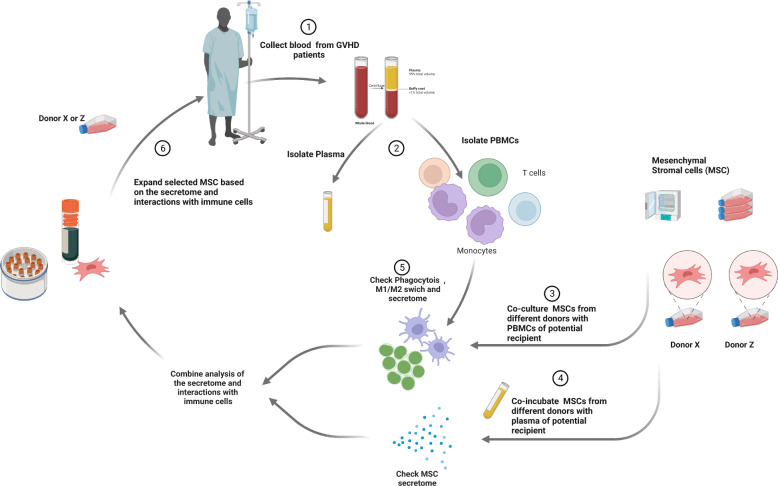
Graft versus host disease (GvHD) is the clinical condition in which bone marrow-derived mesenchymal stromal cells (MSCs) have been most frequently studied. In this review, we summarize the experience from clinical trials that have paved the way to translation. While MSC-based therapy has shown an exceptional safety profile, identifying potency assays and disease biomarkers that reliably predict the capacity of a specific MSC batch to alleviate GvHD has been difficult. As GvHD diagnosis and staging are based solely on clinical criteria, individual patients recruited in the same clinical trial may have vastly different underlying biology, obscuring trial outcomes and making it difficult to determine the benefit of MSCs in subgroups of patients. An accumulating body of evidence indicates the importance of considering not only the cell product but also patient-specific biomarkers and/or immune characteristics in determining MSC responsiveness. A mode of action where intravascular MSC destruction is followed by monocyte-efferocytosis-mediated skewing of the immune repertoire in a permissive inflammatory environment would both explain why cell engraftment is irrelevant for MSC efficacy and stress the importance of biologic differences between responding and nonresponding patients. We recommend a combined analysis of clinical outcomes and both biomarkers of disease activity and MSC potency assays to identify patients with GvHD who are likely to benefit from MSC therapy.
移植物抗宿主病(GvHD)是骨髓来源的间充质基质细胞(MSCs)最常被研究的临床情况。在这篇综述中,我们总结了为转化铺平道路的临床试验经验。虽然基于 MSC 的治疗显示出了极好的安全性,但确定效力测定和疾病生物标志物来可靠地预测特定 MSC 批次缓解 GvHD 的能力一直很困难。由于 GvHD 的诊断和分期仅基于临床标准,因此在同一临床试验中招募的个别患者可能具有截然不同的潜在生物学特征,这掩盖了试验结果,使得难以确定 MSC 在患者亚组中的益处。越来越多的证据表明,在确定 MSC 反应性时,不仅要考虑细胞产品,还要考虑患者特异性生物标志物和/或免疫特征。一种作用模式是,在允许炎症环境中,MSC 破坏后,单核细胞吞噬作用介导免疫库的倾斜,这既能解释为什么细胞植入与 MSC 疗效无关,又强调了反应性和非反应性患者之间的生物学差异的重要性。我们建议对临床结果以及疾病活动和 MSC 效力测定的生物标志物进行联合分析,以确定可能从 MSC 治疗中受益的 GvHD 患者。