Kosak Leonie, Satz Norbert, Jutzi Markus, Dobec Marinko, Schlagenhauf Patricia
University of Zürich, Institute for Epidemiology, Biostatistics and Prevention, Zürich, Switzerland.
Praxis Am Paradeplatz, Zürich, Switzerland.
New Microbes New Infect. 2023 Apr 24;53:101139. doi: 10.1016/j.nmni.2023.101139. eCollection 2023 Jun.
The tick is the main vector of and tick-borne encephalitis virus in Switzerland Spotted fever group Rickettsiae (SFG) and have been detected in Swiss ticks, however, information about the extent and clinical presentation of these infections in humans is scant.
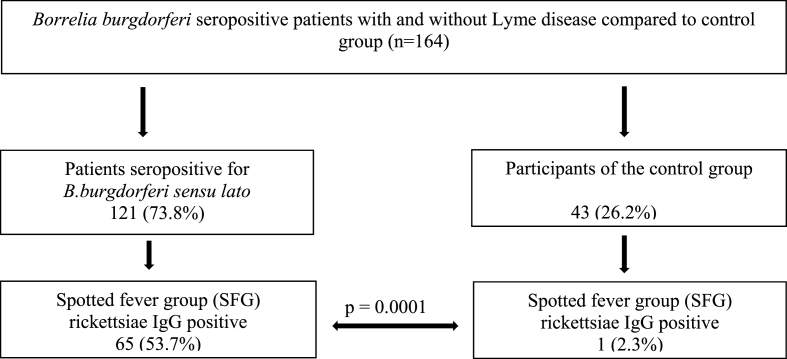
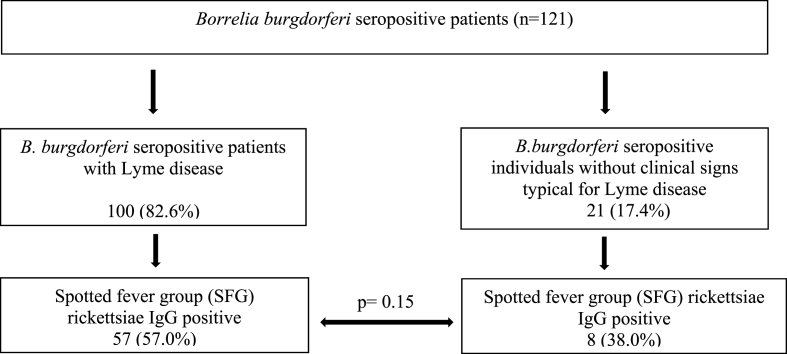
Indirect fluorescent antibody tests for SFG rickettsiae and were performed on serum samples of 121 seropositive patients with and without Lyme disease and 43 negative controls.
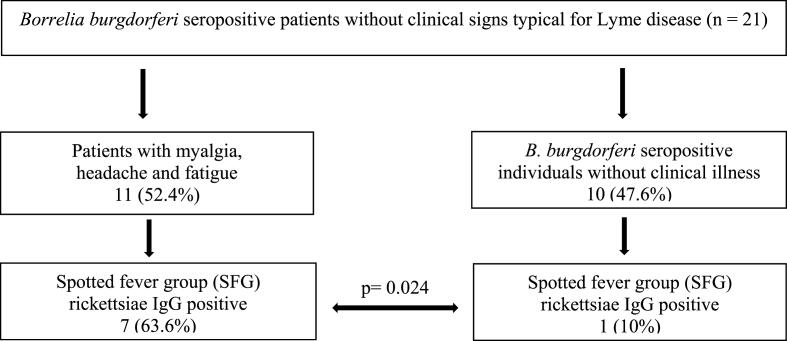
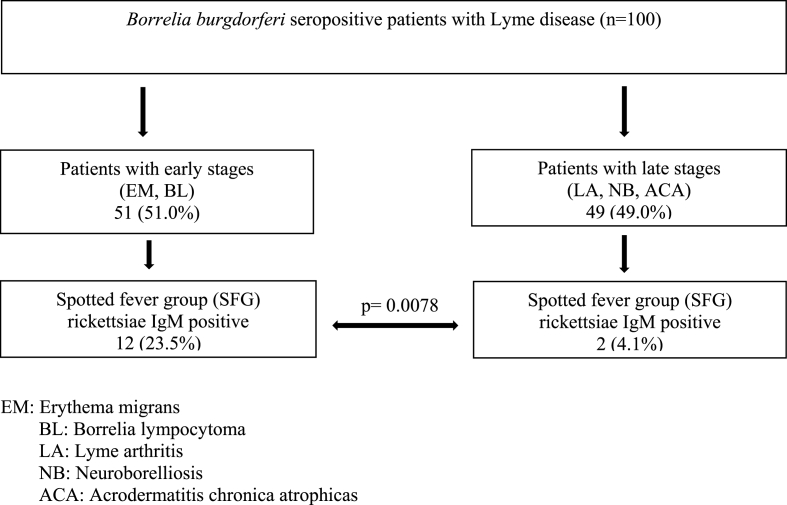
Out of 121 seropositive individuals, 65 (53.7%) were seropositive for IgG and 15 (12.4%) for IgM antibodies to SFG rickettsiae. IgM antibodies were detected more frequently in early-than in late-stage of Lyme disease (12 out of 51 and 2 out of 49; respectively; p = 0.0078). Significantly higher IgG antibody titers against SFG rickettsiae were found in patients with late-stage compared to patients with early-stage Lyme disease (mean titer 1:261 and 1:129, respectively; p = 0.038). This difference was even more pronounced in patients with acrodermatitis chronica atrophicans compared to patients with early stage of Lyme disease (mean titer 1:337 and 1:129, respectively; p = 0.009).In patients presenting with fatigue, headache and myalgia, the prevalence of IgG antibodies against SFG rickettsiae was significantly higher (7 out of 11; 63.6%) than in seropositive individuals without clinical illness (1 out of 10; 10%; p = 0.024). IgG antibodies to were detected in 12 out of 121 individuals (9.9%), no IgM antibodies were found.
Infections with SFG rickettsiae and are underdiagnosed and should be ruled out after a tick bite. Further studies are needed to elucidate the possible causative role of SFG rickettsiae for myalgia, headache and long-lasting fatigue after a tick bite and to determine the necessity for an antibiotic treatment.
蜱是瑞士蜱传脑炎病毒的主要传播媒介。瑞士蜱中已检测到斑点热群立克次体(SFG),然而,关于这些感染在人类中的感染程度和临床表现的信息却很少。
对121例莱姆病血清阳性和阴性患者以及43例阴性对照的血清样本进行SFG立克次体和[病原体名称未给出]的间接荧光抗体检测。
在121例血清阳性个体中,65例(53.7%)针对SFG立克次体的IgG抗体呈阳性,15例(12.4%)针对SFG立克次体的IgM抗体呈阳性。IgM抗体在莱姆病早期比晚期更频繁地被检测到(51例中有12例,49例中有2例;p = 0.0078)。与莱姆病早期患者相比,晚期患者中针对SFG立克次体的IgG抗体滴度显著更高(平均滴度分别为1:261和1:129;p = 0.038)。与莱姆病早期患者相比,在患有慢性萎缩性肢端皮炎的患者中这种差异甚至更明显(平均滴度分别为1:337和1:129;p = 0.009)。在出现疲劳、头痛和肌痛的患者中,针对SFG立克次体的IgG抗体的患病率显著高于无临床疾病的血清阳性个体(11例中有7例;63.6%比10例中有1例;10%;p = 0.024)。在121例个体中有12例(9.9%)检测到针对[病原体名称未给出]的IgG抗体,未发现IgM抗体。
SFG立克次体和[病原体名称未给出]感染的诊断不足,蜱叮咬后应排除这些感染。需要进一步研究以阐明SFG立克次体在蜱叮咬后肌痛、头痛和长期疲劳中可能的致病作用,并确定抗生素治疗的必要性。