
秀丽隐杆线虫近亲中特定发育阶段身体形状变化的相反方向
Opposing directions of stage-specific body shape change in a close relative of C. elegans.
作者信息
Hammerschmith Eric W, Woodruff Gavin C, Moser Kimberly A, Johnson Erik, Phillips Patrick C
机构信息
Institute of Ecology and Evolution, University of Oregon, Eugene, OR, USA.
Princeton Neuroscience Institute, Princeton University, Princeton, NJ, USA.
出版信息
BMC Zool. 2022 Jul 6;7(1):38. doi: 10.1186/s40850-022-00131-y.
BACKGROUND
Body size is a fundamental organismal trait. However, as body size and ecological contexts change across developmental time, evolutionary divergence may cause unexpected patterns of body size diversity among developmental stages. This may be particularly evident in polyphenic developmental stages specialized for dispersal. The dauer larva is such a stage in nematodes, and Caenorhabditis species disperse by traveling on invertebrate carriers. Here, we describe the morphology of a stress-resistant, dauer-like larval stage of the nematode Caenorhabditis inopinata, whose adults can grow to be nearly twice as long as its close relative, the model organism C. elegans.
RESULTS
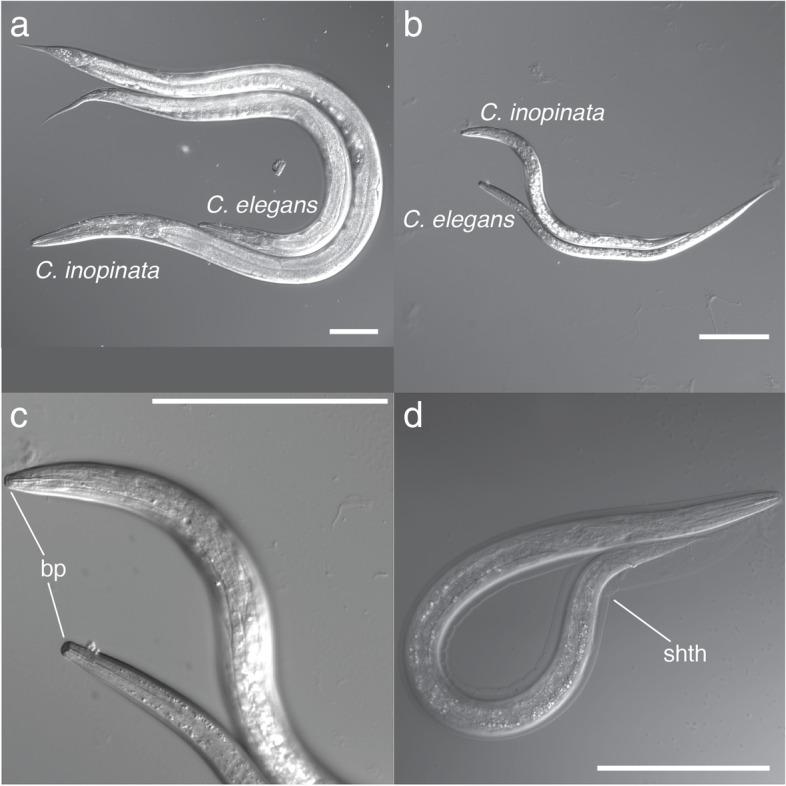
We find that a dauer-like, stress-resistant larval stage in two isolates of C. inopinata is on average 13% shorter and 30% wider than the dauer larvae of C. elegans, despite its much longer adult stage. Additionally, many C. inopinata dauer-like larvae were ensheathed, a possible novelty in this lineage reminiscent of the infective juveniles of parasitic nematodes. Variation in dauer-like larva formation frequency among twenty-four wild isolates of C. inopinata was also observed, although frequencies were low across all isolates (< 2%), with many isolates unable to produce dauer-like larvae under conventional laboratory conditions.
CONCLUSION
Most Caenorhabditis species thrive on rotting plants and disperse on snails, slugs, or isopods (among others) whereas C. inopinata is ecologically divergent and thrives in fresh Ficus septica figs and disperses on their pollinating wasps. While there is some unknown factor of the fig environment that promotes elongated body size in C. inopinata adults, the small size or unique life history of its fig wasp carrier may be driving the divergent morphology of its stress-resistant larval stages. Further characterization of the behavior, development, and morphology of this stage will refine connections to homologous developmental stages in other species and determine whether ecological divergence across multiple developmental stages can promote unexpected and opposing changes in body size dimensions within a single species.
背景
体型是生物体的一个基本特征。然而,随着体型和生态环境在发育过程中发生变化,进化分歧可能会导致发育阶段之间出现意想不到的体型多样性模式。这在专门用于扩散的多型发育阶段可能尤为明显。 dauer幼虫就是线虫中的这样一个阶段,秀丽隐杆线虫属物种通过搭乘无脊椎动物载体进行扩散。在此,我们描述了线虫新种秀丽隐杆线虫(Caenorhabditis inopinata)的一种抗逆性、类似dauer幼虫阶段的形态,其成虫体长几乎是其近缘模式生物秀丽隐杆线虫(C. elegans)的两倍。
结果
我们发现,新种秀丽隐杆线虫两个分离株中的类似dauer、抗逆性幼虫阶段平均比秀丽隐杆线虫的dauer幼虫短13%、宽30%,尽管其成虫阶段长得多。此外,许多新种秀丽隐杆线虫类似dauer的幼虫被包裹着,这在该谱系中可能是一个新特征,让人联想到寄生线虫的感染性幼虫。在新种秀丽隐杆线虫的24个野生分离株中也观察到了类似dauer幼虫形成频率的差异,尽管所有分离株中的频率都很低(<2%),许多分离株在常规实验室条件下无法产生类似dauer的幼虫。
结论
大多数秀丽隐杆线虫属物种在腐烂植物上生存,并通过蜗牛、蛞蝓或等足类动物(以及其他动物)进行扩散,而新种秀丽隐杆线虫在生态上有所不同,在新鲜的全缘榕无花果中生存,并通过其传粉黄蜂进行扩散。虽然无花果环境中存在一些未知因素促进了新种秀丽隐杆线虫成虫的体长增长,但其无花果黄蜂载体的小体型或独特生活史可能推动了其抗逆性幼虫阶段的形态差异。对这一阶段的行为、发育和形态进行进一步表征,将完善与其他物种同源发育阶段的联系,并确定多个发育阶段的生态分歧是否会促进单一物种内体型维度出现意想不到的相反变化。


 Zotero 插件