Department of Biology, Institute of Ecology and Evolution, University of Oregon, Eugene, USA.
BMC Evol Biol. 2019 Mar 11;19(1):74. doi: 10.1186/s12862-019-1388-1.
Variation in body size is thought to be a major driver of a wide variety of ecological and evolutionary patterns, including changes in development, reproduction, and longevity. Additionally, drastic changes in natural context often have profound effects on multiple fitness-related traits. Caenorhabditis inopinata is a recently-discovered fig-associated nematode that is unusually large relative to other members of the genus, including the closely related model system C. elegans. Here we test whether the dramatic increase in body size and shift in ecological context has led to correlated changes in key life history and developmental parameters within this species.
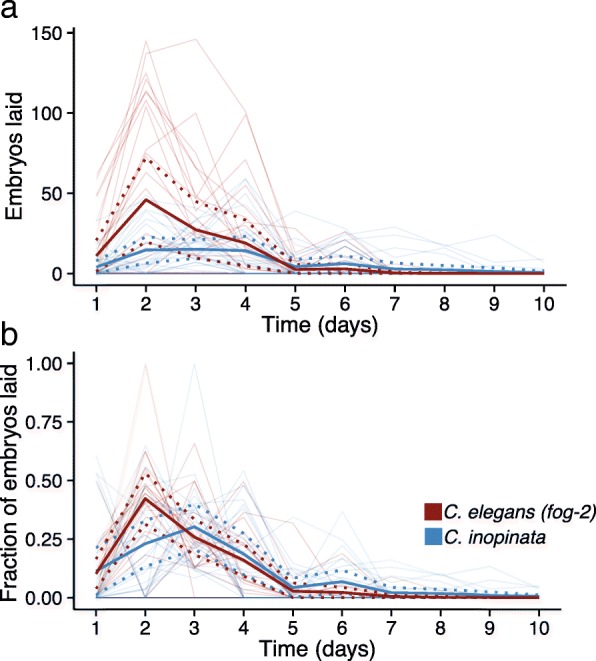
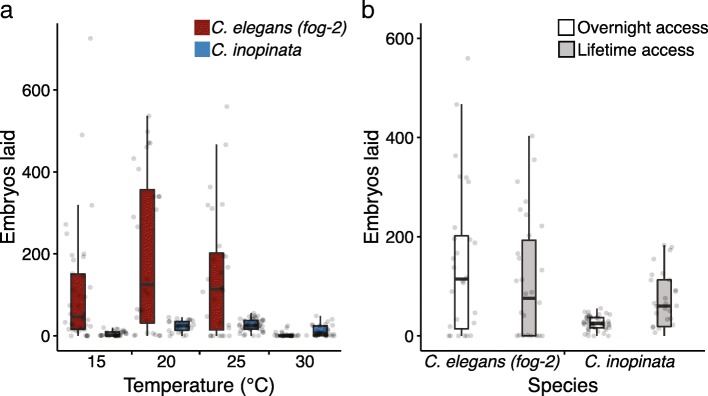
Using four developmental milestones, C. inopinata was found to have a slower rate of development than C. elegans across a range of temperatures. Despite this, C. inopinata did not reveal any differences in adult lifespan from C. elegans after accounting for differences in developmental timing and reproductive mode. C. inopinata fecundity was generally lower than that of C. elegans, but fitness improved under continuous-mating, consistent with sperm-limitation under gonochoristic (male/female) reproduction. C. inopinata also revealed greater fecundity and viability at higher temperatures.
Consistent with observations in other ectotherms, slower growth in C. inopinata indicates a potential trade-off between body size and developmental timing, whereas its unchanged lifespan suggests that longevity is largely uncoupled from its increase in body size. Additionally, temperature-dependent patterns of fitness in C. inopinata are consistent with its geographic origins in subtropical Okinawa. Overall, these results underscore the extent to which changes in ecological context and body size can shape life history traits.
体型的变化被认为是多种生态和进化模式的主要驱动因素,包括发育、繁殖和寿命的变化。此外,自然环境的剧烈变化通常会对多个与适应度相关的特征产生深远的影响。Caenorhabditis inopinata 是一种最近发现的与榕果共生的线虫,与该属的其他成员相比,尤其是与密切相关的模式生物 C. elegans 相比,它的体型异常庞大。在这里,我们测试了体型的急剧增加和生态环境的转变是否导致了该物种关键生活史和发育参数的相关变化。
使用四个发育里程碑,我们发现 C. inopinata 在一系列温度下的发育速度比 C. elegans 慢。尽管如此,在考虑到发育时间和生殖模式的差异后,C. inopinata 的成虫寿命与 C. elegans 没有任何差异。C. inopinata 的繁殖力通常低于 C. elegans,但在连续交配条件下,其繁殖力提高,这与雌雄异体(雄性/雌性)生殖中的精子限制一致。C. inopinata 在较高温度下也表现出更高的繁殖力和活力。
与其他变温动物的观察结果一致,C. inopinata 生长缓慢表明体型和发育时间之间存在潜在的权衡,而其寿命不变表明长寿与体型的增加在很大程度上是不相关的。此外,C. inopinata 适应度随温度的变化模式与其在亚热带冲绳的地理起源一致。总的来说,这些结果突出了生态环境和体型变化对生活史特征的影响程度。