Weyts Kathleen, Quak Elske, Licaj Idlir, Ciappuccini Renaud, Lasnon Charline, Corroyer-Dulmont Aurélien, Foucras Gauthier, Bardet Stéphane, Jaudet Cyril
Department of Nuclear Medicine, Baclesse Cancer Centre, 14076 Caen, France.
Department of Biostatistics, Baclesse Cancer Centre, 14076 Caen, France.
Diagnostics (Basel). 2023 May 4;13(9):1626. doi: 10.3390/diagnostics13091626.
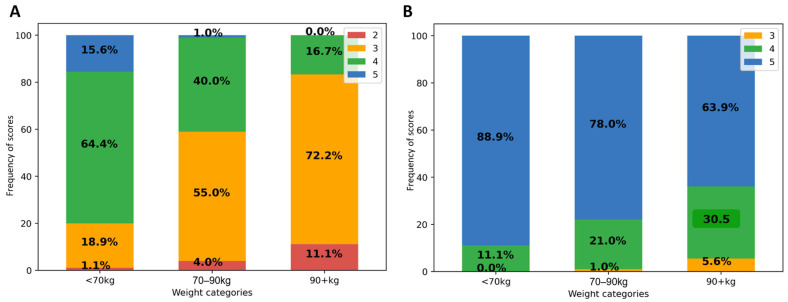
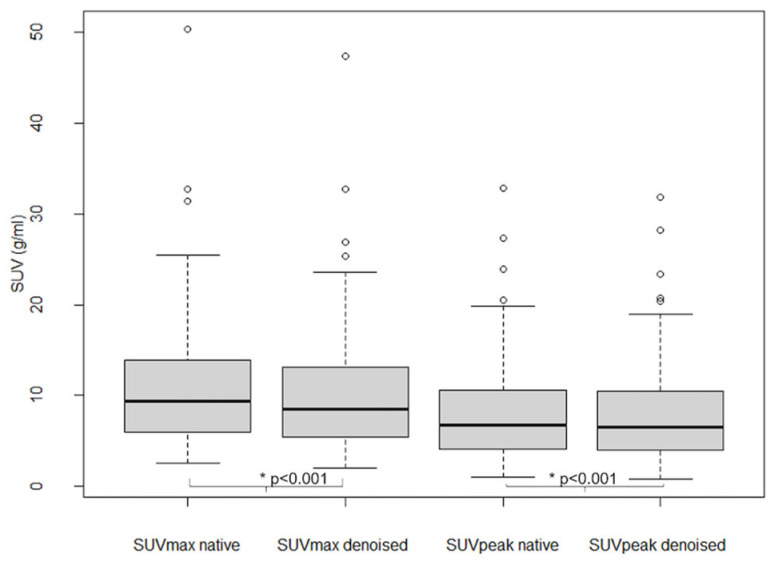
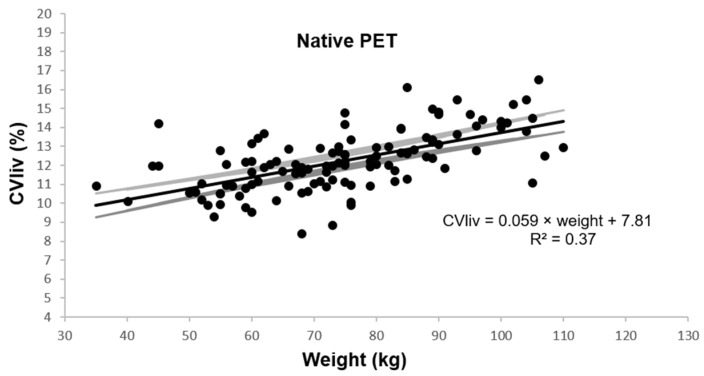
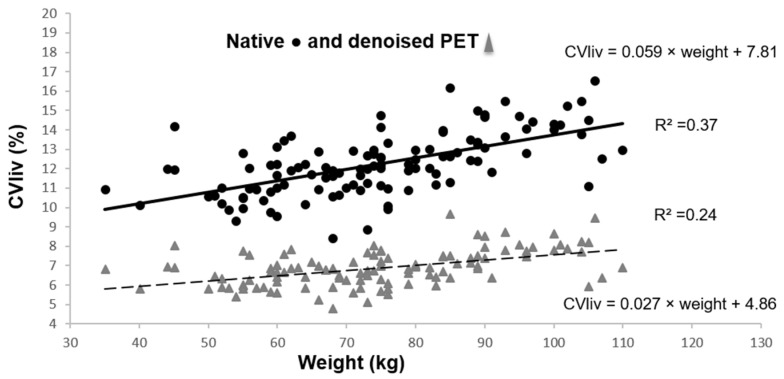
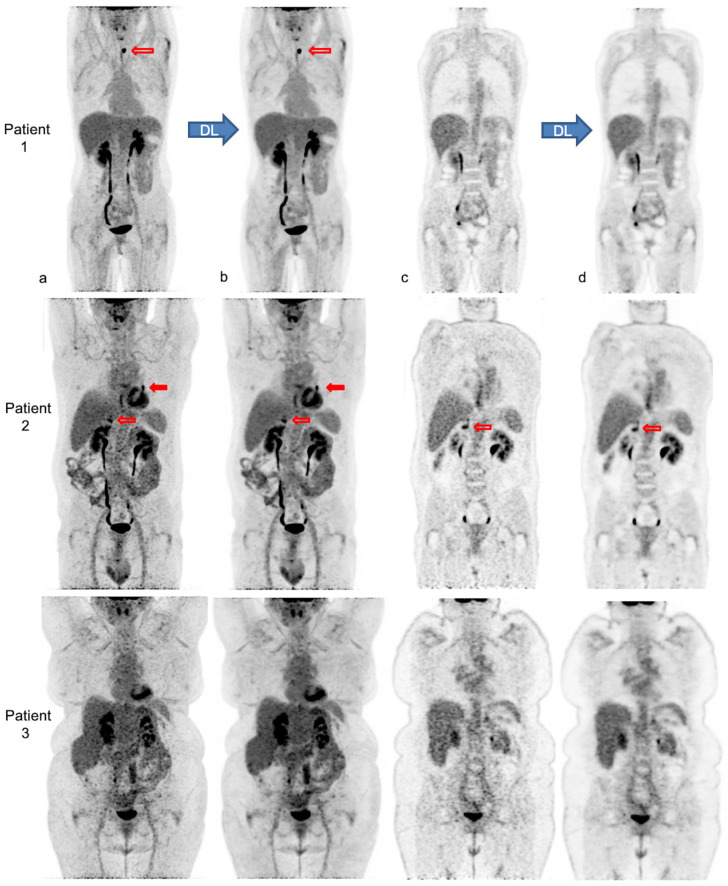
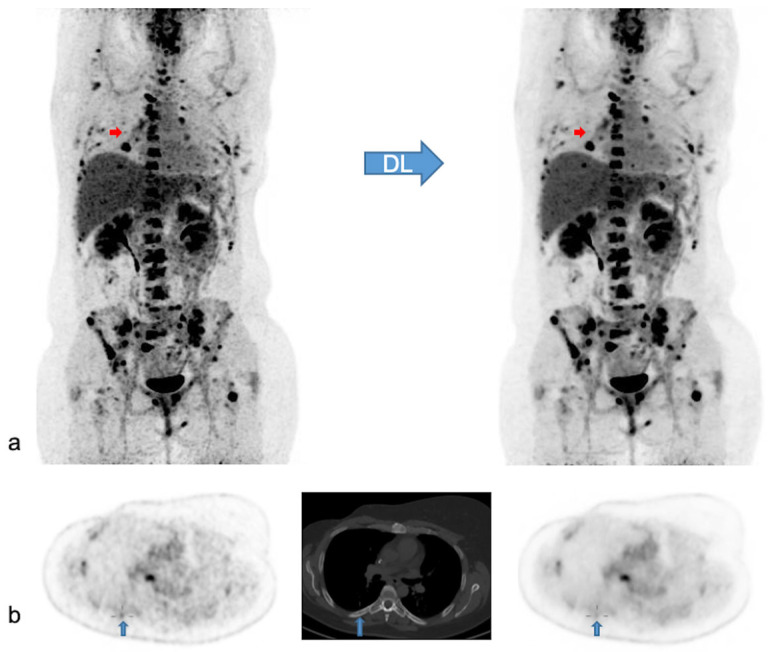
Given the constant pressure to increase patient throughput while respecting radiation protection, global body PET image quality (IQ) is not satisfactory in all patients. We first studied the association between IQ and other variables, in particular body habitus, on a digital PET/CT. Second, to improve and homogenize IQ, we evaluated a deep learning PET denoising solution (Subtle PET) using convolutional neural networks. We analysed retrospectively in 113 patients visual IQ (by a 5-point Likert score in two readers) and semi-quantitative IQ (by the coefficient of variation in the liver, CV) as well as lesion detection and quantification in native and denoised PET. In native PET, visual and semi-quantitative IQ were lower in patients with larger body habitus ( < 0.0001 for both) and in men vs. women ( ≤ 0.03 for CV). After PET denoising, visual IQ scores increased and became more homogeneous between patients (4.8 ± 0.3 in denoised vs. 3.6 ± 0.6 in native PET; < 0.0001). CV were lower in denoised PET than in native PET, 6.9 ± 0.9% vs. 12.2 ± 1.6%; < 0.0001. The slope calculated by linear regression of CV according to weight was significantly lower in denoised than in native PET ( = 0.0002), demonstrating more uniform CV. Lesion concordance rate between both PET series was 369/371 (99.5%), with two lesions exclusively detected in native PET. SUV and SUV of up to the five most intense native PET lesions per patient were lower in denoised PET ( < 0.001), with an average relative bias of -7.7% and -2.8%, respectively. DL-based PET denoising by Subtle PET allowed [F]FDG PET global image quality to be improved and homogenized, while maintaining satisfactory lesion detection and quantification. DL-based denoising may render body habitus adaptive PET protocols unnecessary, and pave the way for the improvement and homogenization of PET modalities.
在既要提高患者检查通量又要遵循辐射防护原则的持续压力下,全身PET图像质量(IQ)在所有患者中并不令人满意。我们首先在数字PET/CT上研究了IQ与其他变量之间的关联,特别是体型。其次,为了改善和统一IQ,我们评估了一种使用卷积神经网络的深度学习PET去噪解决方案(Subtle PET)。我们对113例患者进行回顾性分析,评估视觉IQ(由两名阅片者采用5分制李克特量表评分)和半定量IQ(通过肝脏变异系数,CV),以及原始PET和去噪PET中的病变检测与定量。在原始PET中,体型较大的患者视觉和半定量IQ较低(两者均<0.0001),男性与女性相比也是如此(CV≤0.03)。PET去噪后,视觉IQ评分提高且患者之间变得更加均匀(去噪PET中为4.8±0.3,原始PET中为3.6±0.6;<0.0001)。去噪PET中的CV低于原始PET,分别为6.9±0.9%和12.2±1.6%;<0.0001。根据体重通过线性回归计算的CV斜率在去噪PET中显著低于原始PET(=0.0002),表明CV更加均匀。两个PET系列之间的病变符合率为369/371(99.5%),有两个病变仅在原始PET中检测到。每位患者原始PET中强度最高的五个病变的SUV和SUV在去噪PET中较低(<0.001),平均相对偏差分别为-7.7%和-2.8%。通过Subtle PET进行基于深度学习的PET去噪可改善并统一[F]FDG PET全身图像质量,同时保持令人满意的病变检测与定量。基于深度学习的去噪可能使体型适应性PET协议变得不必要,并为PET模态的改善和统一铺平道路。