Department of Medicine I, University Hospital, LMU Munich, Munich, Germany; DZHK (German Center for Cardiovascular Research), partner site Munich Heart Alliance, Germany.
Department of Medicine I, University Hospital, LMU Munich, Munich, Germany; DZHK (German Center for Cardiovascular Research), partner site Munich Heart Alliance, Germany.
J Thromb Haemost. 2023 Aug;21(8):2020-2031. doi: 10.1016/j.jtha.2023.04.039. Epub 2023 May 11.
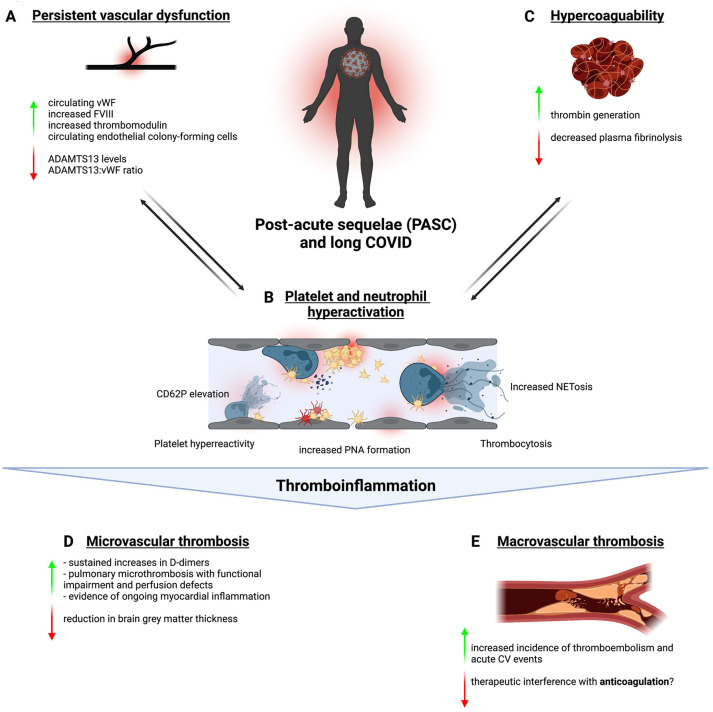
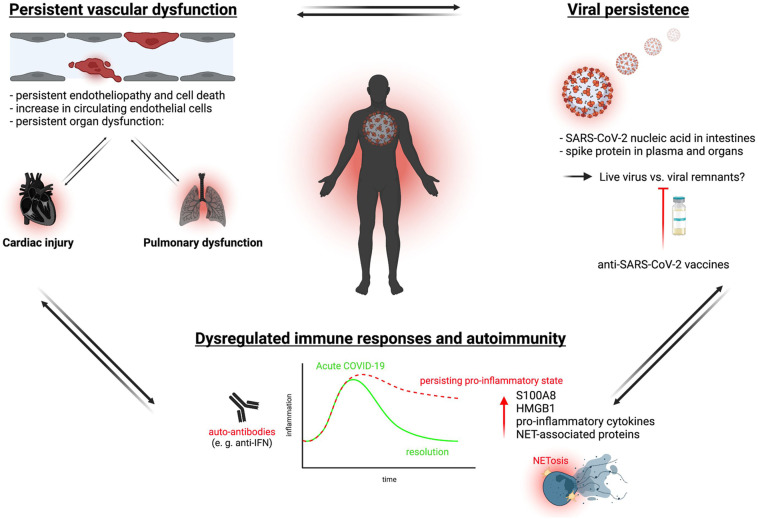
Long COVID is a public health emergency affecting millions of people worldwide, characterized by heterogeneous symptoms across multiple organ systems. Here, we discuss the current evidence linking thromboinflammation to postacute sequelae of COVID-19. Studies have found persistence of vascular damage with increased circulating markers of endothelial dysfunction, coagulation abnormalities with heightened thrombin generation capacity, and abnormalities in platelet counts in postacute sequelae of COVID-19. Neutrophil phenotype resembles acute COVID-19 with an increase in activation and Neutrophil Extracellular Trap formation. These insights are potentially linked by elevated platelet-neutrophil aggregate formation. This hypercoagulable state in turn can lead to microvascular thrombosis, evidenced by microclots and elevated D-dimer in the circulation as well as perfusion abnormalities in the lungs and brains of patients with long COVID. Also, COVID-19 survivors experience an increased rate of arterial and venous thrombotic events. We discuss 3 important, potentially intertwined hypotheses that might contribute to thromboinflammation in long COVID: lasting structural changes, most prominently endothelial damage, caused during initial infection; a persistent viral reservoir; and immunopathology driven by a misguided immune system. Finally, we outline the necessity for large, well-characterized clinical cohorts and mechanistic studies to clarify the contribution of thromboinflammation to long COVID.
长新冠是一种影响全球数百万人的公共卫生紧急情况,其特征是多种器官系统出现异质症状。在这里,我们讨论了将血栓炎症与 COVID-19 后急性后遗症联系起来的现有证据。研究发现,血管损伤持续存在,内皮功能障碍的循环标志物增加,凝血异常伴凝血酶生成能力升高,以及 COVID-19 后急性后遗症血小板计数异常。中性粒细胞表型与急性 COVID-19 相似,其激活和中性粒细胞细胞外陷阱形成增加。这些见解可能与血小板-中性粒细胞聚集的升高有关。这种高凝状态反过来又会导致微血管血栓形成,这在循环中微血栓和 D-二聚体升高以及 COVID-19 长新冠患者肺部和大脑灌注异常中得到了证明。此外,COVID-19 幸存者经历动脉和静脉血栓形成事件的风险增加。我们讨论了 3 个可能导致长新冠血栓炎症的重要、潜在相互交织的假设:在初始感染期间持续存在的结构变化,最突出的是内皮损伤;持续存在的病毒库;以及由免疫系统错误导向引起的免疫病理学。最后,我们概述了需要大型、特征明确的临床队列和机制研究来阐明血栓炎症对长新冠的贡献。