Fredericson Michael, Roche Megan, Barrack Michelle T, Tenforde Adam, Sainani Kristin, Kraus Emily, Kussman Andrea, Miller Olson Emily, Kim Brian Young, Fahy Katherine, Miller Emily, Diamond Ellie, Meraz Sonya, Singh Sonal, Nattiv Aurelia
Department of Orthopaedic Surgery, Division of Physical Medicine & Rehabilitation, Stanford University, Stanford, California, USA.
Department of Epidemiology, Stanford Hospital and Clinics, Stanford, California, USA.
BMJ Open Sport Exerc Med. 2023 May 8;9(2):e001545. doi: 10.1136/bmjsem-2023-001545. eCollection 2023.
We evaluated the effect of a nutrition education intervention on bone stress injury (BSI) incidence among female distance runners at two NCAA Division I institutions.
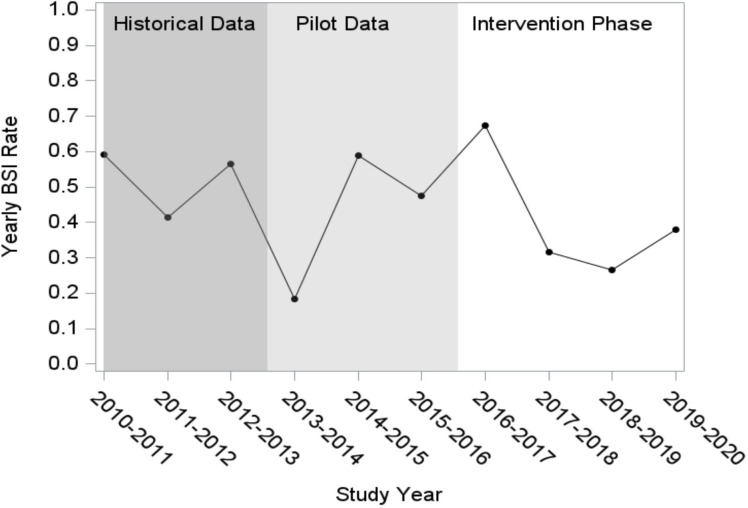
Historical BSI rates were measured retrospectively (2010-2013); runners were then followed prospectively in pilot (2013-2016) and intervention (2016-2020) phases. The primary aim was to compare BSI rates in the historical and intervention phases. Pilot phase data are included only for descriptive purposes. The intervention comprised team nutrition presentations focused on optimising energy availability plus individualised nutrition sessions for runners with elevated Female Athlete Triad risk. Annual BSI rates were calculated using a generalised estimating equation Poisson regression model adjusted for age and institution. Post hoc analyses were stratified by institution and BSI type (trabecular-rich or cortical-rich).
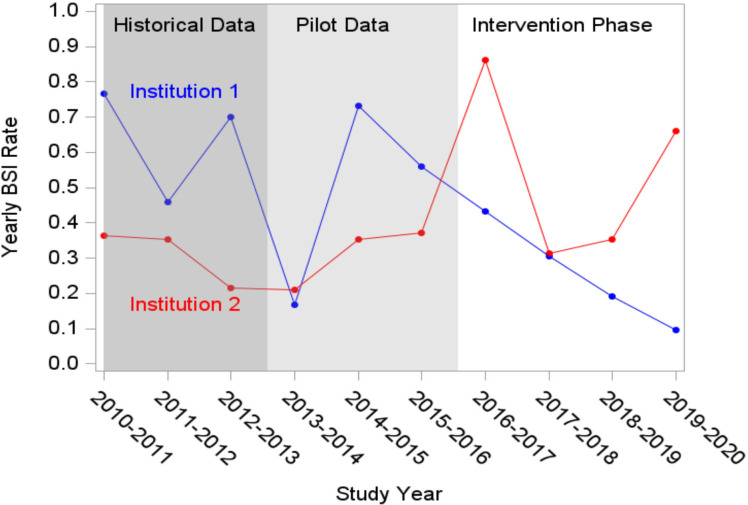
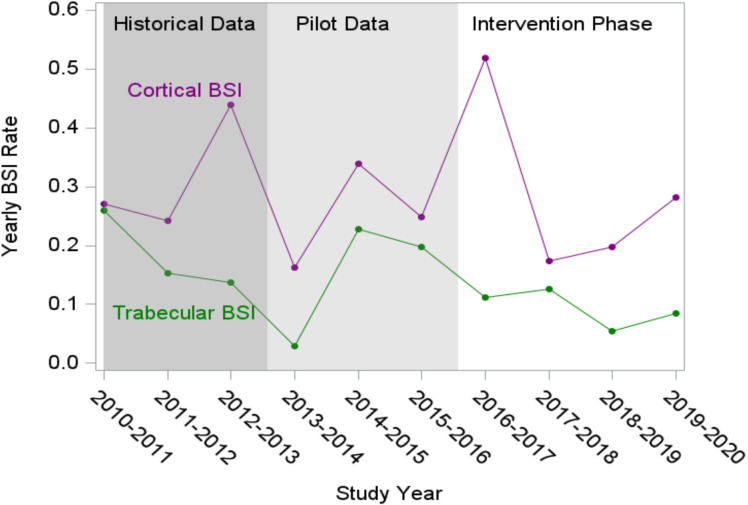
The historical phase included 56 runners and 90.2 person-years; the intervention phase included 78 runners and 137.3 person-years. Overall BSI rates were not reduced from the historical (0.52 events per person-year) to the intervention (0.43 events per person-year) phase. Post hoc analyses demonstrated trabecular-rich BSI rates dropped significantly from 0.18 to 0.10 events per person-year from the historical to intervention phase (p=0.047). There was a significant interaction between phase and institution (p=0.009). At Institution 1, the overall BSI rate dropped from 0.63 to 0.27 events per person-year from the historical to intervention phase (p=0.041), whereas no decline was observed at Institution 2.
Our findings suggest that a nutrition intervention emphasising energy availability may preferentially impact trabecular-rich BSI and depend on team environment, culture and resources.
我们评估了营养教育干预对两所美国大学体育协会(NCAA)一级机构中女子长跑运动员骨应力损伤(BSI)发生率的影响。
回顾性测量历史BSI发生率(2010 - 2013年);然后在试点阶段(2013 - 2016年)和干预阶段(2016 - 2020年)对运动员进行前瞻性跟踪。主要目的是比较历史阶段和干预阶段的BSI发生率。试点阶段的数据仅用于描述目的。干预措施包括针对优化能量供应的团队营养讲座,以及为女性运动员三联征风险升高的跑步者提供个性化营养课程。使用经年龄和机构调整的广义估计方程泊松回归模型计算年度BSI发生率。事后分析按机构和BSI类型(富含小梁或富含皮质)进行分层。
历史阶段包括56名跑步者,共90.2人年;干预阶段包括78名跑步者,共137.3人年。总体BSI发生率从历史阶段(每人年0.52例)到干预阶段(每人年0.43例)并未降低。事后分析表明,富含小梁的BSI发生率从历史阶段到干预阶段显著下降,从每人年0.18例降至0.10例(p = 0.047)。阶段和机构之间存在显著交互作用(p = 0.009)。在机构1,总体BSI发生率从历史阶段到干预阶段从每人年0.63例降至0.27例(p = 0.041),而在机构2未观察到下降。
我们的研究结果表明,强调能量供应的营养干预可能会优先影响富含小梁的BSI,并且取决于团队环境、文化和资源。