Carbuhn Aaron F, Yu Daniel, Magee Lawrence M, McCulloch Patrick C, Lambert Bradley S
Department of Dietetics and Nutrition, University of Kansas Medical Center, Kansas City, Kansas, USA.
Kansas Team Health, Kansas Athletics Inc, Lawrence, Kansas, USA.
Orthop J Sports Med. 2022 Feb 10;10(2):23259671211070308. doi: 10.1177/23259671211070308. eCollection 2022 Feb.
Lower limb bone stress injury (BSI) of the pelvis, femur, and tibia is prevalent in collegiate track and field distance runners. Bone mineral density (BMD), body composition (BComp), and anthropometric parameters before initial collegiate injury have not been compared between runners with BSI and their noninjured counterparts.
To characterize bone health in relation to BComp and anthropometric measurements from total-body dual x-ray absorptiometry (DXA) scans in collegiate male and female distance runners before BSI and develop BMD prediction models.
Case-control study; Level of evidence, 3.
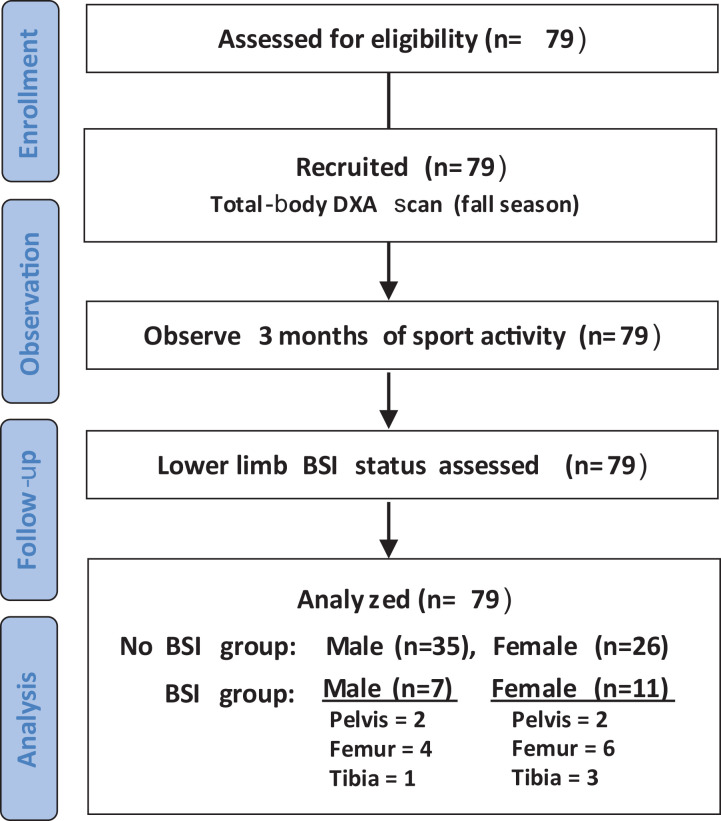
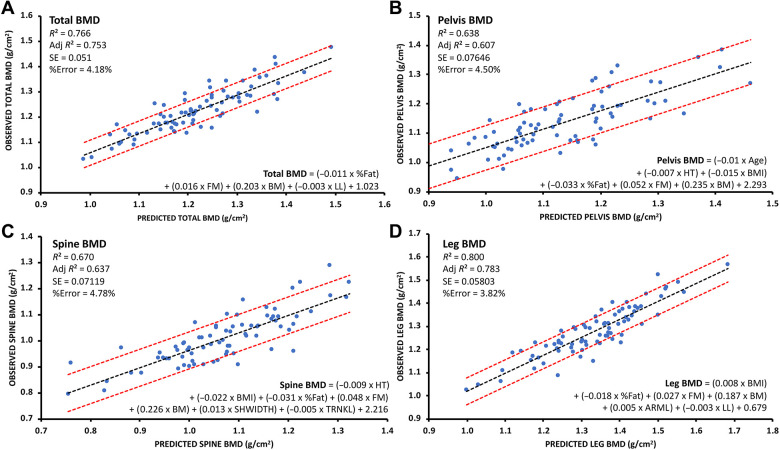
Distance runners (N = 79) from a single university track and field team were retrospectively enrolled into this study. The runners completed a DXA scan during the fall season (August-November) and participated in sport activities before the scan. Three months after scanning, electronic medical records were reviewed for the occurrence of BSI. An independent-sample test was used to compare BMD (total and regional [spine, pelvis, and legs]), BComp (% body fat, fat mass, and lean mass), and anthropometric measurements (shoulder width and leg, arm, and trunk length) between runners with versus without BSI (included subgroup analysis by sex). Multiple linear regression with stepwise removal was used to determine variables most predictive of BMD.
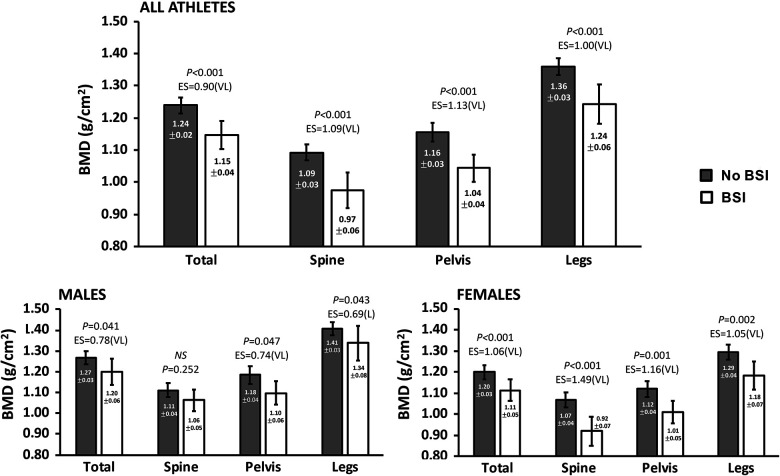
Of the 79 enrolled participants (42 male, 37 female), 18 runners (22.8%; 11 female, 7 male) sustained a lower limb BSI. Compared with the noninjured group, injured runners had lower total and regional BMD ( < .001 for all) and shorter leg and arm lengths ( < .05 for both), whereas injured male runners had lower fat mass and injured female runners had lower lean mass in the legs ( < .05 for both). Injured runners' age-matched total BMD score (-0.1 ± 0.6) was considered clinically normal. BComp and anthropometric measures were predictive of total and regional BMD ( < .05; = 0.64-0.80; percentage error = 3.8%-4.8%).
The DXA scans of injured runners prior to incidence indicated lower BMD compared with noninjured runners. Shorter limb lengths, lower fat mass (male), and lower leg lean mass (female) may also be indicative of risk. Certain BComp and anthropometric measures were predictive of BMD.
骨盆、股骨和胫骨的下肢骨应力损伤(BSI)在大学田径长跑运动员中很常见。初始大学损伤前的骨矿物质密度(BMD)、身体成分(BComp)和人体测量参数在患有BSI的跑步者与其未受伤的同龄人之间尚未进行比较。
描述大学男女长跑运动员在发生BSI之前,通过全身双能X线吸收法(DXA)扫描获得的与BComp和人体测量相关的骨骼健康状况,并建立BMD预测模型。
病例对照研究;证据等级,3级。
对来自单一大学田径队的长跑运动员(N = 79)进行回顾性纳入本研究。跑步者在秋季(8月至11月)完成了一次DXA扫描,并在扫描前参加了体育活动。扫描后三个月,查阅电子病历以了解BSI的发生情况。使用独立样本t检验比较患有和未患有BSI的跑步者之间的BMD(全身和区域[脊柱、骨盆和腿部])、BComp(体脂百分比、脂肪量和瘦体重)和人体测量指标(肩宽以及腿、手臂和躯干长度)(包括按性别进行亚组分析)。采用逐步剔除的多元线性回归来确定最能预测BMD的变量。
在79名纳入的参与者中(42名男性,37名女性),18名跑步者(22.8%;11名女性,7名男性)发生了下肢BSI。与未受伤组相比,受伤的跑步者全身和区域BMD较低(所有P < .001),腿和手臂长度较短(两者P < .05),而受伤的男性跑步者脂肪量较低,受伤的女性跑步者腿部瘦体重较低(两者P < .05)。受伤跑步者年龄匹配的全身BMD z评分(-0.1 ± 0.6)被认为在临床上是正常的。BComp和人体测量指标可预测全身和区域BMD(P < .05;R² = 0.64 - 0.80;百分比误差 = 3.8% - 4.8%)。
受伤跑步者在发病前的DXA扫描显示其BMD低于未受伤的跑步者。较短的肢体长度、较低的脂肪量(男性)和较低的腿部瘦体重(女性)也可能表明存在风险。某些BComp和人体测量指标可预测BMD。