Lalani Baqir, Gray Steven, Mitra-Ganguli Tora
Natural Resources Institute, University of Greenwich, Chatham Maritime, United Kingdom.
Department of Community Sustainability, Michigan State University, East Lansing, MI, United States.
Front Integr Neurosci. 2023 Apr 27;17:1145744. doi: 10.3389/fnint.2023.1145744. eCollection 2023.
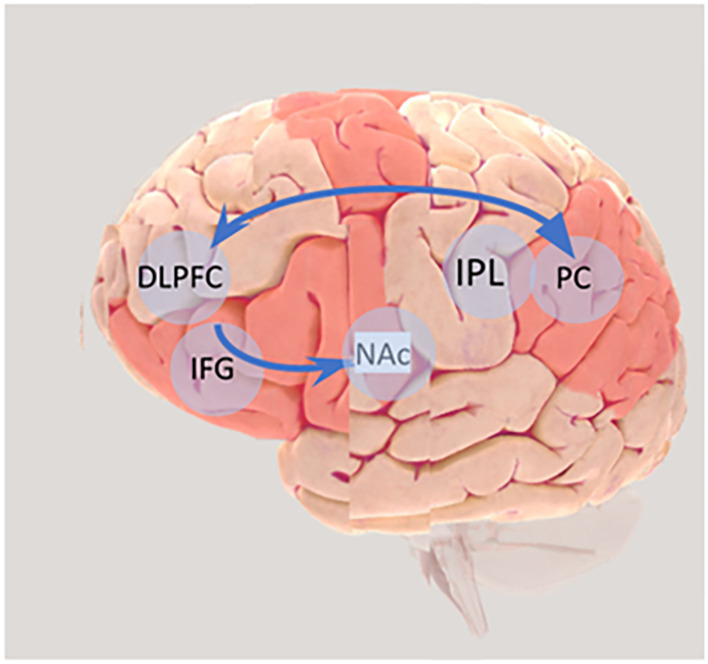
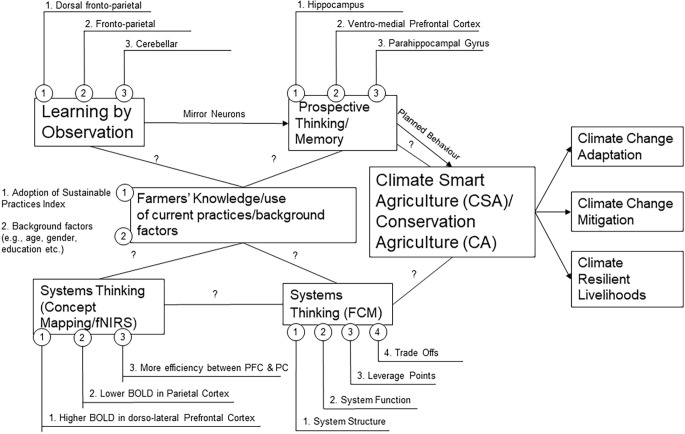
Systems Thinking (ST) can be defined as a mental construct that recognises patterns and connections in a particular complex system to make the "best decision" possible. In the field of sustainable agriculture and climate change, higher degrees of ST are assumed to be associated with more successful adaptation strategies under changing conditions, and "better" environmental decision making in a number of environmental and cultural settings. Future climate change scenarios highlight the negative effects on agricultural productivity worldwide, particularly in low-income countries (LICs) situated in the Global South. Alongside this, current measures of ST are limited by their reliance on recall, and are prone to possible measurement errors. Using Climate-Smart Agriculture (CSA), as an example case study, in this article we explore: (i) ST from a social science perspective; (ii) cognitive neuroscience tools that could be used to explore ST abilities in the context of LICs; (iii) an exploration of the possible correlates of systems thinking: observational learning, prospective thinking/memory and the theory of planned behaviour and (iv) a proposed theory of change highlighting the integration of social science frameworks and a cognitive neuroscience perspective. We find, recent advancements in the field of cognitive neuroscience such as Near-Infrared Spectroscopy (NIRS) provide exciting potential to explore previously hidden forms of cognition, especially in a low-income country/field setting; improving our understanding of environmental decision-making and the ability to more accurately test more complex hypotheses where access to laboratory studies is severely limited. We highlight that ST may correlate with other key aspects involved in environmental decision-making and posit motivating farmers specific brain networks would: (a) enhance understanding of CSA practices (e.g., the frontoparietal network extending from the dorsolateral prefrontal cortex (DLPFC) to the parietal cortex (PC) a control hub involved in ST and observational learning) such as tailoring training towards developing improved ST abilities among farmers and involving observational learning more explicitly and (b) motivate farmers to use such practices [e.g., the network between the DLPFC and nucleus accumbens (NAc)] which mediates reward processing and motivation by focussing on a reward/emotion to engage farmers. Finally, our proposed interdisciplinary theory of change can be used as a starting point to encourage discussion and guide future research in this space.
系统思维(ST)可被定义为一种思维架构,它能识别特定复杂系统中的模式与联系,以做出尽可能“最佳的决策”。在可持续农业和气候变化领域,人们认为更高程度的系统思维与在变化条件下更成功的适应策略相关联,并且在一些环境和文化背景中能做出“更好的”环境决策。未来气候变化情景凸显了对全球农业生产力的负面影响,尤其是对位于全球南方的低收入国家(LICs)。与此同时,当前系统思维的衡量方法因依赖回忆而受到限制,并且容易出现测量误差。以气候智能型农业(CSA)为例进行案例研究,在本文中我们探讨:(i)从社会科学角度看系统思维;(ii)可用于在低收入国家背景下探索系统思维能力的认知神经科学工具;(iii)对系统思维可能的相关因素的探索:观察性学习、前瞻性思维/记忆以及计划行为理论;(iv)提出一种变革理论,强调社会科学框架与认知神经科学视角的整合。我们发现,认知神经科学领域的最新进展,如近红外光谱(NIRS),为探索以前隐藏的认知形式提供了令人兴奋的潜力,特别是在低收入国家/实地环境中;有助于增进我们对环境决策的理解,以及在实验室研究获取严重受限的情况下更准确地检验更复杂假设的能力。我们强调,系统思维可能与环境决策中涉及的其他关键方面相关联,并假定激发农民特定的脑网络会:(a)增强对气候智能型农业实践的理解(例如,从前额顶叶网络,从背外侧前额叶皮层(DLPFC)延伸到顶叶皮层(PC),这是一个参与系统思维和观察性学习的控制枢纽),比如针对提高农民的系统思维能力来调整培训,并更明确地纳入观察性学习;(b)激励农民采用此类实践[例如,DLPFC和伏隔核(NAc)之间的网络],该网络通过关注奖励/情感来调节奖励处理和动机,从而促使农民参与进来。最后,我们提出的跨学科变革理论可作为一个起点,鼓励在此领域进行讨论并指导未来研究。