Dr. Phillip Frost Department of Dermatology & Cutaneous Surgery, University of Miami Miller School of Medicine, Miami, FL 33136, USA.
Curr Oncol. 2023 Mar 25;30(4):3609-3626. doi: 10.3390/curroncol30040275.
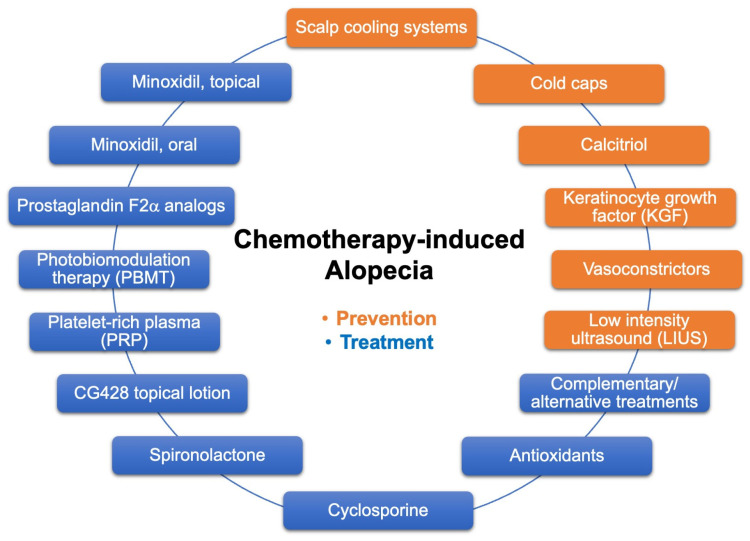
Millions of new cancer patients receive chemotherapy each year. In addition to killing cancer cells, chemotherapy is likely to damage rapidly proliferating healthy cells, including the hair follicle keratinocytes. Chemotherapy causes substantial thinning or loss of hair, termed chemotherapy-induced alopecia (CIA), in approximately 65% of patients. CIA is often ranked as one of the most distressing adverse effects of chemotherapy, but interventional options have been limited. To date, only scalp cooling has been cleared by the US Food and Drug Administration (FDA) to prevent CIA. However, several factors, including the high costs not always covered by insurance, preclude its broader use. Here we review the current options for CIA prevention and treatment and discuss new approaches being tested. CIA interventions include scalp cooling systems (both non-portable and portable) and topical agents to prevent hair loss, versus topical and oral minoxidil, photobiomodulation therapy (PBMT), and platelet-rich plasma (PRP) injections, among others, to stimulate hair regrowth after hair loss. Evidence-based studies are needed to develop and validate methods to prevent hair loss and/or accelerate hair regrowth in cancer patients receiving chemotherapy, which could significantly improve cancer patients' quality of life and may help improve compliance and consequently the outcome of cancer treatment.
每年都有数百万新的癌症患者接受化疗。除了杀死癌细胞外,化疗还可能损伤快速增殖的健康细胞,包括毛囊角质形成细胞。大约 65%的患者会因化疗而出现大量脱发或头发稀疏,即化疗引起的脱发(CIA)。CIA 通常被列为化疗最令人痛苦的不良反应之一,但干预选择有限。迄今为止,只有头皮冷却技术已被美国食品和药物管理局(FDA)批准用于预防 CIA。然而,包括保险不涵盖的高昂费用在内的多种因素限制了其更广泛的应用。本文综述了 CIA 的预防和治疗的现有选择,并讨论了正在测试的新方法。CIA 的干预措施包括头皮冷却系统(非便携式和便携式)和预防脱发的局部制剂,以及米诺地尔的局部和口服制剂、光生物调节疗法(PBMT)和富血小板血浆(PRP)注射等,以促进脱发后头发再生。需要进行基于证据的研究,以开发和验证预防化疗患者脱发和/或加速头发生长的方法,这可以显著提高癌症患者的生活质量,并可能有助于提高依从性,从而改善癌症治疗的结果。