Alhamed Arwa A
College of Nursing, King Saud bin Abdulaziz University for Health Sciences, Prince Mutip Ibn Abdullah Ibn Abdulaziz Rd, Ar Rimayah, Riyadh 14611, Saudi Arabia.
J Prof Nurs. 2023 May-Jun;46:83-91. doi: 10.1016/j.profnurs.2023.02.010. Epub 2023 Mar 17.
The rapid shift to virtual learning in response to the COVID-19 pandemic contributed to high academic stress among health profession students. High academic stress was associated with impaired psychosocial well-being and decreased academic performance.
The purpose of this study was to assess the relationship between academic stress, anxiety, sleep disturbances, depressive symptoms, academic performance, and the moderating effect of resourcefulness among undergraduate health profession students.
This descriptive and cross-sectional study included undergraduate health profession students. The primary investigator distributed the study link to all students through the university's Central Messaging Centre, Twitter account, and WhatsApp. The study variables were measured using the Student Life Stress Inventory, the Generalized Anxiety Disorder-7 questionnaire, the Centre for Epidemiology Scale of Depression, the Pittsburgh Sleep Quality Index, and the Resourcefulness Skills Scale. Pearson R correlation and linear regression analysis were utilized for statistical analysis.
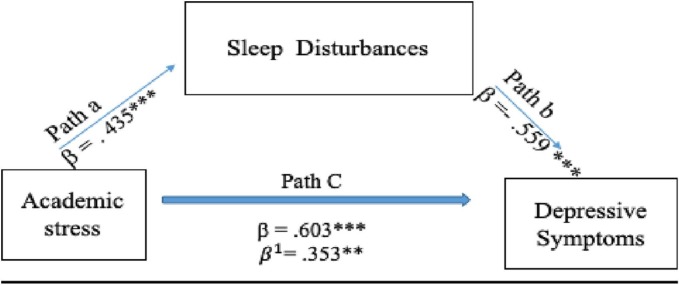
Our sample included 94 undergraduate health profession students, 60 % of which were females with a mean age of 21, and the majority were nursing and medicine students. High academic stress, anxiety, sleep disturbances, depressive symptoms, and resourcefulness were reported among 50.6 %, 43 %, 79.6 %, 60.2 %, and 60 % of the participants, respectively. However, no effect of resourcefulness was found on any of the study variables. Instead, academic stress and sleep disturbances were the strongest predictors of depressive symptoms regardless of the level of resourcefulness.
Adequate academic support during virtual learning and tools to early detect subtle signs of high academic stress, anxiety, depression, and sleep disturbance should be routinely utilized by educational institutions. In addition, incorporating sleep hygiene and resourcefulness training in health professions education is highly indicated.
为应对新冠疫情而迅速转向虚拟学习,这给健康专业学生带来了很高的学业压力。高学业压力与心理社会幸福感受损和学业成绩下降有关。
本研究旨在评估本科健康专业学生的学业压力、焦虑、睡眠障碍、抑郁症状、学业成绩之间的关系,以及足智多谋能力的调节作用。
这项描述性横断面研究纳入了本科健康专业学生。主要研究者通过大学的中央信息中心、推特账号和WhatsApp向所有学生分发了研究链接。使用学生生活压力量表、广泛性焦虑障碍-7问卷、流行病学抑郁量表、匹兹堡睡眠质量指数和足智多谋技能量表来测量研究变量。采用Pearson R相关性分析和线性回归分析进行统计分析。
我们的样本包括94名本科健康专业学生,其中60%为女性,平均年龄21岁,大多数是护理和医学专业学生。分别有50.6%、43%、79.6%、60.2%和60%的参与者报告有高学业压力、焦虑、睡眠障碍、抑郁症状和足智多谋能力。然而,未发现足智多谋能力对任何研究变量有影响。相反,无论足智多谋能力水平如何,学业压力和睡眠障碍都是抑郁症状的最强预测因素。
教育机构应常规利用虚拟学习期间的充分学业支持以及早期发现高学业压力、焦虑、抑郁和睡眠障碍细微迹象的工具。此外,强烈建议在健康专业教育中纳入睡眠卫生和足智多谋能力培训。