Pérez-Calatayud Angel Augusto, Hofmann Axel, Pérez-Ferrer Antonio, Escorza-Molina Carla, Torres-Pérez Bettina, Zaccarias-Ezzat Jed Raful, Sanchez-Cedillo Aczel, Manuel Paez-Zayas Victor, Carrillo-Esper Raul, Görlinger Klaus
Critical Care Division, Hospital General de México Dr. Eduardo Liceaga, Mexico City 06720, Mexico.
Faculty of Health and Medical Sciences, Discipline of Surgery, The University of Western Australia, Perth 6907, WA, Australia.
Biomedicines. 2023 Apr 4;11(4):1093. doi: 10.3390/biomedicines11041093.
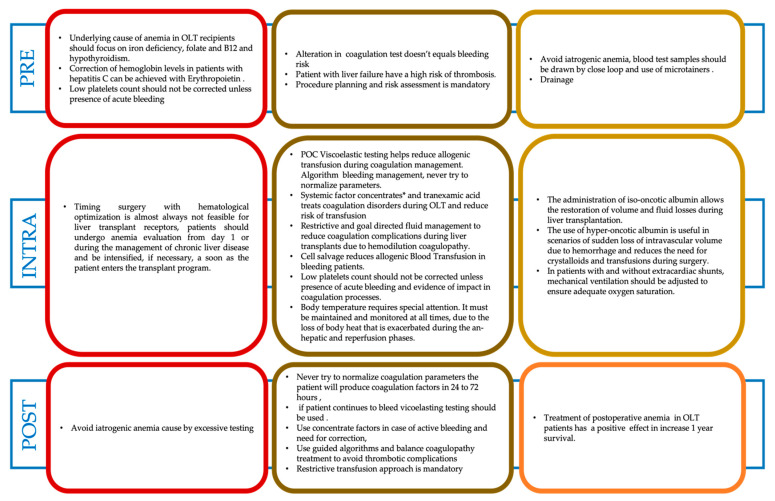
Transfusion of blood products in orthotopic liver transplantation (OLT) significantly increases post-transplant morbidity and mortality and is associated with reduced graft survival. Based on these results, an active effort to prevent and minimize blood transfusion is required. Patient blood management is a revolutionary approach defined as a patient-centered, systematic, evidence-based approach to improve patient outcomes by managing and preserving a patient's own blood while promoting patient safety and empowerment. This approach is based on three pillars of treatment: (1) detecting and correcting anemia and thrombocytopenia, (2) minimizing iatrogenic blood loss, detecting, and correcting coagulopathy, and (3) harnessing and increasing anemia tolerance. This review emphasizes the importance of the three-pillar nine-field matrix of patient blood management to improve patient outcomes in liver transplant recipients.
原位肝移植(OLT)中输血制品会显著增加移植后发病率和死亡率,并与移植物存活率降低相关。基于这些结果,需要积极努力预防并尽量减少输血。患者血液管理是一种革命性方法,被定义为以患者为中心、系统的、循证的方法,通过管理和保存患者自身血液,同时促进患者安全和自主权,来改善患者预后。这种方法基于三个治疗支柱:(1)检测并纠正贫血和血小板减少症;(2)尽量减少医源性失血,检测并纠正凝血功能障碍;(3)利用并提高贫血耐受性。本综述强调患者血液管理的三支柱九领域矩阵对于改善肝移植受者患者预后的重要性。