You Zhenwu, Wang Meng, He Zhiwu
School of Journalism and Information Communication, Huazhong University of Science and Technology, Wuhan, Hubei Province, People's Republic of China.
Risk Manag Healthc Policy. 2023 May 9;16:833-849. doi: 10.2147/RMHP.S407534. eCollection 2023.
During the ongoing COVID-19 pandemic, the resident's WeChat group has created a new material foundation for dialogue to occur and become a powerful platform for resident communication. This study explores the mechanism behind and the effects of residents' WeChat group use on residents' community trust, community attachment, and pro-community behavior.
An online survey questionnaire was used for data collection. The authors collected data from 500 commercial housing community residents in Wuhan, China, and analyzed the data using SPSS 26.0 and Mplus 8.3 software.
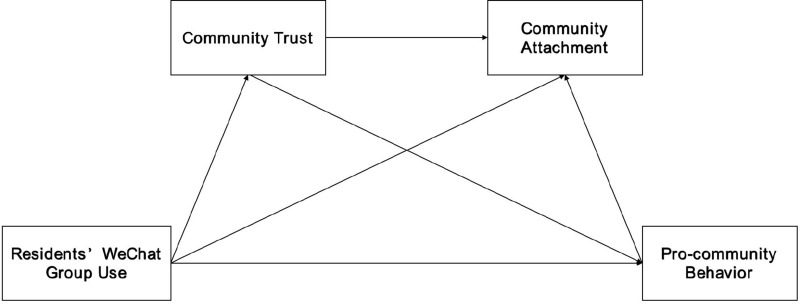
This study's findings uncover that (1) residents' usage of WeChat groups has a statistically significant and positive impact on their community trust, community attachment, and pro-community behavior; (2) community trust and community attachment both play a mediating role in the mechanism behind residents' usage of WeChat groups in improving pro-community behavior; and (3) the transmission and united effects between community trust and community attachment form a distal mediating role.
The model systematically and comprehensively reveals the internal mechanism behind residents' adoption of pro-community behavior. Community managers can actively participate in the resident's WeChat group to ensure the dissemination of positive information in the community; enhance residents' awareness of risk, community trust, and belonging; and cultivate community resilience. At the same time, community managers should also fully recognize the important transformative roles that community trust and community belonging play between the use of WeChat groups by residents and the formation of pro-community behavior. Community managers should actively establish a warm and trusting community culture, strive to create a community atmosphere with a sense of belonging, make residents develop emotional attachment to the community, and then form behavior that is beneficial to the community, greatly enhancing the resilience and self-management of the community in disaster situations.
在持续的新冠疫情期间,居民微信群为对话提供了新的物质基础,并成为居民交流的有力平台。本研究探讨居民微信群使用背后的机制及其对居民社区信任、社区依恋和亲社区行为的影响。
采用在线调查问卷收集数据。作者从中国武汉的500名商品房社区居民中收集数据,并使用SPSS 26.0和Mplus 8.3软件进行数据分析。
本研究结果表明:(1)居民对微信群的使用对其社区信任、社区依恋和亲社区行为具有统计学上的显著正向影响;(2)社区信任和社区依恋在居民使用微信群促进亲社区行为的机制中均起中介作用;(3)社区信任和社区依恋之间的传导与联合效应形成了远端中介作用。
该模型系统全面地揭示了居民采取亲社区行为背后的内在机制。社区管理者可以积极参与居民微信群,确保社区内正面信息的传播;提高居民的风险意识、社区信任和归属感;培养社区韧性。同时,社区管理者也应充分认识到社区信任和社区归属感在居民微信群使用与亲社区行为形成之间所起的重要转化作用。社区管理者应积极营造温暖且相互信任的社区文化,努力营造有归属感的社区氛围,使居民对社区产生情感依恋,进而形成有利于社区的行为,极大地增强社区在灾害情况下的韧性和自我管理能力。