Neuroscience Institute, National Research Council (CNR), Pisa 56124, Italy.
Scuola Normale Superiore, Pisa 56127, Italy.
J Neurosci. 2023 Jun 7;43(23):4234-4250. doi: 10.1523/JNEUROSCI.0750-22.2023. Epub 2023 May 17.
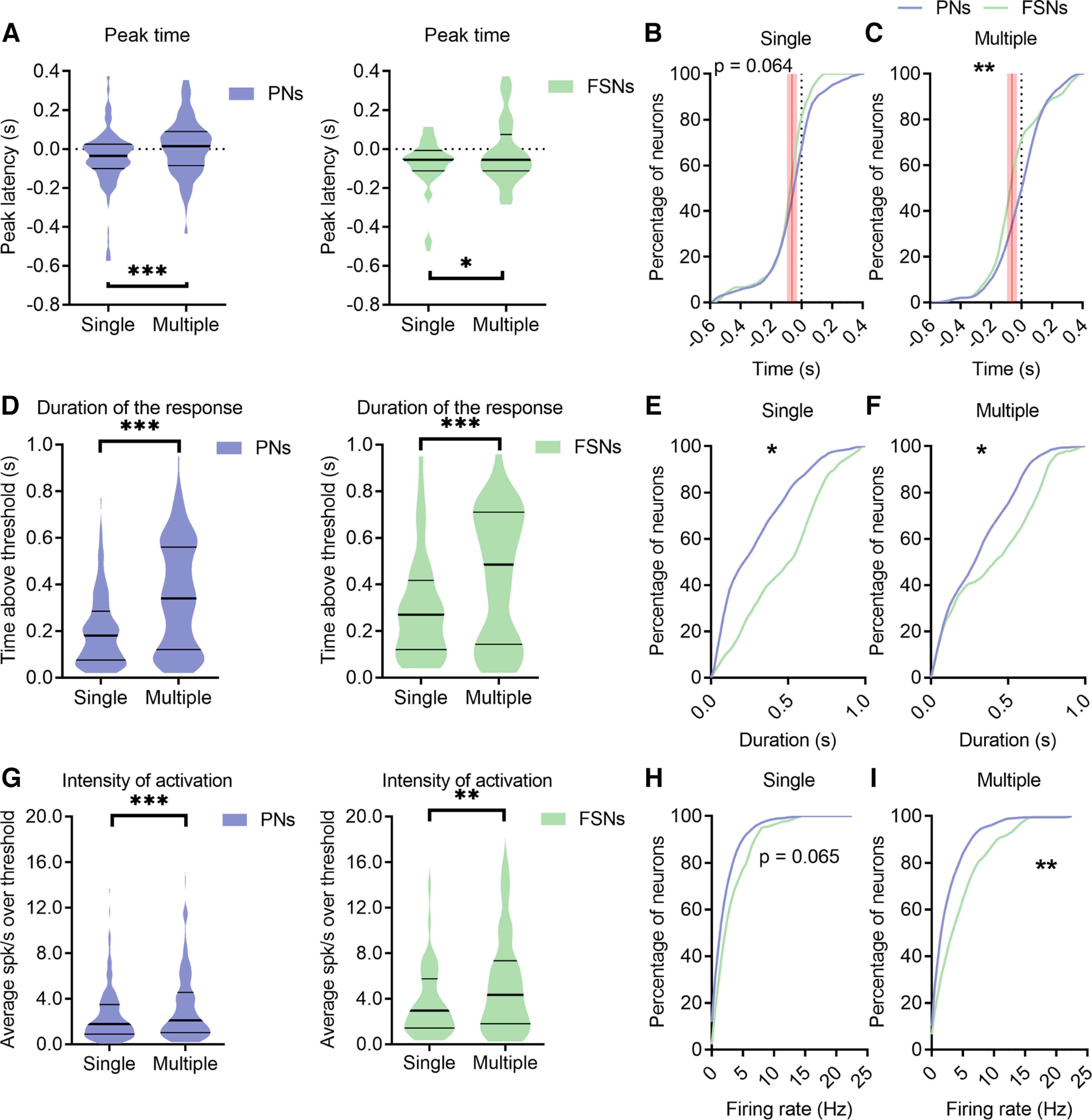
Planning and execution of voluntary movement depend on the contribution of distinct classes of neurons in primary motor and premotor areas. However, timing and pattern of activation of GABAergic cells during specific motor behaviors remain only partly understood. Here, we directly compared the response properties of putative pyramidal neurons (PNs) and GABAergic fast-spiking neurons (FSNs) during spontaneous licking and forelimb movements in male mice. Recordings centered on the face/mouth motor field of the anterolateral motor cortex (ALM) revealed that FSNs fire longer than PNs and earlier for licking, but not for forelimb movements. Computational analysis revealed that FSNs carry vastly more information than PNs about the onset of movement. While PNs differently modulate their discharge during distinct motor acts, most FSNs respond with a stereotyped increase in firing rate. Accordingly, the informational redundancy was greater among FSNs than PNs. Finally, optogenetic silencing of a subset of FSNs reduced spontaneous licking movement. These data suggest that a global rise of inhibition contributes to the initiation and execution of spontaneous motor actions. Our study contributes to clarifying the causal role of fast-spiking neurons (FSNs) in driving initiation and execution of specific, spontaneous movements. Within the face/mouth motor field of mice premotor cortex, FSNs fire before pyramidal neurons (PNs) with a specific activation pattern: they reach their peak of activity earlier than PNs during the initiation of licking, but not of forelimb, movements; duration of FSNs activity is also greater and exhibits less selectivity for the movement type, as compared with that of PNs. Accordingly, FSNs appear to carry more redundant information than PNs. Optogenetic silencing of FSNs reduced spontaneous licking movement, suggesting that FSNs contribute to the initiation and execution of specific spontaneous movements, possibly by sculpting response selectivity of nearby PNs.
计划和执行自主运动依赖于初级运动和运动前区不同类别的神经元的贡献。然而,在特定运动行为过程中 GABA 能细胞的激活时间和模式仍不完全清楚。在这里,我们直接比较了雄性小鼠自发舔舐和前肢运动过程中假定的锥体神经元 (PNs) 和 GABA 能快速放电神经元 (FSNs) 的反应特性。以前外侧运动皮层 (ALM) 的面部/口腔运动区为中心的记录显示,FSNs 的放电时间比 PNs 长,并且比 PNs 更早开始舔舐,但对前肢运动没有影响。计算分析表明,FSNs 携带的关于运动开始的信息比 PNs 多得多。虽然 PNs 在不同的运动行为中不同地调节其放电,但大多数 FSNs 的反应是放电率呈刻板增加。因此,FSNs 之间的信息冗余度比 PNs 更高。最后,光遗传沉默一小部分 FSNs 减少了自发舔舐运动。这些数据表明,整体抑制的增加有助于自发运动动作的启动和执行。我们的研究有助于阐明快速放电神经元 (FSNs) 在驱动特定自发运动的启动和执行中的因果作用。在小鼠运动前皮层的面部/口腔运动区,FSNs 比锥体神经元 (PNs) 更早地放电,具有特定的激活模式:在舔舐开始时,它们比 PNs 更早地达到活动峰值,但在前肢运动中则不然;FSNs 活动的持续时间也更长,与 PNs 相比,对运动类型的选择性更小。因此,FSNs 似乎比 PNs 携带更多冗余信息。FSNs 的光遗传沉默减少了自发舔舐运动,表明 FSNs 有助于特定自发运动的启动和执行,可能通过塑造附近 PNs 的反应选择性来实现。