Department of Chemistry & Loker Hydrocarbon Research Institute, University of Southern California, Los Angeles, California 90089, United States.
Department of Biological Sciences, Division of Molecular and Computational Biology, University of Southern California, Los Angeles, California 90089, United States.
ACS Chem Biol. 2023 Jul 21;18(7):1523-1533. doi: 10.1021/acschembio.3c00141. Epub 2023 May 18.
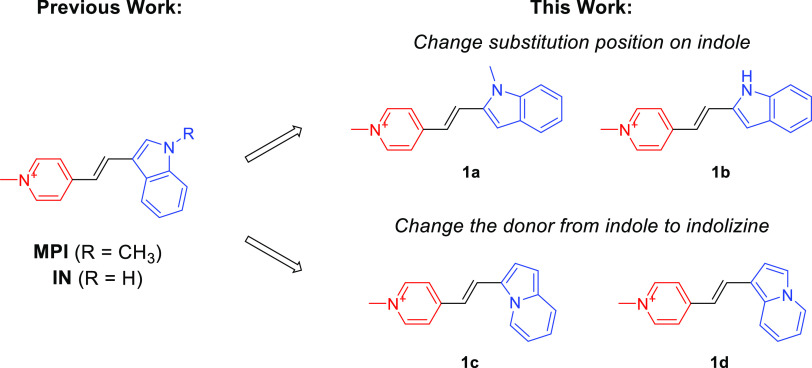
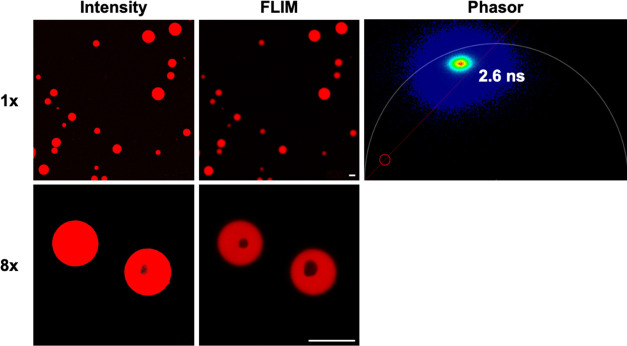
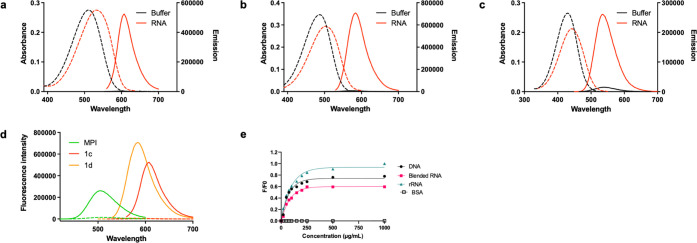
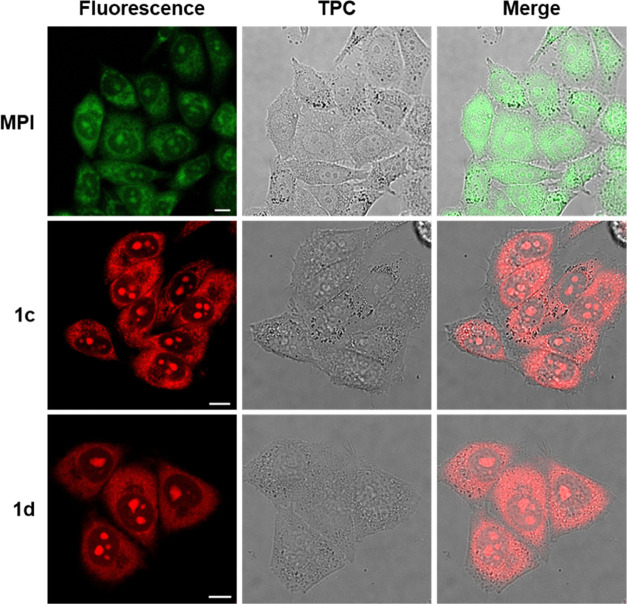
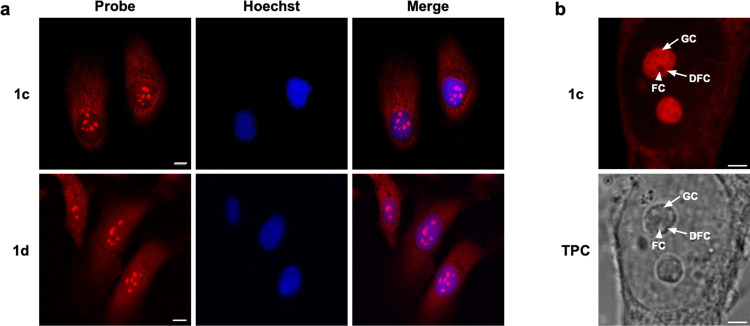
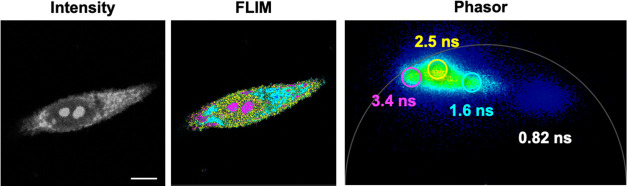
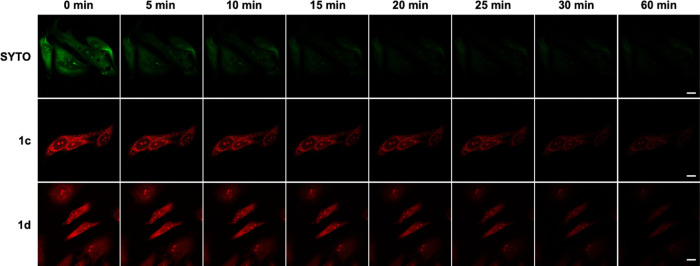
Styrene dyes are useful imaging probes and fluorescent sensors due to their strong fluorogenic responses to environmental changes or binding macromolecules. Previously, indole-containing styrene dyes have been reported to selectively bind RNA in the nucleolus and cytoplasm. However, the application of these indole-based dyes in cell imaging is limited by their moderate fluorescence enhancement and quantum yields, as well as relatively high background associated with these green-emitting dyes. In this work, we have investigated the positional and electronic effects of the electron donor by generating regioisomeric and isosteric analogues of the indole ring. Select probes exhibited large Stokes shifts, enhanced molar extinction coefficients, and bathochromic shifts in their absorption and fluorescence wavelengths. In particular, the indolizine analogues displayed high membrane permeability, strong fluorogenic responses upon binding RNA, compatibility with fluorescence lifetime imaging microscopy (FLIM), low cytotoxicity, and excellent photostability. These indolizine dyes not only give rise to rapid, sensitive, and intense staining of nucleoli in live cells but can also resolve subnucleolar structures enabling highly detailed studies of nucleolar morphology. Furthermore, our dyes can partition into RNA coacervates and resolve the formation of multiphase complex coacervate droplets. These indolizine-containing styrene probes offer the highest fluorescence enhancement among the RNA-selective dyes reported in the literature; thus, these new dyes are excellent alternatives to the commercially available RNA dye, SYTO RNASelect, for visualizing RNA in live cells and .
苯乙烯染料由于对环境变化或与大分子结合的强荧光响应,可用作有用的成像探针和荧光传感器。以前,含有吲哚的苯乙烯染料已被报道可选择性地结合核仁与细胞质中的 RNA。然而,由于这些基于吲哚的染料的荧光增强和量子产率适中,以及与这些发绿光的染料相关的相对较高的背景,这些染料在细胞成像中的应用受到限制。在这项工作中,我们通过生成吲哚环的区域异构和等排体来研究电子供体的位置和电子效应。选择的探针表现出大的斯托克斯位移、增强的摩尔消光系数以及在其吸收和荧光波长中的红移。特别是,吲哚嗪类似物显示出高的膜通透性、与 RNA 结合时的强荧光响应、与荧光寿命成像显微镜(FLIM)的兼容性、低细胞毒性和优异的光稳定性。这些吲哚嗪染料不仅可快速、灵敏、强烈地对活细胞中的核仁进行染色,而且还可分辨亚核仁结构,从而能够对核仁形态进行高度详细的研究。此外,我们的染料可以进入 RNA 凝聚物并分辨出多相复合凝聚物液滴的形成。与文献中报道的 RNA 选择性染料相比,这些含吲哚嗪的苯乙烯探针提供了最高的荧光增强;因此,这些新染料是 SYTO RNASelect 等市售 RNA 染料的极佳替代品,可用于在活细胞中可视化 RNA 。