Wang Xueting, Zhan Weili, Huang Ling, Guo Yunmei, Wang Yousha, Tan Huiwen, Wang Lianhong
Nursing Department, Affiliated Hospital of Zunyi Medical University, Zunyi, China.
Department of Critical Medicine, Affiliated Hospital of Zunyi Medical University, Zunyi, China.
Front Psychiatry. 2023 May 2;14:1160807. doi: 10.3389/fpsyt.2023.1160807. eCollection 2023.
Understanding the relationship between anxiety, depression and health-related quality of life (HRQOL) provides important clues to alleviate anxiety, depression and improve HRQOL in patients after severe acute pancreatitis (SAP). The aim of this study was to examine the effects of anxiety and depression on HRQOL in post-SAP patients using structural equation modeling.
A cross-sectional study design was used and 134 patients with SAP from the Affiliated Hospital of Zunyi Medical University were recruited. Data collected included demographic and clinical characteristics, the English Standard Short Form 36 (SF-36) Health Survey, The Self-rating Anxiety Scale (SAS) and The Self-rating Depression Scale (SDS). Structural equation modeling analysis was conducted using the AMOS 24.0 program.
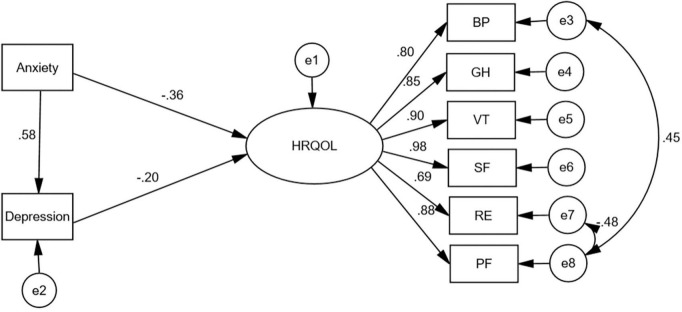
The mean of HRQOL score was 49.42 (SD = 23.01). The prevalence of anxiety and depression in post-SAP patients was 33.6 and 34.3%, respectively. Both anxiety and depression have a direct negative impact on HRQOL (β = -0.360, < 0.001; β = -0.202, = 0.034). Anxiety also negatively affects HRQOL indirectly through depression (β = -0.118, = 0.043). The analysis of the covariance structure revealed that the resulting model had a reasonable goodness of fit.
Anxiety and depression reduce the quality of life of SAP patients during recovery. Regular assessment and management of the anxiety and depression status of SAP patients is necessary and will help them improve their HRQOL more effectively.
了解焦虑、抑郁与健康相关生活质量(HRQOL)之间的关系,为缓解重症急性胰腺炎(SAP)患者的焦虑、抑郁及提高其HRQOL提供了重要线索。本研究旨在采用结构方程模型探讨焦虑和抑郁对SAP术后患者HRQOL的影响。
采用横断面研究设计,招募了遵义医科大学附属医院的134例SAP患者。收集的数据包括人口统计学和临床特征、英文标准简短健康调查量表(SF-36)、自评焦虑量表(SAS)和自评抑郁量表(SDS)。使用AMOS 24.0程序进行结构方程模型分析。
HRQOL评分的平均值为49.42(标准差=23.01)。SAP术后患者焦虑和抑郁的患病率分别为33.6%和34.3%。焦虑和抑郁均对HRQOL有直接负面影响(β=-0.360,<0.001;β=-0.202,=0.034)。焦虑还通过抑郁间接对HRQOL产生负面影响(β=-0.118,=0.043)。协方差结构分析表明,所得模型具有合理的拟合优度。
焦虑和抑郁会降低SAP患者康复期间的生活质量。对SAP患者的焦虑和抑郁状态进行定期评估和管理是必要且有助于他们更有效地提高HRQOL。