Department of Anesthesiology, Baotou Central Hospital, Baotou, China.
Baotou Clinical Medical College, Inner Mongolia Medical University, Baotou, China.
Front Immunol. 2023 May 3;14:1154626. doi: 10.3389/fimmu.2023.1154626. eCollection 2023.
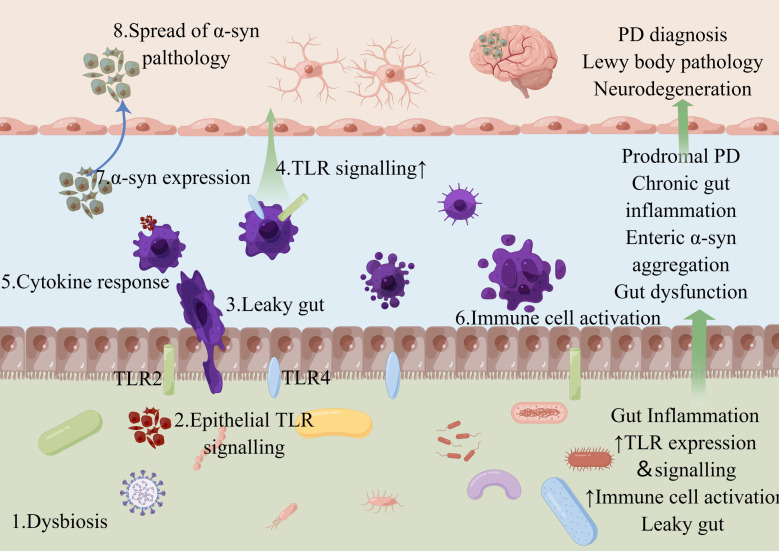
Recently, a large number of experimenters have found that the pathogenesis of Parkinson's disease may be related to the gut microbiome and proposed the microbiome-gut-brain axis. Studies have shown that Toll-like receptors, especially Toll-like receptor 2 (TLR2) and Toll-like receptor 4 (TLR4), are key mediators of gut homeostasis. In addition to their established role in innate immunity throughout the body, research is increasingly showing that the Toll-like receptor 2 and Toll-like receptor 4 signaling pathways shape the development and function of the gut and enteric nervous system. Notably, Toll-like receptor 2 and Toll-like receptor 4 are dysregulated in Parkinson's disease patients and may therefore be identified as the core of early gut dysfunction in Parkinson's disease. To better understand the contribution of Toll-like receptor 2 and Toll-like receptor 4 dysfunction in the gut to early α-synuclein aggregation, we discussed the structural function of Toll-like receptor 2 and Toll-like receptor 4 and signal transduction of Toll-like receptor 2 and Toll-like receptor 4 in Parkinson's disease by reviewing clinical, animal models, and studies. We also present a conceptual model of the pathogenesis of Parkinson's disease, in which microbial dysbiosis alters the gut barrier as well as the Toll-like receptor 2 and Toll-like receptor 4 signaling pathways, ultimately leading to a positive feedback loop for chronic gut dysfunction, promoting α-synuclein aggregation in the gut and vagus nerve.
最近,大量的实验人员发现帕金森病的发病机制可能与肠道微生物群有关,并提出了微生物群-肠道-大脑轴的概念。研究表明,Toll 样受体(TLR),特别是 TLR2 和 TLR4,是肠道内稳态的关键调节因子。除了在全身固有免疫中发挥已确立的作用外,研究越来越表明 TLR2 和 TLR4 信号通路塑造了肠道和肠神经系统的发育和功能。值得注意的是,TLR2 和 TLR4 在帕金森病患者中失调,因此可能被认为是帕金森病早期肠道功能障碍的核心。为了更好地了解 TLR2 和 TLR4 功能障碍在肠道对早期α-突触核蛋白聚集的贡献,我们通过回顾临床、动物模型和研究,讨论了 TLR2 和 TLR4 的结构功能以及 TLR2 和 TLR4 的信号转导在帕金森病中的作用。我们还提出了一个帕金森病发病机制的概念模型,其中微生物失调改变了肠道屏障以及 TLR2 和 TLR4 信号通路,最终导致慢性肠道功能障碍的正反馈循环,促进肠道和迷走神经中α-突触核蛋白的聚集。