Department of Public Health Medicine, Faculty of Medicine, Universiti Kebangsaan Malaysia, 56000, Bandar Tun Razak, Kuala Lumpur, Malaysia.
Environ Sci Pollut Res Int. 2023 Jun;30(29):73137-73149. doi: 10.1007/s11356-023-27089-9. Epub 2023 May 22.
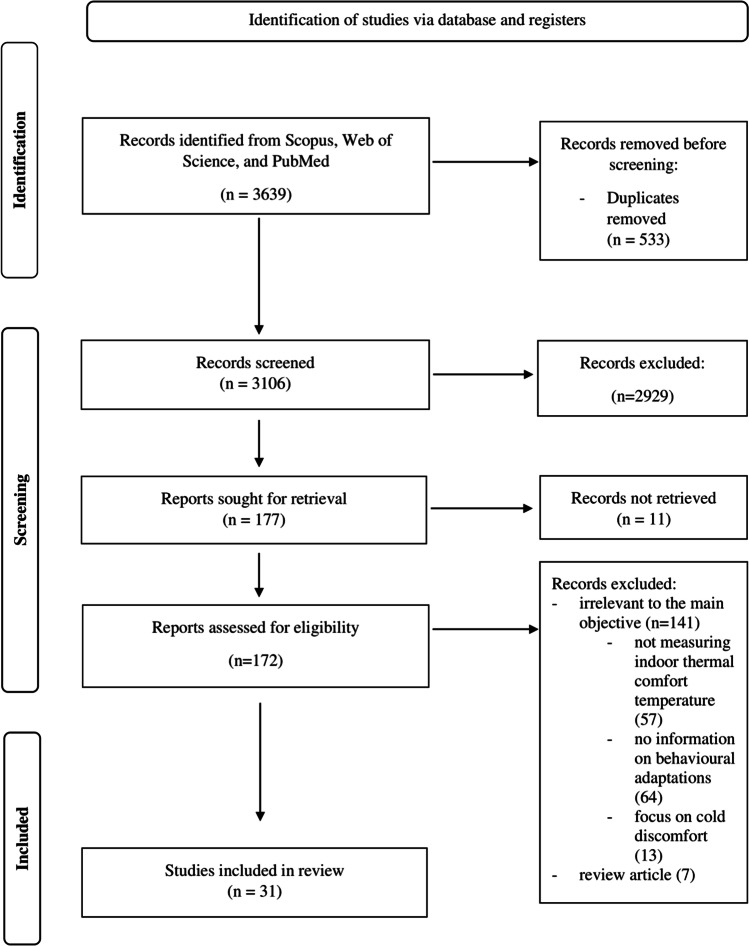
Thermal comfort is linked to our health, well-being, and productivity. The thermal environment is one of the main factors that influence thermal comfort and, consequently, the productivity of occupants inside buildings. Meanwhile, behavioural adaptation is well known to be the most critical contributor to the adaptive thermal comfort model. This systematic review aims to provide evidence regarding indoor thermal comfort temperature and related behavioural adaptation. Studies published between 2010 and 2022 examining indoor thermal comfort temperature and behavioural adaptations were considered. In this review, the indoor thermal comfort temperature ranges from 15.0 to 33.8 °C. The thermal comfort temperature range varied depending on several factors, such as climatic features, ventilation mode, type of buildings, and age of the study population. Elderly and younger children have distinctive thermal acceptability. Clothing adjustment, fan usage, AC usage, and open window were the most common adaptive behaviour performed. Evidence shows that behavioural adaptations were also influenced by climatic features, ventilation mode, type of buildings, and age of the study population. Building designs should incorporate all factors that affect the thermal comfort of the occupants. Awareness of practical behavioural adaptations is crucial to ensure occupants' optimal thermal comfort.
热舒适与我们的健康、幸福感和生产力息息相关。热环境是影响热舒适的主要因素之一,进而影响建筑物内居住者的生产力。同时,行为适应被公认为自适应热舒适模型的最重要贡献因素。本系统评价旨在提供有关室内热舒适温度和相关行为适应的证据。研究对象为 2010 年至 2022 年间发表的研究室内热舒适温度和行为适应的文章。本综述中,室内热舒适温度范围在 15.0 到 33.8°C 之间。热舒适温度范围因气候特征、通风模式、建筑物类型和研究人群的年龄等因素而有所不同。老年人和儿童对热的可接受程度不同。调整衣着、使用风扇、使用空调和打开窗户是最常见的适应行为。有证据表明,行为适应也受到气候特征、通风模式、建筑物类型和研究人群年龄等因素的影响。建筑设计应考虑影响居住者热舒适的所有因素。了解实际的行为适应措施对于确保居住者的最佳热舒适至关重要。