School of Public Health, The University of Queensland, Herston, Qld, 4006, Australia.
Queensland Centre for Mental Health Research, Locked Bag 500, Archerfield, Qld, 4108, Australia.
Soc Psychiatry Psychiatr Epidemiol. 2023 Sep;58(9):1265-1292. doi: 10.1007/s00127-023-02488-y. Epub 2023 May 22.
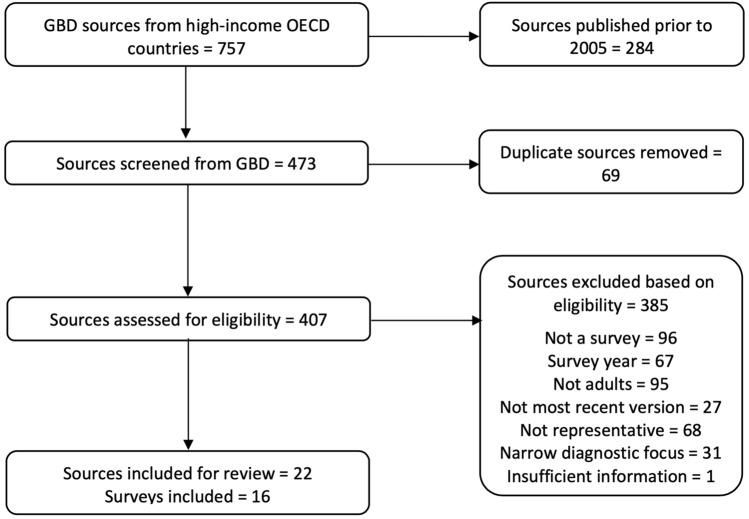
National mental health surveys play a critical role in determining the prevalence of mental disorders in a population and informing service planning. However, current surveys have important limitations, including the exclusion of key vulnerable groups and increasing rates of non-response. This review aims to synthesise information on excluded and undersampled groups in national mental health surveys. We conducted a targeted review of nationally representative adult mental health surveys performed between 2005 and 2019 in high-income OECD countries. Sixteen surveys met our inclusion criteria. The response rate for included surveys ranged between 36.3% and 80.0%. The most frequently excluded groups included people who were homeless, people in hospitals or health facilities and people in correctional facilities. Males and young people were the most commonly underrepresented groups among respondents. Attempts to collect data from non-responders and excluded populations were limited, but suggest that mental health status differs among some of these cohorts. The exclusion of key vulnerable groups and high rates of non-response have important implications for interpreting and using the results of national mental health surveys. Targeted supplementary surveys of excluded or hard-to-reach populations, more inclusive sampling methodologies, and strategies aimed at improving response rates should be considered to strengthen the accuracy and usefulness of survey findings.
全国性心理健康调查在确定人群中心理障碍的患病率和为服务规划提供信息方面发挥着关键作用。然而,目前的调查存在重要的局限性,包括排除了关键的弱势群体以及非应答率的增加。本综述旨在综合关于全国性心理健康调查中被排除和代表性不足的群体的信息。我们对 2005 年至 2019 年间在高收入经合组织国家进行的具有代表性的成人心理健康调查进行了有针对性的审查。有 16 项调查符合我们的纳入标准。纳入调查的应答率在 36.3%至 80.0%之间。最常被排除的群体包括无家可归者、医院或卫生机构中的人和惩教设施中的人。男性和年轻人是应答者中最常见的代表性不足的群体。从非应答者和被排除人群中收集数据的尝试有限,但表明这些群体中的一些人的心理健康状况不同。排除关键弱势群体和高非应答率对解释和使用全国性心理健康调查结果有重要影响。应考虑针对被排除或难以接触的人群进行补充调查、采用更具包容性的抽样方法以及旨在提高应答率的策略,以加强调查结果的准确性和有用性。