ICON plc, 4130 Parklake Ave Suite 400, Raleigh, NC, 27612, USA.
Bausch Pharma US, LLC, Bridgewater, NJ, USA.
Qual Life Res. 2023 Sep;32(9):2573-2585. doi: 10.1007/s11136-023-03407-z. Epub 2023 May 22.
The aim of this study was to generate evidence supporting the development and content validity of a new PRO instrument, the Small Intestinal Bacterial Overgrowth (SIBO) Symptom Measure (SSM) daily diary. The SSM assesses symptom severity in SIBO patients, with the ultimate goal of providing a fit for purpose PRO for endpoint measurement.
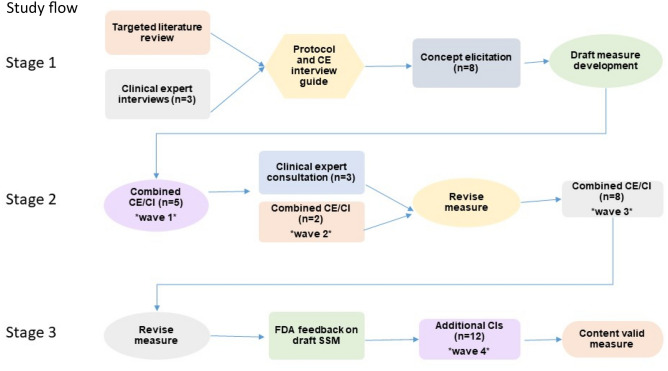
Qualitative research included 35 SIBO patients in three study stages, using a hybrid concept elicitation (CE)/cognitive interview (CI) method with US patients, ≥ 18 years. Stage 1 included a literature review, clinician interviews, and initial CE interviews with SIBO patients to identify symptoms important to patients for inclusion in the SSM. Stage 2 included hybrid CE/CI to learn more about patients' SIBO experience and test the draft SSM. Finally, stage 3 used CIs to refine the instrument and test its content validity.
In stage 1 (n = 8), 15 relevant concepts were identified, with items drafted based on the literature review/clinician interviews and elicitation work. Within stage 2 (n = 15), the SSM was refined to include 11 items; with wording revised for three items. Stage 3 (n = 12) confirmed the comprehensiveness of the SSM, as well as appropriateness of the item wording, recall period, and response scale. The resulting 11-item SSM assesses the severity of bloating, abdominal distention, abdominal discomfort, abdominal pain, flatulence, physical tiredness, nausea, diarrhea, constipation, appetite loss, and belching.
This study provides evidence supporting the content validity of the new PRO. Comprehensive patient input ensures that the SSM is a well-defined measure of SIBO, ready for psychometric validation studies.
本研究旨在为一种新的 PRO 工具——小肠细菌过度生长(SIBO)症状量表(SSM)日常日记——的开发和内容有效性提供证据。SSM 评估 SIBO 患者的症状严重程度,最终目标是提供适合终点测量的特定 PRO。
定性研究包括三个研究阶段的 35 名 SIBO 患者,使用混合概念发掘(CE)/认知访谈(CI)方法,对象为美国年龄≥18 岁的患者。第 1 阶段包括文献回顾、临床医生访谈和对 SIBO 患者的初步 CE 访谈,以确定对患者重要的症状纳入 SSM。第 2 阶段包括混合 CE/CI,以进一步了解患者的 SIBO 体验并测试 SSM 草案。最后,第 3 阶段使用 CI 来完善该仪器并测试其内容有效性。
在第 1 阶段(n=8)中,确定了 15 个相关概念,根据文献回顾/临床医生访谈和发掘工作起草了项目。在第 2 阶段(n=15)中,SSM 进行了细化,纳入了 11 项;对其中三项的措辞进行了修订。第 3 阶段(n=12)确认了 SSM 的全面性,以及项目措辞、回忆期和反应量表的适当性。最终的 11 项 SSM 评估了腹胀、腹部膨胀、腹部不适、腹痛、气胀、身体疲劳、恶心、腹泻、便秘、食欲减退和打嗝的严重程度。
本研究提供了新 PRO 内容有效性的证据。全面的患者投入确保了 SSM 是 SIBO 的一个明确的衡量标准,为心理测量验证研究做好了准备。