Youn Jaeseung, Rhyou Junyeol, Kim Dohui, Lee Jisang, Choi Jeong-Won, Park Tae-Eun, Kim Dong Sung
Department of Mechanical Engineering, Pohang University of Science and Technology (POSTECH), 77 Cheongam-ro, Nam-gu, Pohang, Gyeongbuk, 37673, South Korea.
Department of Biomedical Engineering, College of Information and Biotechnology, Ulsan National Institute of Science and Technology (UNIST), Ulsan, 44919, South Korea.
Mater Today Bio. 2023 Apr 29;20:100648. doi: 10.1016/j.mtbio.2023.100648. eCollection 2023 Jun.
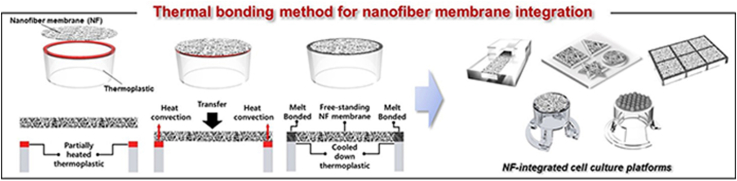
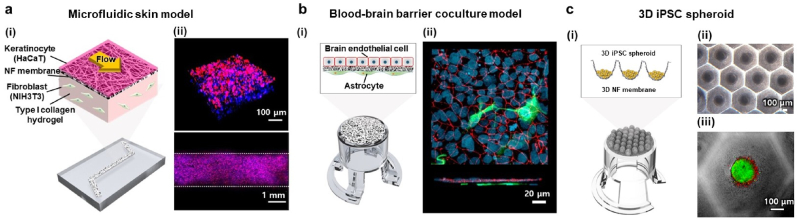
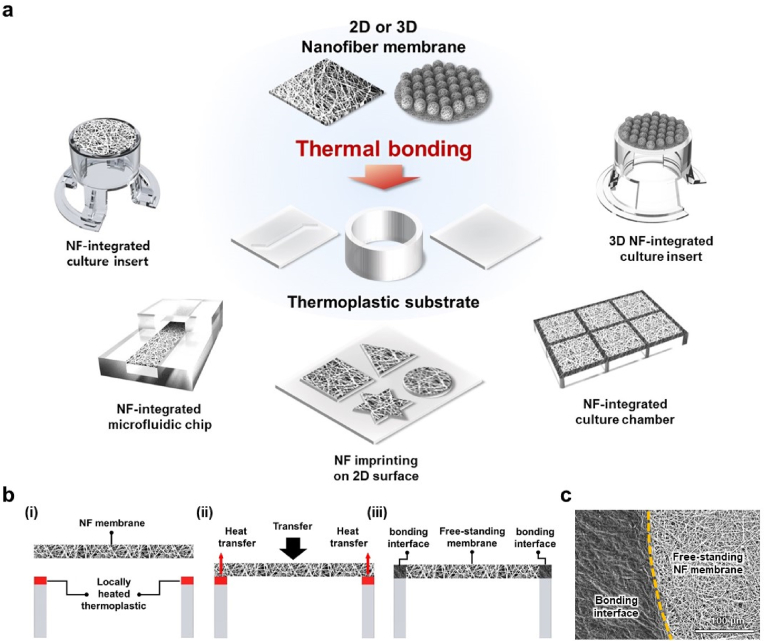
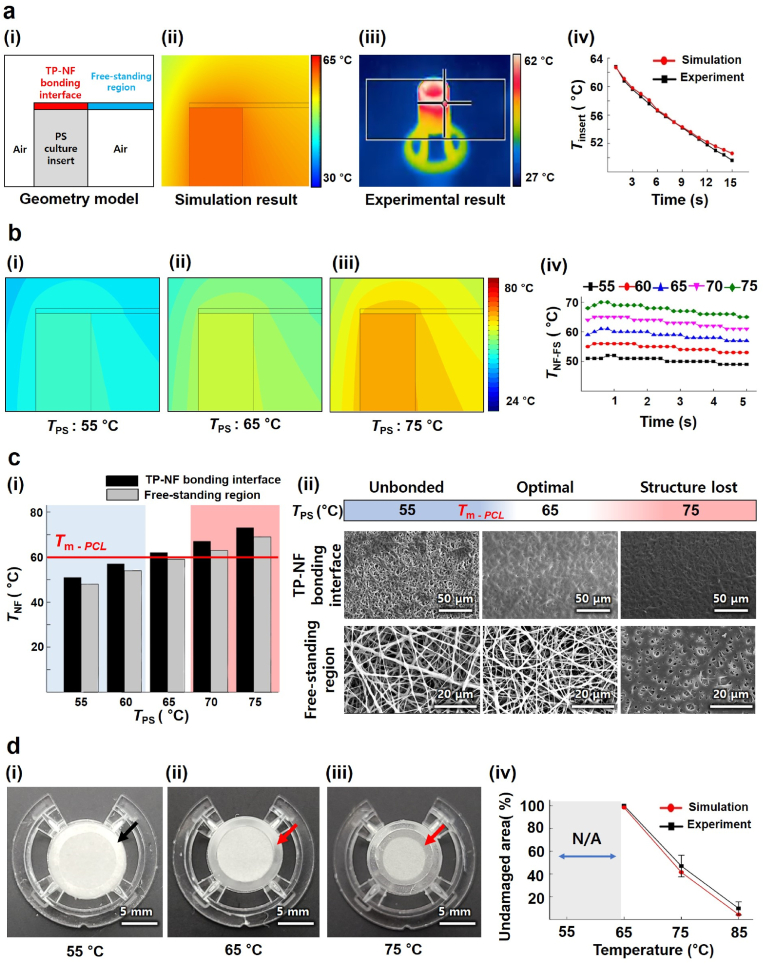
Nanofiber (NF) membranes have been highlighted as functional materials for biomedical applications owing to their high surface-to-volume ratios, high permeabilities, and extracellular matrix-like biomimetic structures. Because many platforms for biomedical applications are made of thermoplastic polymers (TP), a simple and leak-free method for bonding NF membranes onto TP platforms is essential. Here, we propose a facile but leak-free localized thermal bonding method for integrating 2D or 3D-structured NF membrane onto a TP supporting substrate while preserving the pristine nanofibrous structure of the membrane, based on localized preheating of the substrate. A methodology for determining the optimal preheating temperature was devised based on a numerical simulation model considering the melting temperature of the NF material and was experimentally validated by evaluating bonding stability and durability under cell culture conditions. The thermally-bonded interface between the NF membrane and TP substrate was maintained stably for 3 weeks allowing the successful construction of an intestinal barrier model. The applicability of the localized thermal bonding method was also demonstrated on various combinations of TP materials (e.g., polystyrene and polymethylmethacrylate) and geometries of the supporting substrate, including a culture insert and microfluidic chip. We expect the proposed localized thermal bonding method to contribute toward broadening and realizing the practical applications of functional NF membranes in various biomedical fields.
纳米纤维(NF)膜因其高比表面积、高渗透性以及细胞外基质样的仿生结构,已成为生物医学应用中的功能材料。由于许多生物医学应用平台由热塑性聚合物(TP)制成,因此将NF膜无泄漏地粘结到TP平台上的简单方法至关重要。在此,我们基于对基底的局部预热,提出了一种简便且无泄漏的局部热粘结方法,用于将二维或三维结构的NF膜整合到TP支撑基底上,同时保留膜的原始纳米纤维结构。基于考虑NF材料熔化温度的数值模拟模型,设计了一种确定最佳预热温度的方法,并通过在细胞培养条件下评估粘结稳定性和耐久性进行了实验验证。NF膜与TP基底之间的热粘结界面稳定维持了3周,从而成功构建了肠道屏障模型。局部热粘结方法的适用性还在TP材料(如聚苯乙烯和聚甲基丙烯酸甲酯)的各种组合以及支撑基底的几何形状(包括培养插入物和微流控芯片)上得到了证明。我们期望所提出的局部热粘结方法有助于拓宽并实现功能性NF膜在各种生物医学领域的实际应用。