Department of Kinesiology, Exercise Metabolism Research Group, McMaster University, Hamilton, Ontario, Canada.
PLoS One. 2023 May 23;18(5):e0286222. doi: 10.1371/journal.pone.0286222. eCollection 2023.
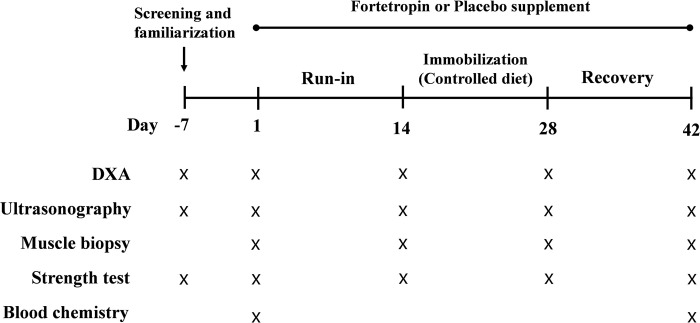
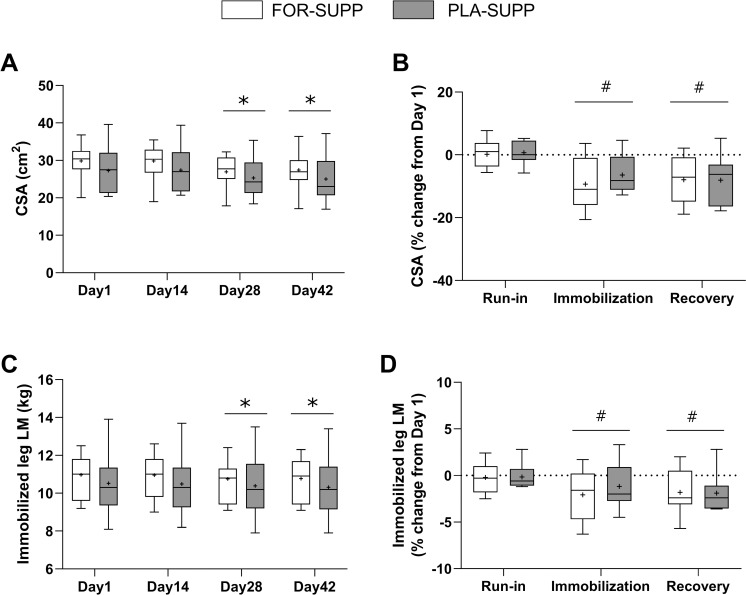
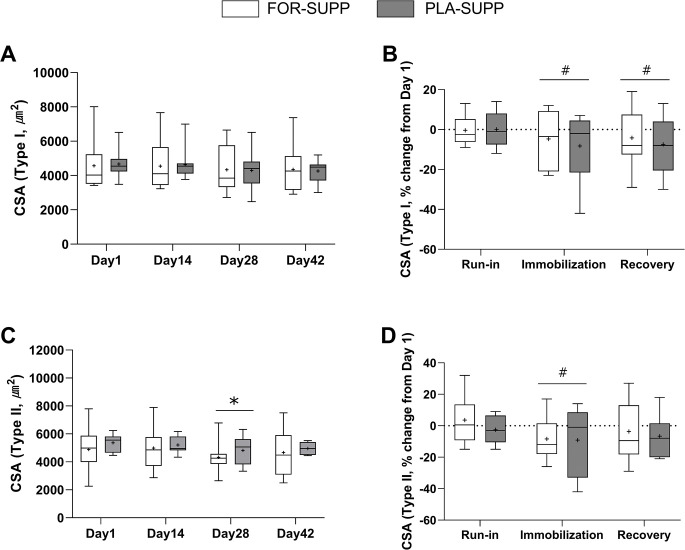
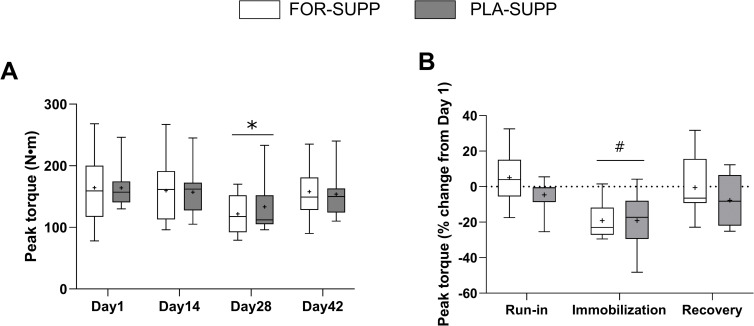
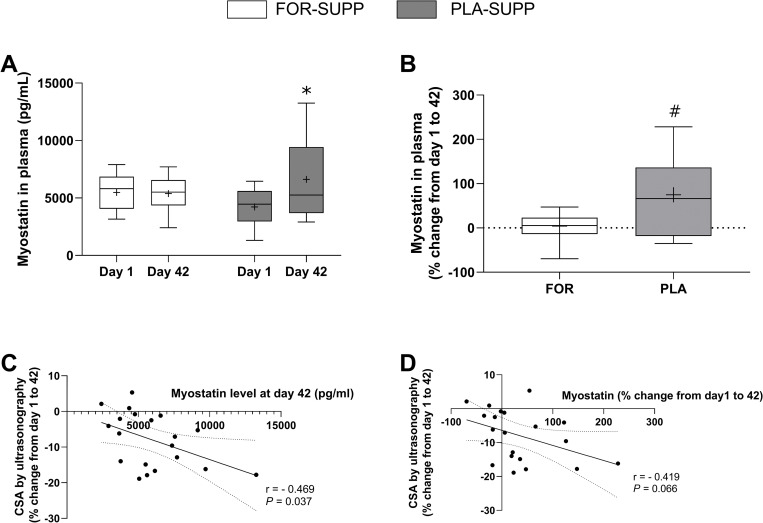
Supplementation with Fortetropin® (FOR), a naturally occurring component from fertilized egg yolks, reduces circulating myostatin concentration. We hypothesized that FOR would mitigate muscle atrophy during immobilization. We examined the effect of FOR supplementation on muscle size and strength during 2-wk of single-leg immobilization and recovery. Twenty-four healthy young men (22 ± 2 yrs; BMI = 24.3 ± 2.9 kg/m2) were randomly allocated to either a Fortetropin® supplement (FOR-SUPP, n = 12) group consuming 19.8 g/d of FOR or placebo (PLA-SUPP, n = 12) group consuming energy- and macronutrient-matched cheese powder for 6-wk. The 6-wk period consisted of 2-wk run-in, 2-wk single-leg immobilization, and 2-wk recovery phase returning to habitual physical activities. Ultrasonography, dual-energy X-ray absorptiometry, muscle biopsies and isometric peak torque assessments were performed prior to and following each phase (days 1, 14, 28, and 42) to measure vastus lateralis and muscle fiber cross-section area (CSA), leg lean mass (LM), and muscular strength. Blood samples were taken on days 1 and 42 for measurement of plasma myostatin concentration, which increased in PLA-SUPP (4221 ± 541 pg/mL to 6721 ± 864 pg/mL, P = 0.013) but not in FOR-SUPP (5487 ± 489 pg/mL to 5383 ± 781 pg/mL, P = 0.900). After the immobilization phase, vastus lateralis CSA, LM, and isometric peak torque were decreased by 7.9 ± 1.7% (P < 0.001), -1.6 ± 0.6% (P = 0.037), and -18.7 ± 2.7% (P < 0.001) respectively, with no difference between groups. The decreased peak torque was recovered after 2-wk of normal activity (vs. day 1, P = 0.129); however, CSA and LM were not recovered (vs. day 1, P < 0.001 and P = 0.003, respectively), with no differences between groups. Supplementation with FOR prevented the rise in circulating myostatin but not disuse-induced muscle atrophy in young men after 2-wk of single-leg immobilization.
补充 Fortetropin®(FOR),一种来自受精卵黄的天然成分,可以降低循环中的肌肉生长抑制素浓度。我们假设 FOR 会减轻固定期间的肌肉萎缩。我们研究了 FOR 补充剂对单腿固定 2 周和恢复期间肌肉大小和力量的影响。24 名健康年轻男性(22 ± 2 岁;BMI = 24.3 ± 2.9 kg/m2)随机分为 Fortetropin®补充剂(FOR-SUPP,n = 12)组,每天摄入 19.8 g FOR 或安慰剂(PLA-SUPP,n = 12)组,摄入能量和宏量营养素匹配的奶酪粉 6 周。6 周的周期包括 2 周的适应期、2 周的单腿固定期和 2 周的恢复期,恢复到习惯性的体育活动。在每个阶段(第 1、14、28 和 42 天)之前和之后进行超声检查、双能 X 射线吸收法、肌肉活检和等长峰值扭矩评估,以测量股外侧肌和肌肉纤维横截面积(CSA)、腿部瘦体重(LM)和肌肉力量。在第 1 天和第 42 天采集血样,测量血浆肌肉生长抑制素浓度,PLA-SUPP 组(4221 ± 541 pg/mL 至 6721 ± 864 pg/mL,P = 0.013)增加,但 FOR-SUPP 组(5487 ± 489 pg/mL 至 5383 ± 781 pg/mL,P = 0.900)没有增加。在固定阶段后,股外侧肌 CSA、LM 和等长峰值扭矩分别下降了 7.9 ± 1.7%(P < 0.001)、-1.6 ± 0.6%(P = 0.037)和-18.7 ± 2.7%(P < 0.001),组间无差异。经过 2 周的正常活动后,峰值扭矩得到恢复(与第 1 天相比,P = 0.129);然而,CSA 和 LM 没有恢复(与第 1 天相比,P < 0.001 和 P = 0.003),组间无差异。在单腿固定 2 周后,补充 FOR 可防止年轻人循环中肌肉生长抑制素的升高,但不能防止废用性肌肉萎缩。