Department of Human Nutrition, Wageningen University, Wageningen, The Netherlands.
Top Institute Food and Nutrition, Wageningen, The Netherlands.
Sports Med. 2017 Aug;47(8):1661-1671. doi: 10.1007/s40279-016-0670-2.
A short period of leg immobilization leads to rapid loss of muscle mass and strength. Creatine supplementation has been shown to increase lean body mass in active individuals and can be used to augment gains in muscle mass and strength during prolonged resistance-type exercise training.
Our objective was to investigate whether creatine loading can attenuate the loss of muscle mass and strength during short-term leg immobilization.
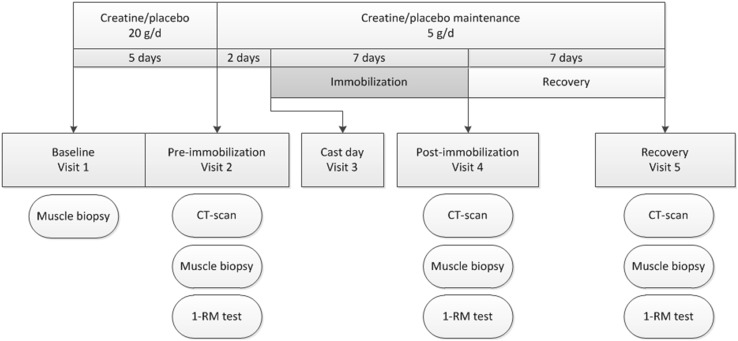
Healthy young men (n = 30; aged 23 ± 1 years; body mass index [BMI] 23.3 ± 0.5 kg/m) were randomly assigned to either a creatine or a placebo group. Subjects received placebo or creatine supplements (20 g/d) for 5 days before one leg was immobilized by means of a full-leg cast for 7 days. Muscle biopsies were taken before creatine loading, prior to and immediately after leg immobilization, and after 7 days of subsequent recovery. Quadriceps cross-sectional area (CSA) (computed tomography [CT] scan) and leg muscle strength (one-repetition maximum [1-RM] knee extension) were assessed before and immediately after immobilization and after 1 week of recovery. Data were analyzed using repeated measures analysis of variance (ANOVA). Data are presented consistently as mean ± standard error of the mean (SEM).
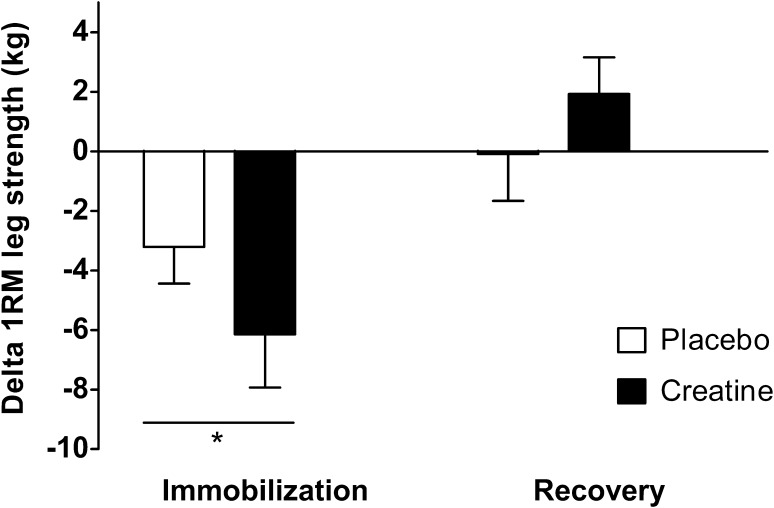
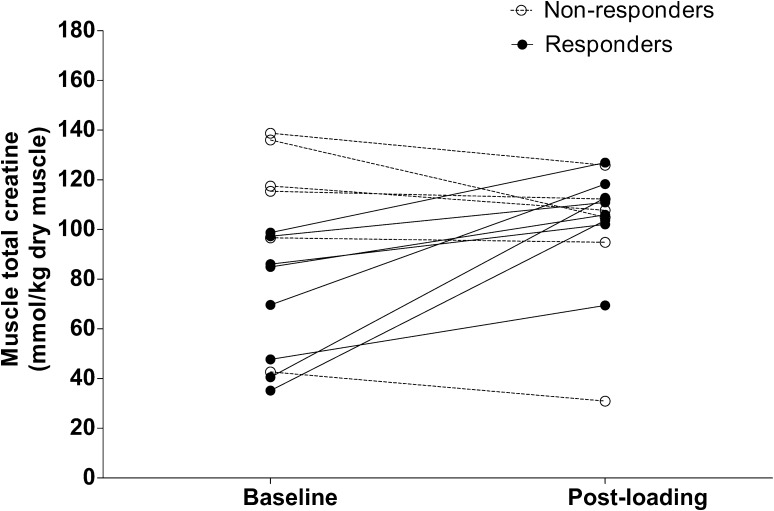
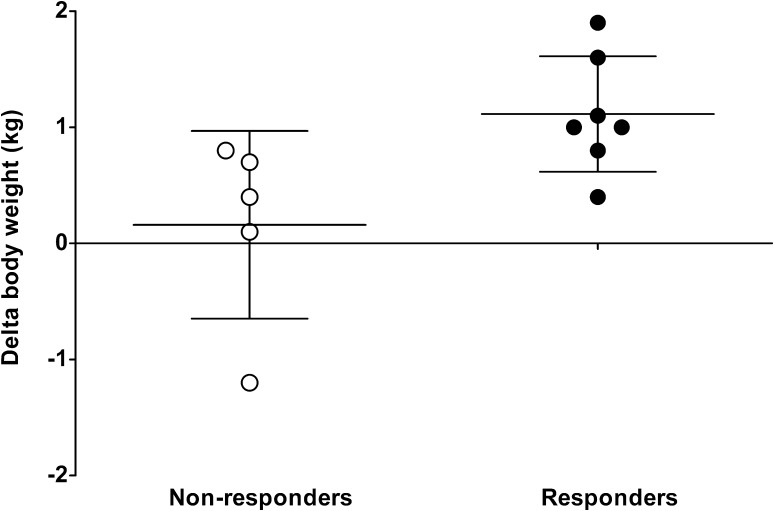
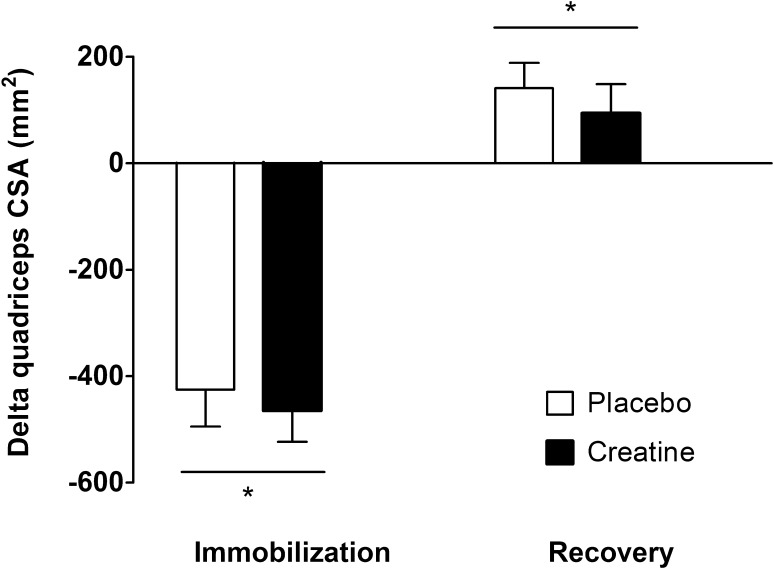
There was a significant overall increase in muscle total creatine content following the 5-day loading phase (p = 0.049), which appeared driven by an increase in the creatine group (from 90 ± 9 to 107 ± 4 mmol/kg dry muscle) with no apparent change in the placebo group (from 88 ± 4 to 90 ± 3 mmol/kg; p = 0.066 for time × treatment interaction). Quadriceps muscle CSA had declined by 465 ± 59 and 425 ± 69 mm (p < 0.01) in the creatine and placebo group, respectively, with no differences between groups (p = 0.76). Leg muscle strength decreased from 56 ± 4 to 53 ± 4 kg in the creatine and from 59 ± 3 to 53 ± 3 kg in the placebo group, with no differences between groups (p = 0.20). Muscle fiber size did not change significantly over time in either group (p > 0.05). When non-responders to creatine loading were excluded (n = 6), responders (n = 8; total creatine content increasing from 70 to 106 mmol/kg) showed similar findings, with no signs of preservation of muscle mass or strength during immobilization. During the subsequent recovery phase, no differences in muscle mass or strength were found between the two groups (p > 0.05).
Creatine supplementation prior to and during leg immobilization does not prevent or attenuate the loss of muscle mass or strength during short-term muscle disuse. NIH Clinical Trial Registration Number: NCT01894737 ( http://www.clinicaltrials.gov/ ).
短期的腿部固定会导致肌肉质量和力量迅速下降。研究表明,肌酸补充剂可以增加活跃个体的瘦体重,并且可以用于增强长时间抗阻型运动训练期间肌肉质量和力量的增加。
我们的目的是研究肌酸负荷是否可以减轻短期腿部固定期间的肌肉质量和力量损失。
健康的年轻男性(n=30;年龄 23±1 岁;体重指数[BMI]23.3±0.5 kg/m)被随机分配到肌酸或安慰剂组。受试者在 5 天内接受安慰剂或肌酸补充剂(20 g/d),然后用全腿石膏固定一条腿 7 天。在肌酸负荷前、腿部固定前和固定后立即以及随后的恢复 7 天后采集肌肉活检。在固定前和固定后以及恢复 1 周后,使用计算机断层扫描(CT)扫描评估股四头肌横截面积(CSA)和腿部肌肉力量(1-RM 膝关节伸展)。使用重复测量方差分析(ANOVA)进行数据分析。数据以均数±标准误(SEM)一致呈现。
在 5 天的加载阶段后,肌肉总肌酸含量显著增加(p=0.049),这似乎是由于肌酸组(从 90±9 增加到 107±4 mmol/kg 干肌),而安慰剂组没有明显变化(从 88±4 增加到 90±3 mmol/kg;治疗时间交互作用的 p=0.066)。股四头肌 CSA 在肌酸组和安慰剂组中分别下降了 465±59 和 425±69 mm(p<0.01),两组之间无差异(p=0.76)。腿部肌肉力量从 56±4 减少到 53±4 kg 在肌酸组,从 59±3 减少到 53±3 kg 在安慰剂组,两组之间无差异(p=0.20)。在任何一组中,肌肉纤维大小在时间上均无明显变化(p>0.05)。当排除肌酸负荷的无反应者(n=6)时,反应者(n=8;总肌酸含量从 70 增加到 106 mmol/kg)显示出类似的发现,在固定期间没有肌肉质量或力量保存的迹象。在随后的恢复阶段,两组之间的肌肉质量或力量没有差异(p>0.05)。
在腿部固定前和固定期间补充肌酸并不能预防或减轻短期肌肉失用期间的肌肉质量或力量损失。美国国立卫生研究院临床试验注册号:NCT01894737(http://www.clinicaltrials.gov/)。