Yin Hanzhi, Zhou Xishu, Zhou Zhengui, Liu Rong, Mo Xiwei, Chen Zewen, Yang Erqi, Huang Zhen, Li Hao, Wu Hao, Zhou Jun, Long Yi, Hu Bin
Wuhan National Laboratory for Optoelectronics, School of Optical and Electronic Information, Huazhong University of Science and Technology, Wuhan, Hubei 430074, P. R. China.
School of Mechanical Science and Engineering, Huazhong University of Science and Technology, Wuhan, Hubei 430074, P. R. China.
Research (Wash D C). 2023 Apr 17;6:0103. doi: 10.34133/research.0103. eCollection 2023.
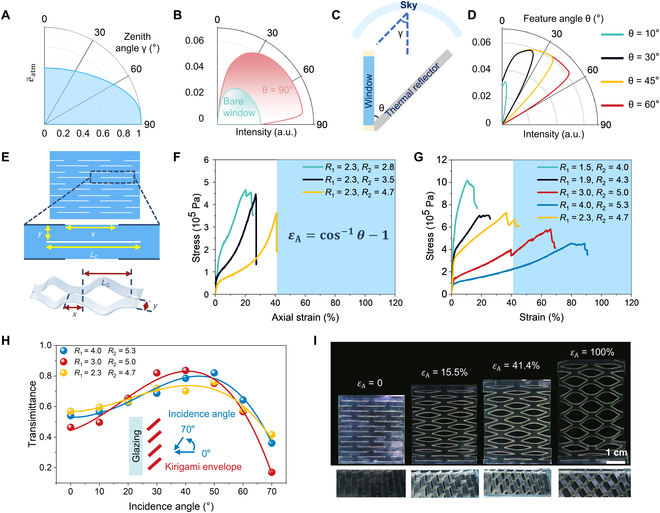
Efficient regulation of thermal radiation is an effective way to conserve energy consumption of buildings. Because windows are the least energy-efficient part of buildings, their thermal radiation regulation is highly demanded, especially in the changing environment, but is still a challenge. Here, by employing a kirigami structure, we design a variable-angle thermal reflector as a transparent envelope of windows for their thermal radiation modulation. The envelope can be easily switched between heating and cooling modes by loading different pre-stresses, which endow the envelope windows with the ability of temperature regulation, and the interior temperature of a building model can be reduced by ~3.3 °C under cooling mode and increased by ~3.9 °C under heating mode in the outdoor test. The improved thermal management of windows by the adaptive envelope provides an extra heating, ventilation, and air-conditioning energy savings percentage of 13% to 29% per year for buildings located in different climate zones around the world, making the kirigami envelope windows a promising way for energy-saving utilization.
高效调节热辐射是降低建筑能耗的有效途径。由于窗户是建筑中能源效率最低的部分,因此对其热辐射调节的需求极高,尤其是在不断变化的环境中,但这仍然是一个挑战。在此,我们通过采用一种剪纸结构,设计了一种可变角度的热反射器作为窗户的透明外壳,用于调节其热辐射。通过加载不同的预应力,该外壳可以轻松地在加热和冷却模式之间切换,赋予外壳窗户温度调节能力,在室外测试中,建筑模型的内部温度在冷却模式下可降低约3.3°C,在加热模式下可升高约3.9°C。这种自适应外壳对窗户热管理的改进,为全球不同气候区的建筑每年额外节省13%至29%的供暖、通风和空调能源,使剪纸外壳窗户成为一种很有前景的节能利用方式。