Pan Zhenzhen, Wang Qian, Guo Yun, Xu Shidi, Pan Shanshan, Xu Shiyao, Zhou Qin, Li Ling
Department of Pediatric Respiratory, Affiliated Children's Hospital of Jiangnan University, No. 299-1 at Qingyang Road, Liangxi District, Wuxi 214023, Jiangsu Province, China.
Prev Med Rep. 2023 Mar 25;33:102190. doi: 10.1016/j.pmedr.2023.102190. eCollection 2023 Jun.
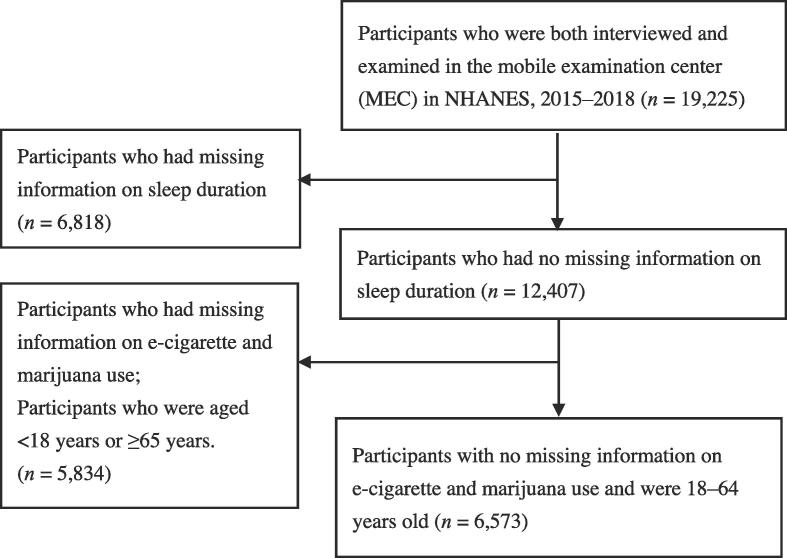
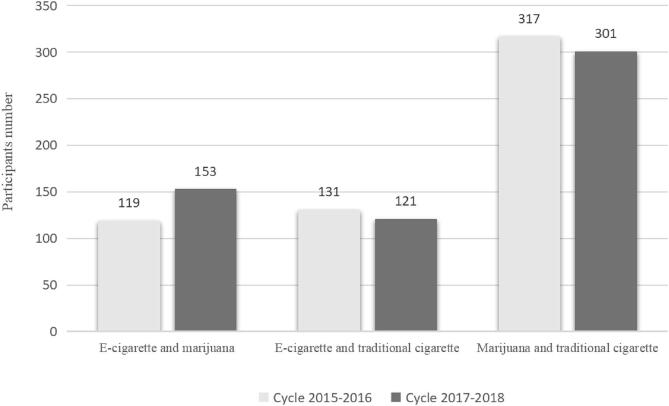
Electronic cigarette (e-cigarette) use is becoming more widespread, and studies show that they are not absolutely harmless. To investigate the association between the dual use of e-cigarettes and marijuana with sleep duration among adults in the United States, this cross-sectional study used data from 6,573 participants aged 18-64 years from 2015 to 2018 from the National Health and Nutrition Examination Survey database. Chi-square tests and analysis of variance were used for bivariate analyses of binary and continuous variables, respectively. Multinomial logistic regression models were used for univariate and multivariate analyses of e-cigarette use, marijuana use, and sleep duration. Sensitivity analyses were conducted in populations with dual e-cigarette and traditional cigarette use and dual marijuana and traditional cigarette use. People who concurrently use e-cigarettes and marijuana had higher odds of not having the recommended sleep duration than neither users (short sleep duration: odds ratio [OR], 2.34; 95% confidence interval [CI], 1.19-4.61; = 0.014; long sleep duration: OR, 2.09; 95% CI, 1.53-2.87; < 0.001) and a shorter sleep duration than e-cigarette only users (OR, 4.24; 95% CI, 1.75-4.60; < 0.001). Concurrent traditional cigarette and marijuana users had higher odds of long sleep duration than neither users (OR, 1.98; 95% CI, 1.21-3.24; = 0.0065). Almost half of the people who concurrently use e-cigarettes and marijuana had both short and long sleep durations compared to neither users and short sleep duration compared to e-cigarette only users. Longitudinal randomized controlled trials are needed to explore the joint effect of dual tobacco use on sleep health.
电子烟的使用正变得越来越普遍,并且研究表明它们并非绝对无害。为了调查美国成年人中电子烟与大麻同时使用和睡眠时间之间的关联,这项横断面研究使用了2015年至2018年来自国家健康与营养检查调查数据库的6573名年龄在18 - 64岁参与者的数据。卡方检验和方差分析分别用于二元和连续变量的双变量分析。多项逻辑回归模型用于电子烟使用、大麻使用和睡眠时间的单变量和多变量分析。在同时使用电子烟和传统香烟以及同时使用大麻和传统香烟的人群中进行了敏感性分析。同时使用电子烟和大麻的人比既不使用这两者的人更有可能没有达到推荐的睡眠时间(短睡眠时间:比值比[OR],2.34;95%置信区间[CI],1.19 - 4.61;P = 0.014;长睡眠时间:OR,2.09;95% CI,1.53 - 2.87;P < 0.001),并且睡眠时间比仅使用电子烟的人短(OR,4.24;95% CI,1.75 - 4.60;P < 0.001)。同时使用传统香烟和大麻的人比既不使用这两者的人更有可能有长睡眠时间(OR,1.98;95% CI,1.21 - 3.24;P = 0.0065)。与既不使用这两者的人相比,几乎一半同时使用电子烟和大麻的人既有短睡眠时间又有长睡眠时间,与仅使用电子烟的人相比有短睡眠时间。需要进行纵向随机对照试验来探索双重烟草使用对睡眠健康的联合影响。