Contiliani Danyel F, Nebó João Felipe C de O, Ribeiro Rafael V, Landell Marcos G de A, Pereira Tiago C, Ming Ray, Figueira Antonio, Creste Silvana
Graduate Program in Genetics, Ribeirão Preto Medical School, Universidade de São Paulo, Ribeirão Preto, SP, Brazil.
Sugarcane Center, Agronomic Institute (IAC), Ribeirão Preto, SP, Brazil.
Front Plant Sci. 2023 May 8;14:1182461. doi: 10.3389/fpls.2023.1182461. eCollection 2023.
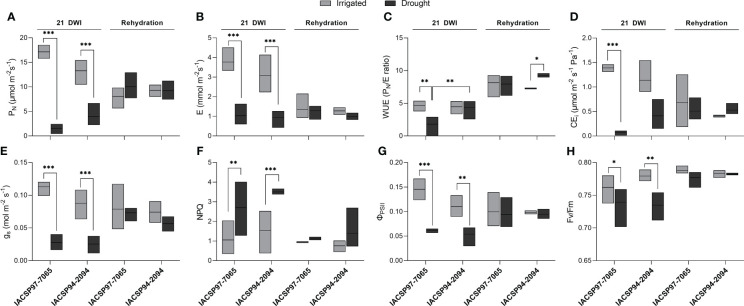
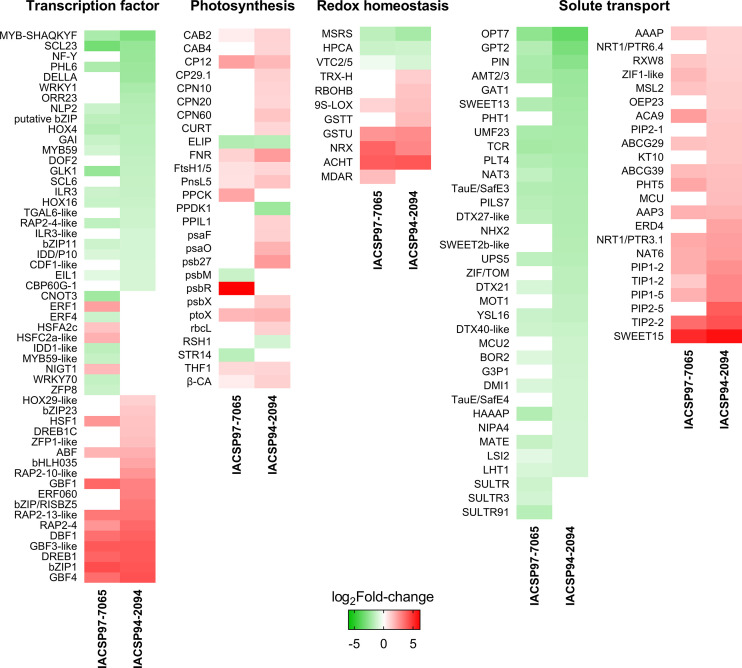
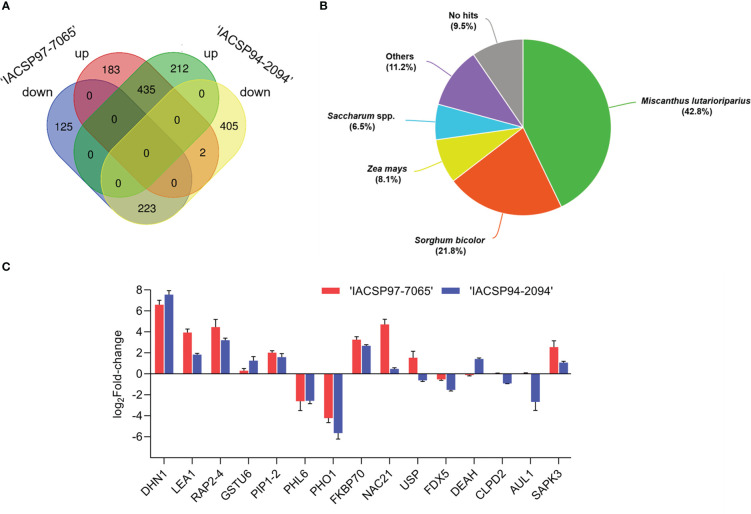
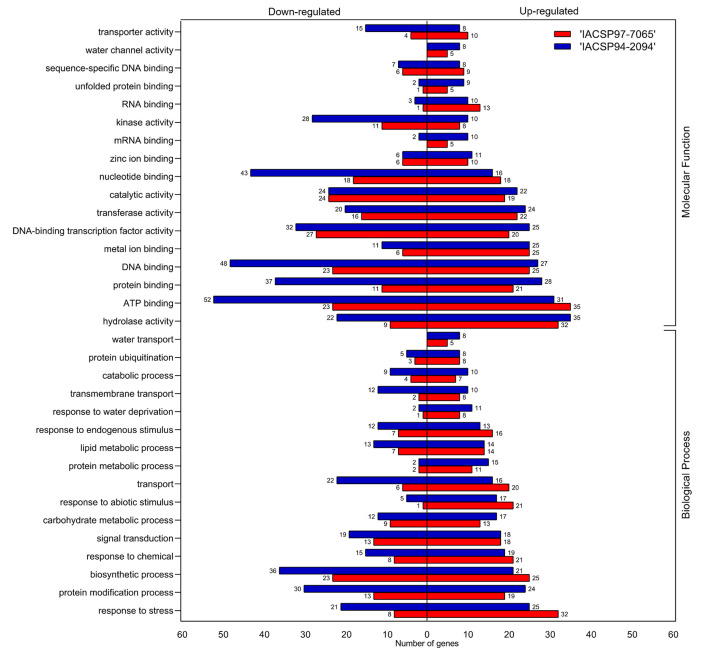
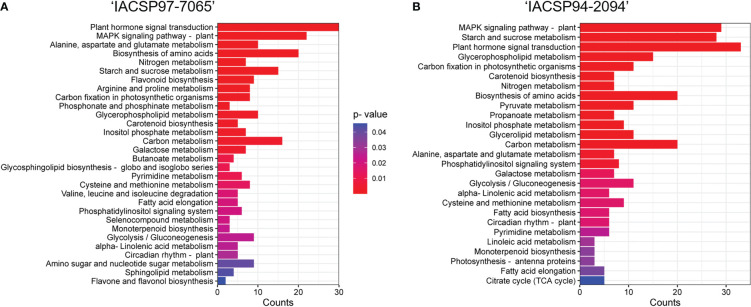
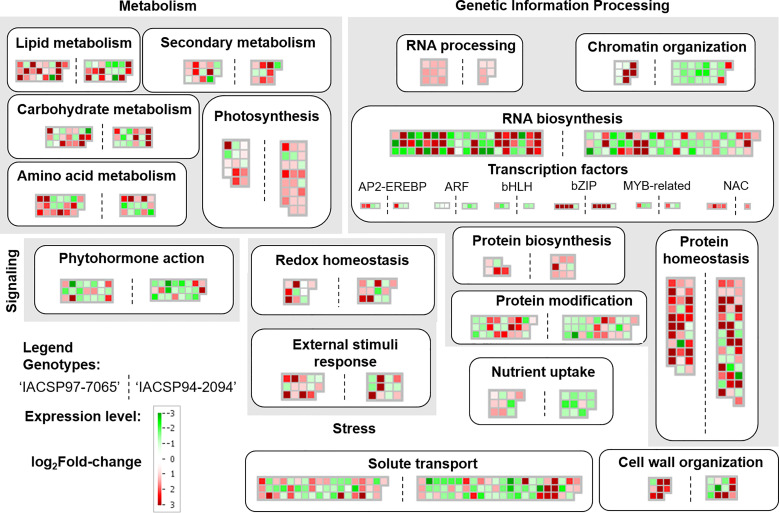
Drought is a major constraint to sugarcane ( spp.) production and improving the water use efficiency (WUE) is a critical trait for the sustainability of this bioenergy crop. The molecular mechanism underlying WUE remains underexplored in sugarcane. Here, we investigated the drought-triggered physiological and transcriptional responses of two sugarcane cultivars contrasting for drought tolerance, 'IACSP97-7065' (sensitive) and 'IACSP94-2094' (tolerant). After 21 days without irrigation (DWI), only 'IACSP94-2094' exhibited superior WUE and instantaneous carboxylation efficiency, with the net CO assimilation being less impacted when compared with 'IACSP97-7065'. RNA-seq of sugarcane leaves at 21 DWI revealed a total of 1,585 differentially expressed genes (DEGs) for both genotypes, among which 'IACSP94-2094' showed 617 (38.9%) exclusive transcripts (212 up- and 405 down-regulated). Functional enrichment analyses of these unique DEGs revealed several relevant biological processes, such as photosynthesis, transcription factors, signal transduction, solute transport, and redox homeostasis. The better drought-responsiveness of 'IACSP94-2094' suggested signaling cascades that foster transcriptional regulation of genes implicated in the Calvin cycle and transport of water and carbon dioxide, which are expected to support the high WUE and carboxylation efficiency observed for this genotype under water deficit. Moreover, the robust antioxidant system of the drought-tolerant genotype might serve as a molecular shield against the drought-associated overproduction of reactive oxygen species. This study provides relevant data that may be used to develop novel strategies for sugarcane breeding programs and to understand the genetic basis of drought tolerance and WUE improvement of sugarcane.
干旱是甘蔗(品种)生产的主要限制因素,提高水分利用效率(WUE)是这种生物能源作物可持续性的关键性状。甘蔗中WUE的分子机制仍未得到充分研究。在此,我们研究了两个耐旱性不同的甘蔗品种‘IACSP97 - 7065’(敏感型)和‘IACSP94 - 2094’(耐受型)在干旱引发下的生理和转录反应。在21天不灌溉(DWI)后,只有‘IACSP94 - 2094’表现出卓越的WUE和瞬时羧化效率,与‘IACSP97 - 7065’相比,其净CO同化受影响较小。在21 DWI时对甘蔗叶片进行RNA测序,发现两种基因型共有1585个差异表达基因(DEG),其中‘IACSP94 - 2094’有617个(38.9%)独特转录本(212个上调和405个下调)。对这些独特DEG的功能富集分析揭示了几个相关的生物学过程,如光合作用、转录因子、信号转导、溶质运输和氧化还原稳态。‘IACSP94 - 2094’更好的干旱响应表明存在信号级联反应,促进了与卡尔文循环以及水和二氧化碳运输相关基因的转录调控,这有望支持该基因型在水分亏缺条件下观察到的高WUE和羧化效率。此外,耐旱基因型强大的抗氧化系统可能作为一种分子屏障,抵御干旱相关的活性氧过量产生。本研究提供了相关数据,可用于制定甘蔗育种计划的新策略,并了解甘蔗耐旱性和WUE提高的遗传基础。