Department of Neurology, Kyung Hee University Medical Center, Kyung Hee University College of Medicine, Seoul, South Korea.
Department of Medicine, Kyung Hee University College of Medicine, Seoul, South Korea.
JAMA Netw Open. 2023 May 1;6(5):e2314838. doi: 10.1001/jamanetworkopen.2023.14838.
Despite the COVID-19 pandemic's effect on daily life, limited research exists on the prevalence and risk factors of suicidality and sadness among South Korean adolescents.
To examine whether the observed sadness and suicidality in the early to middle periods of the COVID-19 pandemic differed from the expected level and to investigate changes in risk factors for sadness and suicidality.
DESIGN, SETTING, AND PARTICIPANTS: This nationwide serial cross-sectional survey study used data on 1 109 776 Korean adolescents aged 13 to 18 years from the Korea Youth Risk Behavior Web-based Survey from 2005 to 2021.
The COVID-19 pandemic.
The pattern of changes in the percentage or proportion of sadness or suicidality, as well as the risk factors for sadness or suicidality. The transitional effect of the COVID-19 pandemic was assessed using weighted odds ratios (wORs) or weighted beta coefficients with 95% CIs.
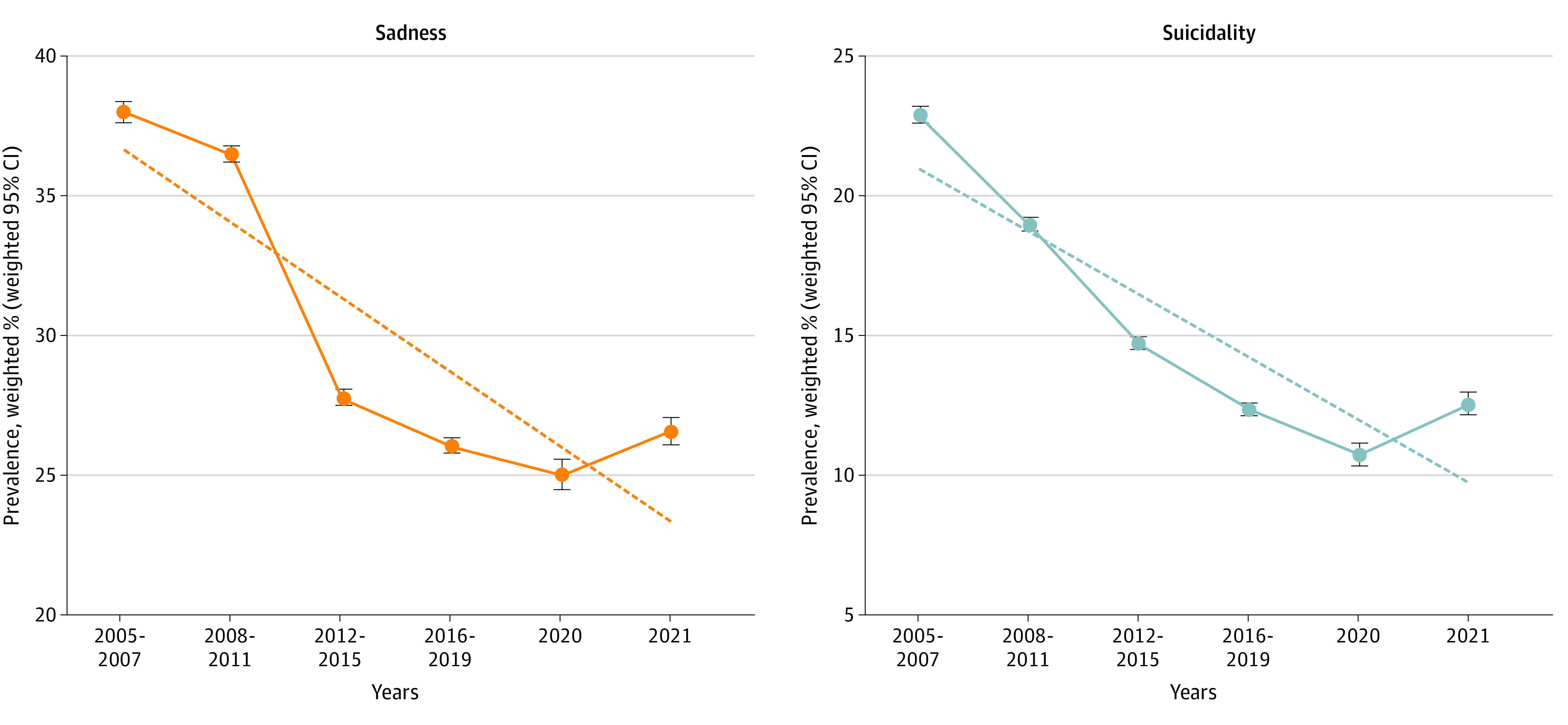
Between 2005 and 2021, 1 109 776 adolescents (mean [SD] age, 15.0 [1.7] years; 51.5% male adolescents; and 51.7% in grades 7-9 and 48.3% in grades 10-12) were included in the Korea Youth Risk Behavior Web-based Survey. The slope of the long-term trends in sadness and suicidality decreased in the prepandemic period (sadness: from 37.8% [95% CI, 37.4%-38.2%] in 2005-2007 to 26.1% [95% CI, 25.9%-26.4%] in 2016-2019; suicidality: from 23.0% [95% CI, 22.7%-23.3%] in 2005-2007 to 12.3% [95% CI, 12.1%-12.5%] in 2016-2019), whereas the slope increased during the COVID-19 pandemic (sadness: from 25.0% [95% CI, 24.5%-25.6%] in 2020 to 26.6% [95% CI, 26.1%-27.1%] in 2021; trend difference in β, 0.249 [95% CI, 0.236-0.262]; suicidality: from 10.7% [95% CI, 10.3%-11.1%] in 2020 to 12.5% [95% CI, 12.1%-12.9%] in 2021; trend difference in β, 0.328 [95% CI, 0.312-0.344]). The trends presented a similar tendency in the subgroups according to sex, school grade, residential area, smoking status, and current alcohol use. Compared with the prepandemic period, the risk factors associated with sadness during the pandemic were younger age (wOR, 0.907; 95% CI, 0.881-0.933), female sex (wOR, 1.031; 95% CI, 1.001-1.062), urban residence (wOR, 1.120; 95% CI, 1.087-1.153), current smoking status (wOR, 1.134; 95% CI, 1.059-1.216), and current alcohol use (wOR, 1.051; 95% CI, 1.002-1.102). Female sex (wOR, 1.064; 95% CI, 1.021-1.109), urban residence (wOR, 1.117; 95% CI, 1.074-1.162), and low economic status (wOR, 1.286; 95% CI, 1.180-1.403) were the risk factors significantly associated with suicidality after the COVID-19 pandemic began.
In this nationwide serial cross-sectional survey study of South Korean adolescents, the slope of the prevalence of sadness and suicidality increased during the COVID-19 pandemic after a decrease prior to the pandemic. The findings suggest that public health measures are needed to recognize vulnerable groups with risk factors and to prevent an increase in sadness and suicidality among adolescents during the COVID-19 pandemic.
尽管 COVID-19 大流行对日常生活产生了影响,但关于韩国青少年的自杀意念和悲伤的流行率和风险因素的研究有限。
检查 COVID-19 大流行的早中期观察到的悲伤和自杀意念是否与预期水平不同,并调查悲伤和自杀意念的风险因素的变化。
设计、地点和参与者:本全国性的连续横断面调查研究使用了来自 2005 年至 2021 年韩国青少年风险行为网络调查的 1109776 名 13 至 18 岁的韩国青少年的数据。
COVID-19 大流行。
悲伤或自杀意念的百分比或比例的变化模式,以及悲伤或自杀意念的风险因素。使用加权优势比(wOR)或带有 95%置信区间(CI)的加权β系数评估 COVID-19 大流行的过渡效应。
在 2005 年至 2021 年期间,共有 1109776 名青少年(平均[SD]年龄 15.0[1.7]岁;51.5%为男性青少年;51.7%在 7-9 年级,48.3%在 10-12 年级)纳入韩国青少年风险行为网络调查。在大流行前时期,悲伤和自杀意念的长期趋势斜率下降(悲伤:从 2005-2007 年的 37.8%[95%CI,37.4%-38.2%]下降到 2016-2019 年的 26.1%[95%CI,25.9%-26.4%];自杀意念:从 2005-2007 年的 23.0%[95%CI,22.7%-23.3%]下降到 2016-2019 年的 12.3%[95%CI,12.1%-12.5%]),而在 COVID-19 大流行期间斜率增加(悲伤:从 2020 年的 25.0%[95%CI,24.5%-25.6%]增加到 2021 年的 26.6%[95%CI,26.1%-27.1%];β趋势差异,0.249[95%CI,0.236-0.262];自杀意念:从 2020 年的 10.7%[95%CI,10.3%-11.1%]增加到 2021 年的 12.5%[95%CI,12.1%-12.9%];β趋势差异,0.328[95%CI,0.312-0.344])。根据性别、学校年级、居住地区、吸烟状况和当前饮酒状况,这些趋势在亚组中呈现出相似的趋势。与大流行前时期相比,大流行期间与悲伤相关的风险因素是年龄较小(wOR,0.907;95%CI,0.881-0.933)、女性(wOR,1.031;95%CI,1.001-1.062)、城市居住(wOR,1.120;95%CI,1.087-1.153)、当前吸烟状况(wOR,1.134;95%CI,1.059-1.216)和当前饮酒状况(wOR,1.051;95%CI,1.002-1.102)。女性(wOR,1.064;95%CI,1.021-1.109)、城市居住(wOR,1.117;95%CI,1.074-1.162)和经济状况较低(wOR,1.286;95%CI,1.180-1.403)是 COVID-19 大流行开始后与自杀意念显著相关的风险因素。
在这项针对韩国青少年的全国性连续横断面调查研究中,悲伤和自杀意念的流行率斜率在 COVID-19 大流行期间增加,而在大流行前时期则下降。研究结果表明,需要采取公共卫生措施,以识别具有风险因素的脆弱群体,并防止 COVID-19 大流行期间青少年的悲伤和自杀意念增加。