Department of Social and Behavioral Studies, University West, Gustava Melinsgata 2, 46132, Trollhättan, Sweden.
Department of Psychology, Stockholm University, Stockholm, Sweden.
BMC Psychol. 2022 Feb 26;10(1):44. doi: 10.1186/s40359-022-00756-1.
The aim of the study was to investigate how general family relations, reported changes in family interaction and involvement with peers during the Covid-19 pandemic, and following rules and recommendations during the pandemic relate to adolescent smoking, alcohol use, inebriation, and use of narcotics during Covid-19.
An online national survey of Swedish adolescents (n = 1818) aged 15-19 years was conducted in June 2020. Hierarchical regression analysis was used to predict adolescents' reported change in substance use during the pandemic. Person-oriented analyses, were used to identify clusters of participants characterized by similar patterns of substance use following ANOVA analysis with Scheffe post hoc tests testing differences between clusters in terms of family relations, reported changes in family interaction and involvement with peers during the Covid-19 pandemic, and following rules and recommendations during the pandemic.
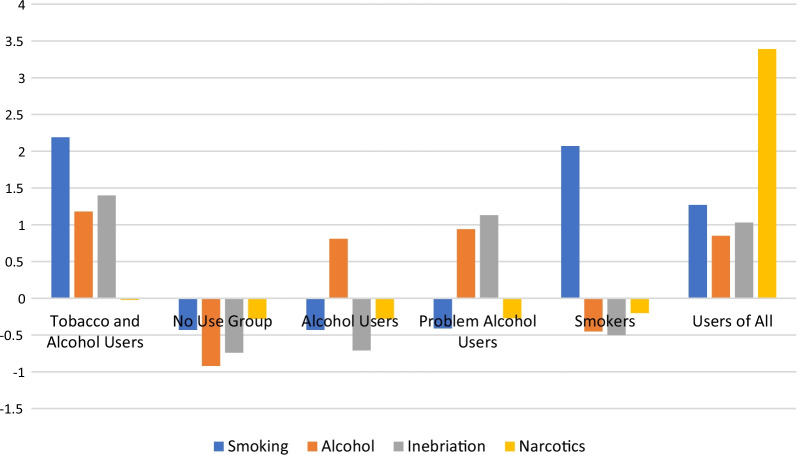
Higher general family conflict, increased involvement with peers, a strained relationship with parents, and less compliance with rules and restrictions during the pandemic predicted a reported increase in adolescent substance use during this period. The grouping of scores for adolescent smoking, alcohol use, inebriation, and use of narcotics resulted in a six-cluster solution. One cluster (n = 767) either did not use or had decreased use of substances during the Covid-19 pandemic. Five other clusters, thus risk clusters, had retained or increased use of substances during the pandemic. Poor general family relations, increased peer involvement, and difficulties to conform to the rules and restrictions during the covid-19 pandemic were characteristics of risk clusters.
Most of adolescents in our study did not increase their substance use during the pandemic. However, adolescents with poor family relations who turn to peers during stressful times and who have difficulty following the government's rules and restrictions, are at risk of increased substance use during the pandemic. This is a potential threat both to adolescents themselves and others in their surroundings which is why at-risk adolescents and their families need more attention from public health and social services during this time of crisis.
本研究旨在调查在新冠疫情期间以及在遵守防疫规则和建议的情况下,一般家庭关系、家庭互动和与同伴的参与情况的变化如何与青少年吸烟、饮酒、醉酒和使用麻醉品有关。
2020 年 6 月,对瑞典 15-19 岁青少年进行了一项在线全国调查。采用分层回归分析预测青少年在疫情期间报告的物质使用变化。采用个体导向分析,根据方差分析后 Scheffe 事后检验,识别出参与者中具有相似物质使用模式的聚类,以检验聚类之间在家庭关系、在新冠疫情期间家庭互动和与同伴的参与情况以及遵守防疫规则和建议方面的差异。
较高的一般家庭冲突、与同伴的更多接触、与父母的紧张关系以及在疫情期间较少遵守规则和限制,预测青少年在此期间物质使用的增加。青少年吸烟、饮酒、醉酒和使用麻醉品的评分分组得出了一个六聚类解决方案。一个聚类(n=767)在新冠疫情期间没有使用或减少了物质使用。其他五个聚类,即风险聚类,在疫情期间保留或增加了物质使用。较差的一般家庭关系、与同伴的更多接触以及在疫情期间难以遵守规则和限制是风险聚类的特征。
在我们的研究中,大多数青少年在疫情期间没有增加他们的物质使用。然而,在困难时期求助于同伴且难以遵守政府规则和限制的青少年,在疫情期间有增加物质使用的风险。这对青少年本身和他们周围的人都是潜在的威胁,这就是为什么在这个危机时期,需要公共卫生和社会服务部门更多地关注有风险的青少年及其家庭。