Department of Surgery, Endoscopic & Oncoplastic Breast Surgery Center, Changhua Christian Hospital, Changhua, Taiwan.
Division of General Surgery, Department of Surgery, Changhua Christian Hospital, Changhua, Taiwan.
Ann Surg. 2024 Jan 1;279(1):138-146. doi: 10.1097/SLA.0000000000005924. Epub 2023 May 25.
To compare the clinical and patient-reported outcomes of minimal access and conventional nipple-sparing mastectomy (C-NSM). The secondary outcomes investigated included medical costs and oncological safety.
Minimal-access NSM has been increasingly applied in the treatment of patients with breast cancer. However, prospective multicenter trials comparing robotic-assisted NSM (R-NSM) versus C-NSM or endoscopic-assisted NSM (E-NSM) are lacking.
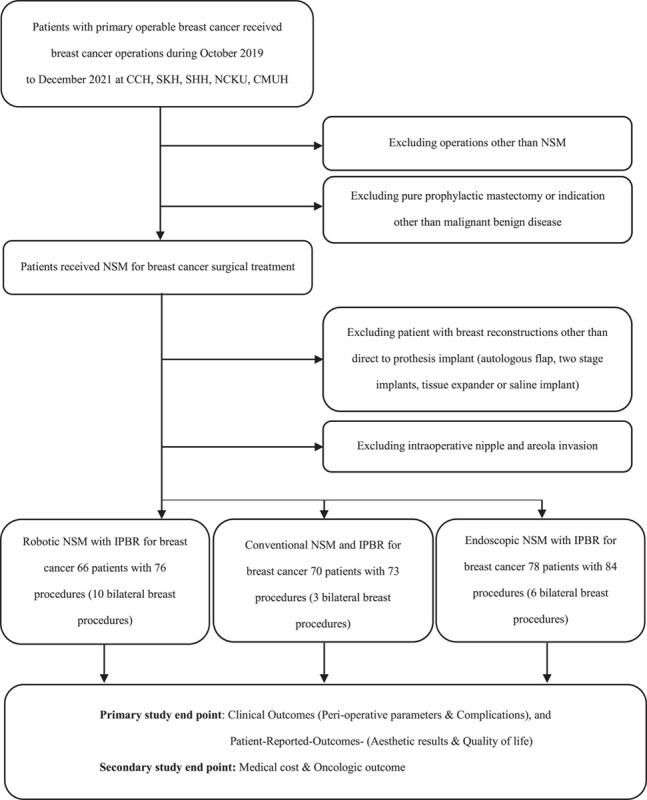
A prospectively designed 3-arm multicenter, nonrandomized trial (NCT04037852) was conducted from October 1, 2019 to December 31, 2021, to compare R-NSM with C-NSM or E-NSM.
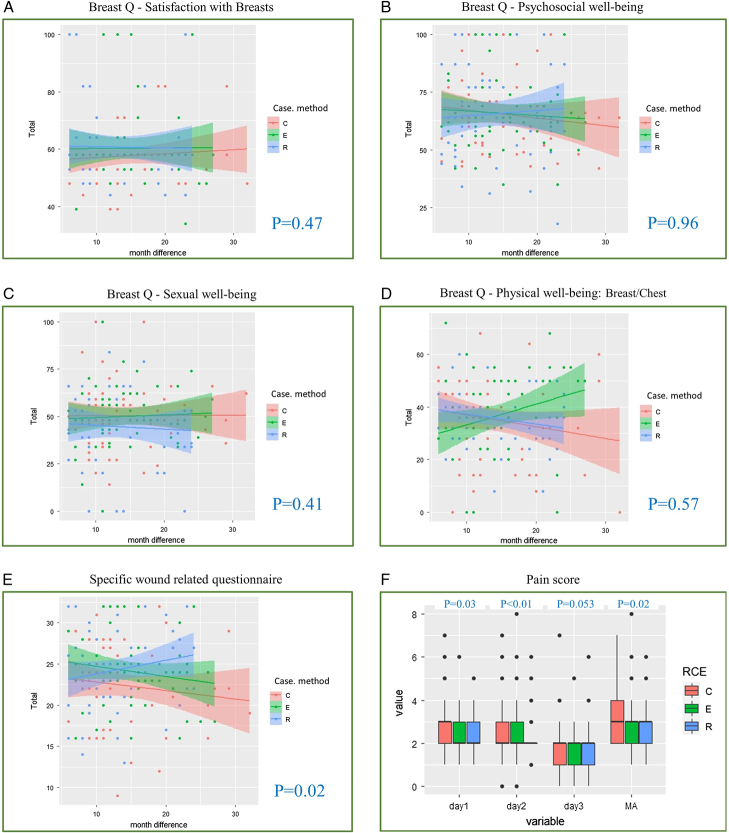
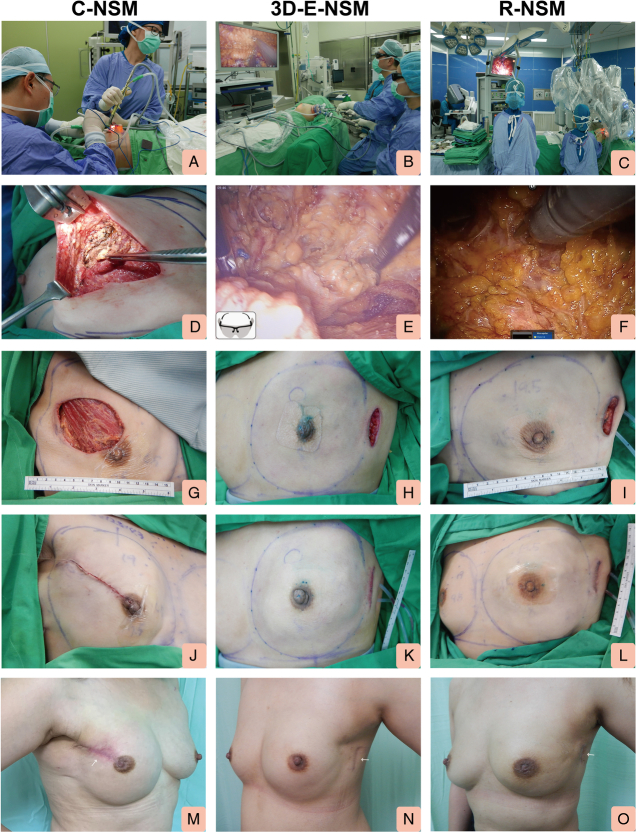
A total of 73 R-NSM, 74 C-NSM, and 84 E-NSM procedures were enrolled. The median wound length and operation time of C-NSM was (9 cm, 175 minutes), (4 cm, and 195 minutes) in R-NSM, and (4 cm and 222 minutes) in E-NSM. Complications were comparable among the groups. Better wound healing was observed in the minimal-access NSM group. The R-NSM procedure was 4000 and 2600 United States Dollars more expensive than C-NSM and E-NSM, respectively. Wound/scar and postoperative acute pain evaluation favored the use of minimal access NSM over C-NSM. Quality of life in terms of chronic breast/chest pain, mobility, and range of motion of the upper extremity showed no significant differences. The preliminary oncologic results showed no differences among the 3 groups.
R-NSM or E-NSM is a safe alternative if compared with C-NSM in terms of perioperative morbidities, especially with better wound healing. The advantage of minimal access groups was higher wound-related satisfaction. Higher costs remain one of the major limiting factors in the widespread adoption of R-NSM.
比较微创与传统保乳头乳房切除术(C-NSM)的临床和患者报告结果。次要结局包括医疗费用和肿瘤学安全性。
微创保乳头乳房切除术已越来越多地应用于乳腺癌患者的治疗。然而,缺乏比较机器人辅助保乳头乳房切除术(R-NSM)与 C-NSM 或内镜辅助保乳头乳房切除术(E-NSM)的前瞻性多中心试验。
2019 年 10 月 1 日至 2021 年 12 月 31 日,进行了一项前瞻性设计的 3 臂多中心、非随机试验(NCT04037852),比较 R-NSM 与 C-NSM 或 E-NSM。
共纳入 73 例 R-NSM、74 例 C-NSM 和 84 例 E-NSM 手术。C-NSM 的中位切口长度和手术时间分别为(9cm,175 分钟)、(4cm 和 195 分钟),E-NSM 分别为(4cm 和 222 分钟)。各组并发症相当。微创保乳头乳房切除术组的伤口愈合更好。R-NSM 手术比 C-NSM 和 E-NSM 分别贵 4000 美元和 2600 美元。在切口/疤痕和术后急性疼痛评估方面,微创保乳头乳房切除术优于 C-NSM。在慢性乳房/胸部疼痛、活动度和上肢活动范围方面的生活质量方面,无显著差异。初步的肿瘤学结果显示 3 组之间无差异。
与 C-NSM 相比,R-NSM 或 E-NSM 在围手术期并发症方面是一种安全的替代方法,特别是在伤口愈合方面更好。微创组的优势在于更高的伤口相关满意度。高成本仍然是广泛采用 R-NSM 的主要限制因素之一。