Salsman Margot L, Nordberg Hannah O, Howell Jaxen, Berthet-Miron Maria Michelle, Rosenfield David, Ritz Thomas
Department of Psychology, Southern Methodist University, P.O. Box 750442, Dallas, TX, 75275-0442, USA.
J Behav Med. 2023 Dec;46(6):960-972. doi: 10.1007/s10865-023-00412-y. Epub 2023 May 25.
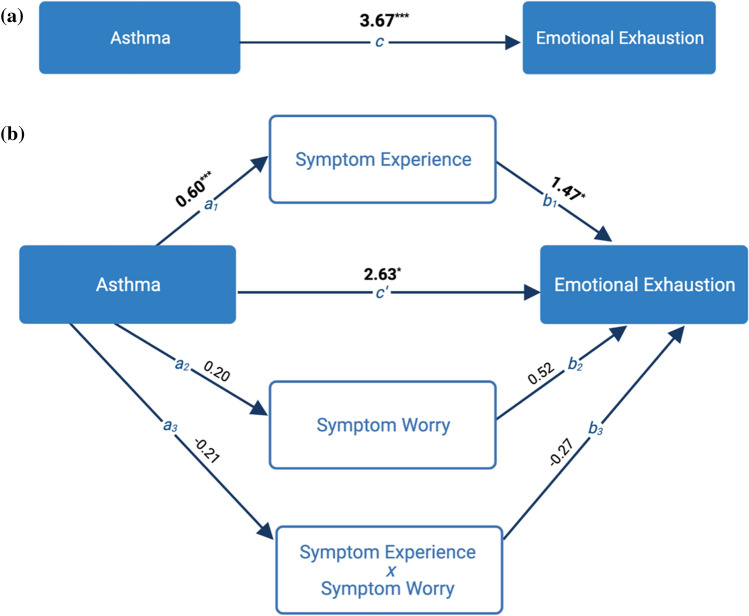
People with asthma may be particularly vulnerable to pandemic-related psychological distress, and research is needed to understand the impact of the coronavirus disease 19 (COVID-19) pandemic on their health and well-being. We sought to study the well-being of people with asthma relative to non-asthmatic controls during the COVID-19 pandemic. We also investigated asthma symptoms and COVID-19-related anxiety as potential mediators of distress. Participants completed self-report measures of psychological functioning, including anxiety, depression, stress, and burnout. Controlling for potential confounds, multiple-regression analyses examined differences in psychological health between people with and without asthma. Mediator analyses investigated the role of asthma symptoms and COVID-19-related anxiety in this relationship. 234 adults (111 with asthma, 123 without) participated in an online survey from July to November 2020. During this time, people with asthma reported higher levels of anxiety, perceived stress, and burnout symptoms compared to controls. Elevations in burnout symptoms were found beyond general anxiety and depression (sr = .03, p < .001). Reported symptoms typical in both asthma and COVID-19 partially mediated this relationship (P = .42, p < .05). People with asthma reported unique psychological challenges during the COVID-19 pandemic including elevated burnout symptoms. Experience of asthma symptoms played a key role in vulnerability to emotional exhaustion. Clinical implications include increased attention to asthma symptom burden within the context of heightened environmental stress and restricted healthcare access.
哮喘患者可能特别容易受到与大流行相关的心理困扰,因此需要开展研究以了解2019冠状病毒病(COVID-19)大流行对他们健康和幸福的影响。我们试图研究在COVID-19大流行期间哮喘患者相对于非哮喘对照者的幸福状况。我们还调查了哮喘症状和与COVID-19相关的焦虑作为困扰的潜在中介因素。参与者完成了心理功能的自我报告测量,包括焦虑、抑郁、压力和倦怠。在控制潜在混杂因素的情况下,多元回归分析检验了哮喘患者和非哮喘患者心理健康的差异。中介分析调查了哮喘症状和与COVID-19相关的焦虑在这种关系中的作用。234名成年人(111名患有哮喘,123名没有哮喘)在2020年7月至11月期间参与了一项在线调查。在此期间,与对照组相比,哮喘患者报告的焦虑、感知压力和倦怠症状水平更高。发现倦怠症状的升高超出了一般焦虑和抑郁(sr = 0.03,p < 0.001)。哮喘和COVID-19中常见的报告症状部分介导了这种关系(P = 0.42,p < 0.05)。哮喘患者在COVID-19大流行期间报告了独特的心理挑战,包括倦怠症状升高。哮喘症状的经历在易患情绪衰竭方面起关键作用。临床意义包括在环境压力增加和医疗保健受限的背景下,更加关注哮喘症状负担。